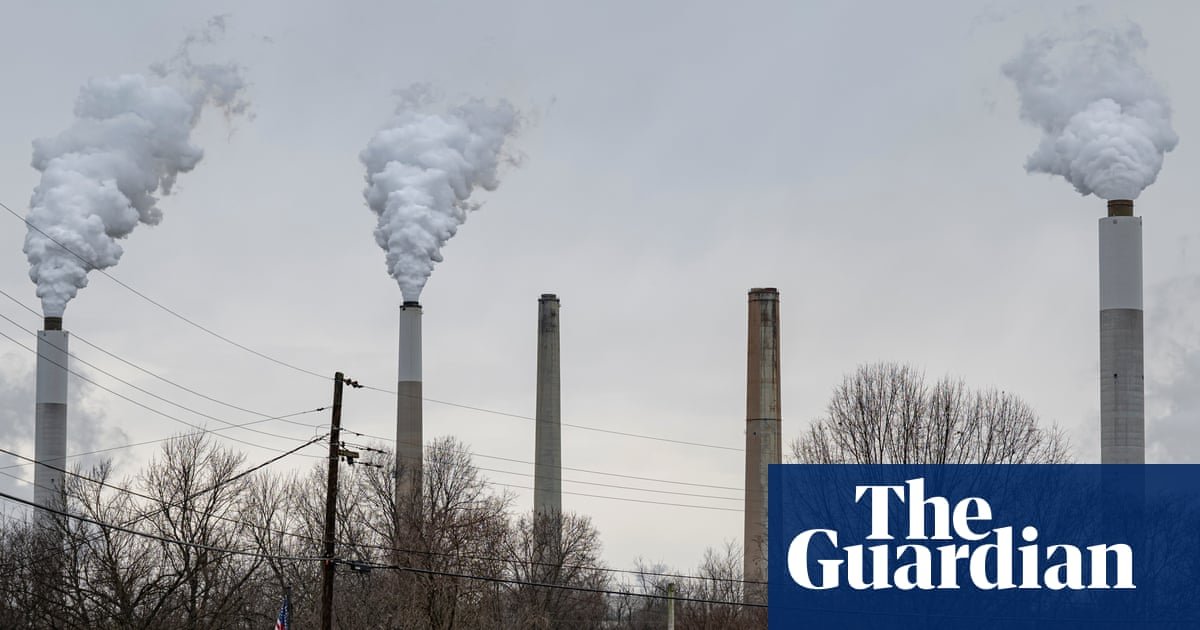
The world needs to cut carbon emissions by nearly a fifth in the next four years, and by close to half within a decade, to avoid overshooting climate targets by a disastrous margin.
Although the “window has closed” on holding temperature rises to 1.5C, in line with scientific advice, limiting the “overshoot” of that target is still possible, according to the UN Environment Programme (Unep).
But countries are failing to translate their long-term targets on reducing emissions into short-term actions, a report on the “emissions gap” between climate goals and policies has found.
Global carbon output appears to have stalled: the emission levels in 2025 were broadly similar to those of the previous year. But Unep analysts were wary of calling it a peak or plateau, given the vast uncertainties of geopolitics and an increased reliance on fossil fuels, despite strong growth in renewable energy.
Cutting greenhouse gases by 18% by 2030, and by 45% by 2045, would yield a good chance of limiting temperature rises to 1.7C above preindustrial levels. This would still allow events such as the record heatwaves of the last few months to become frequent and common, but could help prevent them from getting drastically worse.
Governments were warned for years that time was running out, said Inger Andersen, the executive director of Unep. “[We used to say] there’s still an opportunity if we make this herculean effort [to stay within the 1.5C limit],” she said. “It’s now clear the herculean effort was not made. We procrastinated, and now we are saying this window has closed.”
Nevertheless, she urged countries to keep the 1.5C goal – the centrepiece of the Paris climate agreement. “We can make the overshoot as brief and as short as possible. It’s not time to throw in the towel and give up. This is about how to find our way back, as shortly and quickly as possible.”
Under Donald Trump, the US – the world’s second biggest emitter, after China – has withdrawn from the Paris climate agreement and is threatening to reverse its longstanding trend of falling greenhouse gas emissions.
Bill Hare, the chief executive of the Climate Analytics thinktank, said: “All governments have a job to do, but in particular it is time for major fossil fuel producers such as the US and Saudi Arabia, which produce 20-25% of fossil fuels globally, to stop playing politics and face the scientific reality. Right now they are looking at the fire, denying it exists and pouring more petrol on it, while their own citizens increasingly face searing heat, wildfires and other impacts.”
Other countries appear to have been affected by US intransigence – pledges made last year on greenhouse gases were noticeably weak, according to UNEP analysis. At the Cop30 climate summit in Brazil last November, governments were supposed to make fresh commitments under the Paris agreement to cut emissions. But the commitments made were nowhere near strong enough.
Even if all of those updated pledges were fulfilled, temperatures would still rise to 2.6C above preindustrial levels, according to Unep’s projections, endangering life across swathes of the globe. Policy has also not kept up with pledges: on current policies around the world, temperatures would rise to 2.8C. Every five years of greenhouse gas emissions at current levels pushes up forecasts of global heating by 0.1C. Scientists also fear that the greater the margin by which we exceed 1.5C, the greater the likelihood of triggering tipping points in the climate system.
Mohamed Adow, the director of the thinktank Power Shift Africa, said: “The tragedy is that we have the solutions within our grasp. Solar and wind power are growing far faster than anyone expected, yet governments are still failing to move away from fossil fuels quickly enough. The technology is racing ahead while political leadership is dragging its feet.”
The shortfall in countries’ commitments is supposed to be corrected under a Paris agreement mechanism called the “global stocktake”, an assessment of emissions targets next scheduled for 2028. But that has also been thrown into doubt: this week, the UN’s Intergovernmental Panel on Climate Change failed to set a timetable to publish its latest report before the global stocktake, which would prevent governments from assessing their progress against the latest science.
Johan Rockström, the director of the Potsdam Institute for Climate Impact Research and one of the world’s leading climate scientists, said rows over the timing of IPCC reports must not be allowed to stall government action. “If all current national commitments are implemented, global emissions are projected to reach approximately 50 gigatonnes of carbon dioxide equivalent annually by 2035, when they should be below 35 gigatonnes. The science is already clear. Closing that gap is a question of political action, not a lack of scientific evidence,” he said.
One way identified by Unep to limit warming quickly would be to cut methane, a greenhouse gas 80 times more powerful than carbon dioxide.
Source: https://www.theguardian.com/environment/2026/oct/21/world-cut-emissions-un-climate-crisis
About the Author