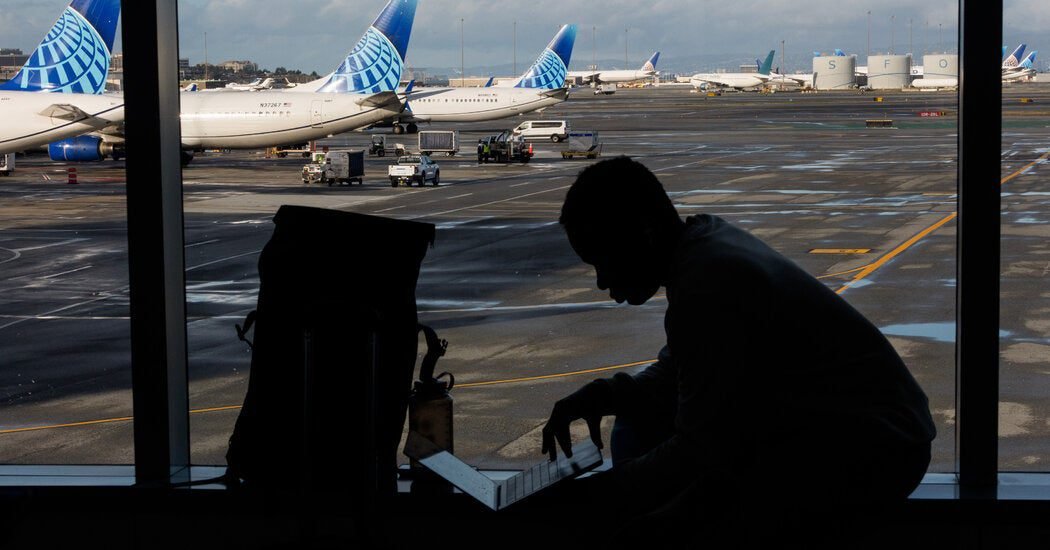
Effects of a nationwide ground stop on air travel Friday evening, which stranded thousands of passengers and caused widespread delays, rippled into Saturday as airlines canceled thousands of flights and airports struggled to recover.
The air traffic control system, which faced a faulty upgrade that caused communications failures leading to the ground stop, is expected to be back to normal by Sunday night, said Bryan Bedford, who leads the Federal Aviation Administration. Flight schedules could take several days to return to normal.
Federal officials are still trying to determine who is at fault and have called for congressional funding to prevent similar failures. There is no evidence that the problem was caused by a cyberattack, officials have said.
Here’s what to know:
What caused the ground stop?
L3Harris, a contractor managing the F.A.A.’s telecoms network, made a standard upgrade at a remote air traffic location, federal officials said Saturday. L3Harris was conducting a routine task — replacing copper wire with more modern fiber optic cable — that was expected to pose no significant disruption to air traffic, said Sean Duffy, the transportation secretary.
But the switch from copper to fiber overwhelmed the system with levels of data it could not handle, prompting widespread communications failures across air traffic facilities that manage the national air space. Alarmed at the scope of the problems, officials issued a rare nationwide ground stop for hours.
Administration officials say it’s still unclear whether L3Harris or faulty equipment was to blame. L3Harris said in a statement on Saturday that it was supporting the F.A.A. investigation and that it “takes the nationwide ground stop and its impact on travelers, airlines and air traffic operations seriously.”
There was no evidence that nefarious activity, or the agency’s recent efforts to equip its air traffic control facilities with assistive A.I. technology, had played a role in triggering the issue, Mr. Duffy and Mr. Bedford said.
How are officials responding?
On Friday, Mr. Duffy faulted Congress for not providing adequate funding to overhaul the aging air traffic control system. On Friday, he asked for $50 billion to modernize the system, thrusting the funding issue to the forefront of the final days of G.O.P. control on Capitol Hill.
Last year, Congress approved $12.5 billion to help pay for upgrades to the air traffic communications system. Speaker Mike Johnson told Fox News on Saturday morning that he would seek to increase F.A.A. funding in an “aggressive legislative package” he planned to put forth before Democrats take control of both chambers.
Democrats said the Trump administration had more than enough money to allocate toward improvements, but that it had prioritized deportations over air safety. They vowed to hold the administration accountable for what had happened and said that Congress needed to begin investigating the administration’s failures.
Why haven’t flights returned to normal yet?
For an aviation system to function well, availability of planes, crews and an open airport gate need to line up at the right time and place. It could take days for airlines to juggle their schedules, rebook passengers and reposition planes.
While airlines can try to make up for lost time after minor disruptions, bigger disruptions often require them to reset the network by canceling flights proactively.
On Friday, thousands of flights were halted. Many planes returned to the airports they had just taken off from, according to Cirium, an aviation data firm, crowding limited space on the ground while flight crews quickly hit their legal working limits.
What should you do if your flight is canceled?
Since individual airlines were not to blame for the upgrade that caused the ground stop, travelers can expect limited accommodations. In the United States, if your flight is canceled, significantly delayed or changed, airlines will try to rebook you on another flight. You’re also entitled to a refund as long as you choose to not take that flight.
Carriers including United Airlines, Delta Air Lines, JetBlue Airways, Alaska Airlines and Southwest Airlines have issued waivers allowing travelers to change or cancel their flights without incurring any change fees or fare differences.
Stranded travelers can consider other strategies to reach their destination, such as joining the standby list for an earlier flight or calling an airline’s international hotline, which will have fewer callers.
Karoun Demirjian, Annie Karni, Niraj Chokshi and Christine Chung contributed reporting.
Source: https://www.nytimes.com/2026/11/14/us/flight-delays-cancelations-what-to-know.html
About the Author