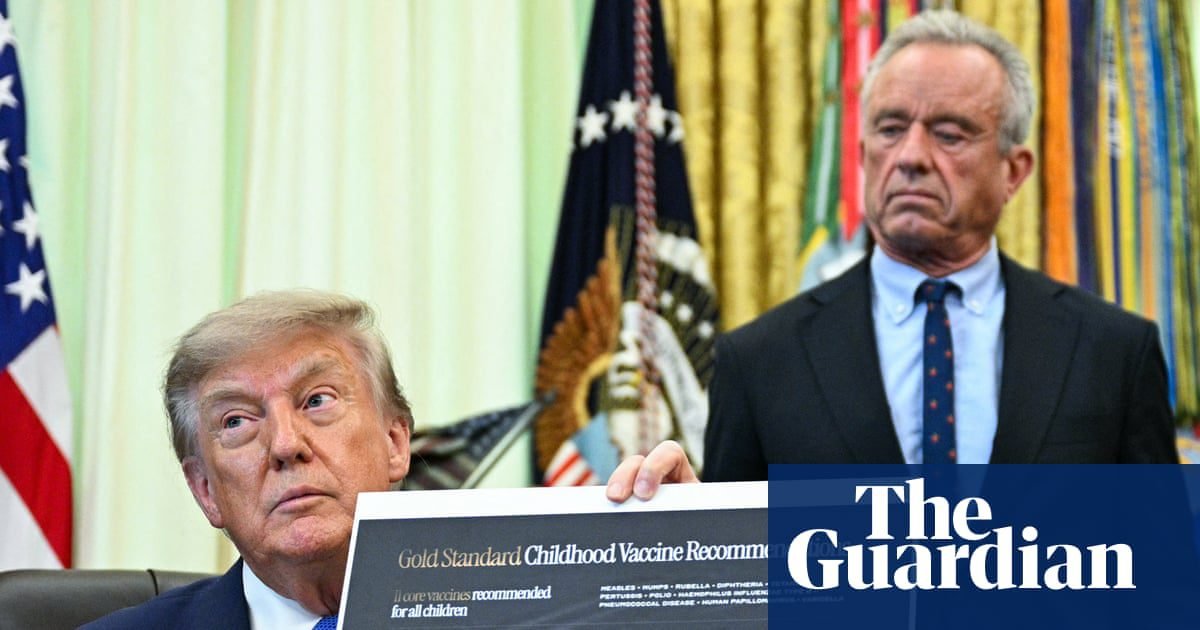
A new executive order from the US president, Donald Trump, calls for sweeping changes to childhood vaccine recommendations.
His plans would result in fewer vaccines being recommended overall; the combined measles, mumps and rubella (MMR) vaccine being replaced with three separate shots, and all childhood immunisations being administered during separate medical visits “to the maximum extent feasible”.
Is there any science behind the proposals? And what are the likely implications inside and outside the US border?
What impact will this order have in the US?
The main outcome will be “confusion for parents”, Dr Aaron Milstone of the American Academy of Pediatrics told Reuters, with conflicting messages likely to mean delayed vaccinations.
During any delay, some children may be infected with deadly vaccine-preventable diseases. Measles cases are already at a 30-year high in the US.
An executive order has no immediate, legal effect on the public – but it is likely to put pressure on US states to make changes to requirements that children be vaccinated before attending schools. And it sets the stage for legal challenges against states that have implemented their own vaccine recommendations.
What about in other countries?
The recommendations are unlikely to be copied in other countries, said Ben Kasstan-Dabush, assistant professor in global health and development at the London School of Hygiene & Tropical Medicine: “No country would want to deal with the inevitably costly outbreak responses that would occur as a result of this policy decision.”
But ideas as well as diseases spread easily across borders. The short-term risk is that parents in other countries get the false impression that the vaccines they are being offered for their children are not safe, and delay or avoid vaccination, putting their own children at risk.
The longer-term risk is that the misinformation leads to lower vaccination rates at a population level, and the world sees a resurgence of diseases that could have been prevented.
“There is a risk of the confused messaging affecting people outside the US,” said Prof Sir Andrew Pollard, director of the Oxford Vaccine Group. “Confidence in vaccines, and getting jabbed, is critical for the health of a population.”
Shortly after Trump’s announcement, the World Health Organization defended the science-based process used to set child immunisation schedules in countries around the world.
WHO spokesperson Tarik Jašarević told a press briefing in Geneva it was important that countries’ vaccine schedule recommendations be made by independent experts and “free of industry and political influence”.
“When these standards are not upheld, trust in vaccines, health experts and scientific institutions, like WHO, can erode,” he added.
Why is Trump doing this?
Trump himself has many times repeated discredited claims that vaccination causes autism, and appeared to make the same link when signing the order.
The US health secretary, Robert F Kennedy Jr, is a leading vaccination sceptic, who has for years amplified misinformation about vaccines. One study found he was the top “superspreader” of Covid-19 vaccine misinformation on Twitter (now X) in 2021.
Kennedy has tried to reshape US vaccination schedules but has found his attempts blocked by a federal judge. A White House official told reporters that was a separate issue to the executive order.
In 2025, UK vaccine experts called on public health agencies in other countries to get “Kennedy ready”. They argued that “the political agenda against vaccination in the United States raises implications for routine childhood vaccination programmes in the United Kingdom and countries around the world, due to the transnational spread of diseases and ideas”.
Does the MMR jab cause autism?
No. There is “strong evidence of no link”, said Helen Bedford, professor of child public health at UCL. “The vaccine has, and continues to save, millions of lives.”
False claims of a link between the MMR vaccine and autism were made by British doctor Andrew Wakefield in 1998 in the Lancet medical journal. That paper was retracted, and Wakefield was struck off by the UK’s medical regulator. But he has been lauded by anti-vaccination groups, and attended Trump’s first inauguration.
Is there any science supporting breaking up the MMR vaccine into separate shots?
“The three vaccines have never been administered as separate doses to young children as part of vaccination policy so that policy’s safety and effectiveness are unproven,” said Bedford. “However, just by delaying protection it would be a serious step backwards for protecting our children’s health.”
In fact, says Kasstan-Dabush, giving them separately amounts to “an experiment with children’s health”.
Adam Finn, emeritus professor of paediatrics at the University of Bristol, raised a more practical issue for the US and many other countries.
“Dividing the vaccine into separate components makes no logical sense and is infeasible at this time in any case as no such vaccines are available,” he added.
Would these proposals affect vaccination rates?
Studies of communities with low vaccination rates typically find that, while hesitancy can be an issue, accessibility, such as the logistics of getting children to health appointments also play a role. If parents can only get one shot in an appointment, they may not return for the rest.
“Spacing vaccines across many separate visits increases the likelihood of delayed or missed doses and leaves children susceptible for longer, with no demonstrated safety benefit in healthy children,” said Azeem Majeed, professor of primary care and public health, Imperial College London.
Source: https://www.theguardian.com/society/2026/aug/11/what-effect-will-donald-trumps-childhood-vaccine-recommendations-have-in-the-us-and-beyond
About the Author