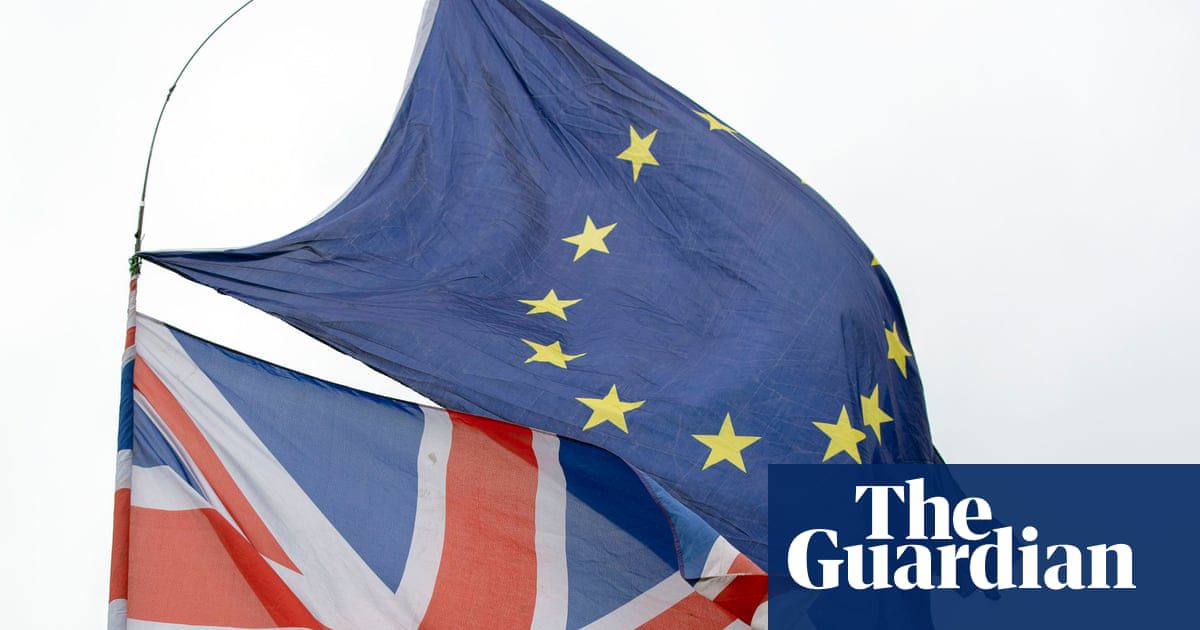
The UK government pitched the creation of a single market for goods with the EU as the cornerstone of an ambitious attempt to reintegrate British trade back into Europe, the Guardian can reveal.
During recent visits to Brussels, the Cabinet Office’s top official on EU relations, Michael Ellam, presented the idea to deepen the UK’s economic relationship with the bloc.
But in a sign of the challenge Keir Starmer’s government faces in securing growth through a closer relationship with Europe, sources said that EU officials rejected the idea – and instead suggested a customs union or economic alignment through the European Economic Area.
Those ideas are impossible under Starmer’s red lines. He said in 2024 the UK would not rejoin the EU, the single market or customs union in his lifetime. The EEA – a single market of 30 mostly EU countries – would also mean accepting free movement of people, another Labour red line.
UK government sources, however, denied that the EU had definitively rejected a single market for goods and said it was among a range of options being discussed before a summit tentatively pencilled in for 13 July.
The UK and EU have not yet agreed a forward-looking agenda to be launched at the summit.
Both sides hope to announce: a veterinary agreement to ease trade in food, drink and animal products; an accord linking emissions trading schemes (ETS); and to break the deadlock over a youth mobility programme – three deals promised at the last EU-UK summit in 2025.
But Labour’s attempts to deepen the economic relationship are hitting the same buffers Theresa May encountered with her Chequers plan when she tried to craft a “common rulebook” for goods, without free movement of people, during the Brexit negotiations in 2018.
EU officials want to avoid a complicated relationship with the UK that could prove an attractive model to anti-EU populists in the 27 member states.
For instance, it is argued that a special deal for the UK could embolden a Eurosceptic candidate in France’s 2027 presidential elections to argue that Paris should pay less attention to single market rules.
Other countries, it is suggested, might question their contributions to the EU budget if the UK is deemed to be getting special treatment.
An EU diplomat said the EU’s approach was based on its interests: “If you start going back on those principles – leading to a non-member being treated better than an actual member – you certainly would trigger an internal debate on the fundamentals of [EU] cooperation.”
The prime minister and chancellor have said they are keen to explore alignment on goods. In her Mais lecture, Rachel Reeves said there was “a strategic imperative for deeper integration between the UK and EU – in our shared need for greater economic resilience”.
UK government sources said the EU had always been nervous about its red lines, but pointed out that Brussels had opened talks on access to the single market for food and agricultural products, and electricity.
A Cabinet Office spokesperson said: “We have previously confirmed that the next UK-EU summit will be held this summer. A final date will be confirmed in due course.
“We are negotiating an ambitious package of measures with the EU ahead of the summit, including a food and drink SPS [sanitary and phytosanitary] deal and emissions trading deal that, alone, are set to add up to £9bn a year to the UK economy by 2040.”
The Cabinet Office minister Nick Thomas-Symonds last month told reporters in Brussels that the UK wanted deals with the EU on steel and electric cars, to avoid British industry being damaged by imminent changes in EU rules in these sectors.
The government is also seeking deeper cooperation in defence: the prime minister announced earlier this month he would like the UK to enter talks to join the EU’s €90bn (£78bn) EU loan for Ukraine, enabling British firms to benefit from defence contracts for Kyiv.
A European Commission spokesperson declined to comment on the UK pitch for a single market in goods, adding that the commission was working to conclude the SPS agreement, ETS linkage and youth experience scheme.
“We also see scope to deepen cooperation where it matters most now: defence industrial cooperation,” the spokesperson added, citing the UK’s wish to start talks on the Ukraine loan.
The spokesperson also referred to continuing discussions between the EU and UK on an innovation fund for hi-tech industries and joint work to curb irregular migration.
Following the rebuff over a single market for goods, EU officials are not expecting the government to do much on defining a future agenda before the Makerfield byelection in June, where Labour faces a tough challenge from the anti-EU Reform party.
The Labour candidate, Andy Burnham, who is expected to stand to replace Starmer as prime minister, has said he will not try to return the UK to the EU and promised “a relentless domestic focus”.
In a speech intended to rescue his premiership earlier this month, Starmer said his government would be defined by “putting Britain at the heart of Europe”. As an example of the stronger relationship he said he wanted, Starmer called for an “ambitious” youth experience scheme that would allow young people to live, work and study in Europe.
But negotiations remain stalled. The EU continues to reject UK proposals for a cap on numbers and a requirement that EU students should pay the much higher rate of tuition fees for foreign students, rather than the domestic rate.
The EU and Mexico signed a long-stalled free trade agreement on Friday as they seek to decrease dependence on the US and partly insulate themselves from Donald Trump’s tariffs.
The accord, on which they reached broad agreement in 2025 but have delayed signing, expands a trade accord from 2000, which covered only industrial goods. The new pact adds services, government procurement, digital trade, investment and farm produce.
Mexico’s president, Claudia Sheinbaum, the European Commission president, Ursula von der Leyen, and the European Council president, António Costa, signed the deal in Mexico City in their first summit in more than a decade.
“This agreement is a true geopolitical statement,” Costa said on Friday, shortly after signing the agreement. “With the modernised global agreement, we are better prepared to face the challenges of our time.”
Sheinbaum said: “This agreement opens up enormous opportunities for both regions, allowing for expanded trade.” She highlighted the pharmaceutical industry, agriculture, technological development and electric mobility.
Additional reporting by Reuters
Source: https://www.theguardian.com/politics/2026/may/22/uk-pitched-single-market-for-goods-with-eu-as-it-pursues-trade-reintegration
About the Author