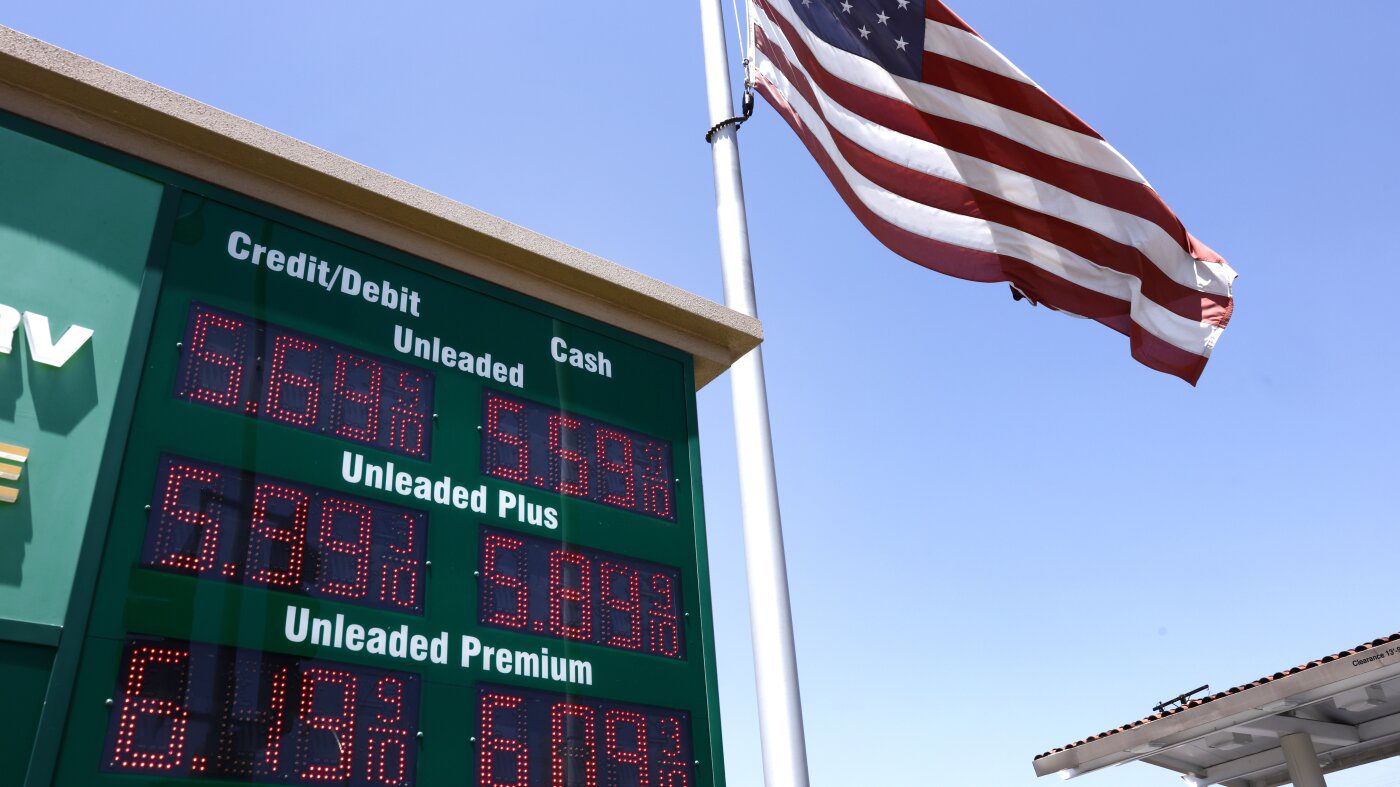

An American flag flies above a sign displaying gas prices at a gas station in Arcadia, Calif., on May 11.
Mario Tama/Getty Images
hide caption
toggle caption
Mario Tama/Getty Images
Stay up to date with our Up First newsletter, sent every weekday morning.
President Trump has called for a temporary waiver of the federal gas tax, which costs drivers 18.4 cents per gallon.
It’s one of several attempts to relieve pain at the pump as voters grow increasingly frustrated with gasoline prices, which have hit four-year highs thanks to the oil trade disruption triggered by the war with Iran.

A national gas tax holiday would require an act of Congress. Lawmakers have floated the idea, with several bills introduced before Trump called for a temporary pause on the tax.
But even with the president’s backing, it’s not clear whether his proposal will make it to the floor for a vote. Gas tax holidays are controversial, with advocates arguing they provide quick relief and with critics denouncing them as costly and even counterproductive.
Here’s what you need to know.
How much would a federal gas tax holiday save?
At most, waiving the tax would save drivers 18.4 cents per gallon, or $2.76 on a 15-gallon fill-up. The national average price for a gallon of gasoline is now $4.46, up from around $3 prewar, so the relief would make up for only a fraction of that price spike.
But there are two reasons that drivers might save even less. First, some of the tax savings might instead go toward refineries and gas stations. That’s especially true for a shorter holiday, says Kent Smetters, the faculty director at the Penn Wharton Budget Model, which researches the cost of public policies.

“What we generally think is that over long periods of time, most of the tax cut would go to consumers,” he says. “But over shorter periods of time, suppliers — even though it’s fairly competitive to sell gas — they still have some market power.” And that market power means they could hike their prices a little bit, eating into those tax savings and keeping some of the benefit for themselves.
Penn Wharton estimates that about 13.2 cents a gallon in savings would actually reach consumers; Adam Hoffer, the director of excise tax policy at the Tax Foundation think tank, estimates it’s about 16 cents.

And second, waiving the gas tax can increase demand for gasoline; that’s the natural result of lower prices. That could worsen the supply-demand imbalance that’s driving prices up.
A pause on the federal gas tax alone probably isn’t large enough to send demand soaring. But Patrick De Haan, an analyst with the app GasBuddy, told NPR this spring that if states widely suspend their own gas taxes, that could push demand — and prices — back up.
That’s because state taxes are usually much higher than the federal tax. The amount varies by state — from 9 cents a gallon in Alaska to 70.9 cents in California. On average, states tack on an extra 33.3 cents per gallon.
A handful of states have already cut or paused their gas taxes. Kentucky lopped 10 cents off in May. Georgia completely froze its gas tax in March for two months and has extended its freeze as the conflict with Iran continues.
The price of a gas tax pause
While waiving gas taxes may save drivers a bit at the pump, it means less money for keeping roads safe.

Revenue from the federal gas tax goes into the Highway Trust Fund, which is used to pay for interstate construction and repair, as well as to invest in mass transit. Revenue from state gas taxes is often used for local road repairs.
The Penn Wharton Budget Model estimated that when Georgia paused its tax for two months, this cost the state about $361 million.
“Now we’re talking real money,” Smetters said.
That’s less funding available to the state for repairs. “Anytime you take away a source of funding for highway construction and maintenance, then you’re running the risk of the roads getting worse and not better,” said Rob Bhatt, an insurance analyst at LendingTree, which recently issued a report about the condition of U.S. roads.
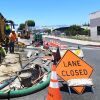
Drivers feel the pain of poorly maintained roads in very familiar ways: in potholes and dips. Patrick Marshall, a music teacher in New Orleans, wasn’t watching close enough one morning and hit a dip that nearly broke a wheel off his 1989 GMC Sierra. The incident cost Marshall $2,500 and resulted in a 10-block walk to work.
“It’s a tough hit to take when it’s an unexpected expense,” Marshall said.
(Well, not that unexpected — at least not in a city infamous for rough roads. When Marshall leads his students on brass and drum lines through New Orleans’ streets, they know to shout warnings of “Pothole!” loud enough to eclipse the trumpets and French horns.)
All those pothole-related damages add up: AAA estimated that damage from potholes cost drivers some $26.5 billion in repairs in 2021.
Overall, this month’s LendingTree report, which was based on federal data from 2024, found that 8.9% of the nation’s road miles are in poor condition. Rhode Island scored the worst, with 31.5% of road miles rated as poor, with California and Massachusetts coming in second and third at 27.0% and 24.5%, respectively.
Minnesota stood out as the most improved between 2019 and 2024 — the state reduced the share of road miles rated as poor by more than 60%. But nationally, the report didn’t find much improvement at all over that five-year span.
And even drivers in Rhode Island, the report’s lowest-rated state, say potholes are bad everywhere. “I hit a pothole in New York City about a month ago, though that literally took life out of me,” said Rhode Island resident Carleen Quattrucci.
The bigger problem: The gas tax is broken
Here’s even more bad news: The federal gas tax hasn’t collected enough money to fully fund highway construction and repairs for years. And that fundamental problem is only getting worse.
It wasn’t always like this. The gas tax was based on the premise that the people who use highways the most should pay the most for their upkeep. And the more miles a driver puts on their car, the more gasoline or diesel they purchase, so the more tax they pay — no toll booth required.
From the mid-1970s through the mid-1990s, that worked well, says the Tax Foundation’s Hoffer.
“The revenue from gas tax collections was sufficient to cover all federal highway road construction and maintenance expenses,” he says. “So the drivers were paying for the roads to be maintained and more roads to be built, when they drove on the roads. It was a terrific system.”
But the last time the gas tax was raised was in 1993. It was 18.4 cents a gallon then; it’s 18.4 cents a gallon now.
Yet since 1993, the cost of road repairs and construction has risen — and the price of gasoline has tripled.
“It’s a weird tax,” says Smetters, because it’s not pegged to the price of gasoline, so it doesn’t rise with inflation.
Meanwhile, new vehicles have gotten more fuel efficient, and per capita miles driven per year peaked 20 years ago. That means the government collects less and less with the gas tax.
Now, the tax falls short of the highway fund’s needs every year. For 2026, the shortfall is estimated to be $17 billion. Congress has to keep making up the gap with general taxpayer funds.
Raising the federal tax wouldn’t fix the problem for long
Hypothetically, the national tax could be increased. After all, many states’ gas taxes are set to raise automatically.
One problem: “Nobody likes gas taxes. Politicians don’t like them. Drivers don’t like them. Voters don’t like them,” Hoffer says. “So increasing these taxes is a real political challenge.” That’s even though higher gas taxes do have benefits. For example, by discouraging driving, they cut down on carbon emissions, which improves air quality and human health. And a well-designed gas tax is a fairer way of paying for highways than drawing from the general tax pool, Hoffer says.


But there’s another problem: Gas taxes make less sense as more drivers choose electric vehicles. EVs use roads and highways, so they add to the wear and tear on infrastructure. But they don’t burn gasoline. So as EVs make up a growing share of vehicles, even a significantly higher gas tax would be doomed. It would bring in less money over time, because fewer drivers would pay it.
Many states have imposed EV registration fees to address this problem; the federal government is also considering adding one. However, because EVs still make up a very small share of vehicles, this doesn’t come close to addressing the gas tax shortfall. Also, in many cases the fee for EVs is — or would be — much higher than the typical driver pays in gas taxes, creating an unfair system. Other potential solutions are being debated too. A lobbying group representing major automakers is pushing for a fee that all car owners would pay based on vehicle weight, so trucks would pay more than sedans. Heavier vehicles are harder on roads.
Some states are experimenting with road-user fees, which drivers pay based on how many miles they drive. In some cases, the programs use odometer readings; in others, they rely on devices or phone apps to measure miles driven. While economists say they’re a fairer way to collect revenue — because, like with a gas tax traditionally, the people who use roads the most contribute the most toward their upkeep — those plans can raise privacy concerns, depending on the technology used to track miles driven.
Smetters, of the Penn Wharton Budget Model, also points to congestion fees and toll lanes as alternative funding mechanisms.
None of these ideas has yet caught on as a replacement for the federal fuel tax. But one thing is clear: At some point down the road, this tax is going to run out of gas.
Source: https://www.npr.org/2026/05/28/nx-s1-5835634/gasoline-tax-holiday-trump-potholes
About the Author