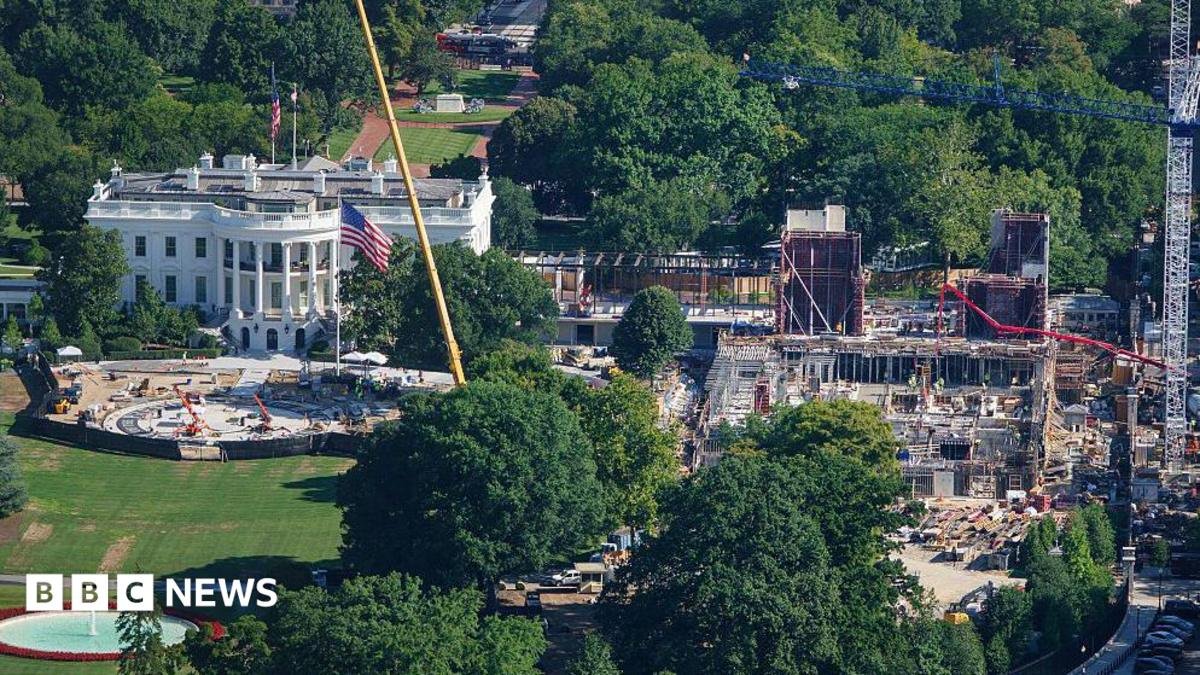
The US Supreme Court has temporarily allowed construction of the White House ballroom to move forward.
The decision on Friday by Chief Justice John Roberts, issued as a stay, will allow US President Donald Trump’s $400m (£297m) project to continue as the high court mulls over a case aiming to halt it entirely.
The stay will remain in place pending further action from the court.
The case, originally filed by a preservation group that argues the project would become irreversible unless stopped immediately, was appealed to the high court after a federal appeals court had ordered work to halt earlier this month.
The appeals court ruled that Trump was a “temporary tenant” of the White House and could not make the alterations without congressional approval. It gave the administration two weeks to appeal the decision.
The National Trust for Historic Preservation, a preservation group, has led the lawsuit against the ballroom, arguing it is causing irreversible damage to a historical landmark.
“We are aware of the administrative stay,” the group told the BBC on Friday. “To be clear, this is not a final decision on the merits of the government’s stay application, and we await further action.”
Trump posted on social media that he is grateful for the Supreme Court’s decision, saying the new complex is “vital for National Security”.
“It is something that Presidents have wanted for 150 years, and that the Military has been seeking for the last 100 years. Their wish will soon be fulfilled!” he wrote of the new ballroom on Truth Social.
The court’s decision represents a victory – albeit perhaps a temporary one – for Trump, who has long argued that the White House needs a larger events space, and more recently, that it was important for his security.
Had the Supreme Court not issued a stay, or chosen to rule against the Trump administration, the White House would have been legally obligated to halt construction on Friday.
The president has asserted that the new ballroom was needed to accommodate grand parties and state visits and would improve security.
Government lawyers have argued the additional security complex and features included in the ballroom project are needed to protect the White House complex from drones, ballistic missiles, biohazards and other threats – changes essential to protecting the president, his family, and staff.
While initially billed as a 650-person ballroom that would incorporate the existing building when it was announced in July 2025, revised plans later expanded it to have a capacity of 900, and then about 1,000, with the entire structure of the East Wing being demolished in the process.
Source: https://www.bbc.co.uk/news/articles/c78g2vq6nx6o?at_medium=RSS&at_campaign=rss
About the Author