Key events
Canary Islands government rejects hantavirus-hit cruise plans to dock there
In other news from Spain, the regional government of Canary Islands said it is opposed to allowing a luxury cruise ship that has been hit by the outbreak of the deadly hantavirusto dock on the archipelago, its leader, Fernando Clavijo, said.
“This decision is not based on any technical criteria, nor is there sufficient information to reassure the public or guarantee their safety,” Clavijo told radio station COPE, as reported by Reuters.
He added that he had requested an urgent meeting with prime minister Pedro Sánchez to discuss the issue. Clavijo belongs to the conservative People’s Party – the main opposition to Sanchez’s Socialists.
Earlier today, Spanish state broadcaster TVE reported the cruise ship was set to dock at the Canary island of Tenerife, citing sources from the country’s health ministry. The ministry did not immediately respond to Reuters’ requests for comment.
Morning opening: Spain’s Sánchez v Trump
Jakub Krupa
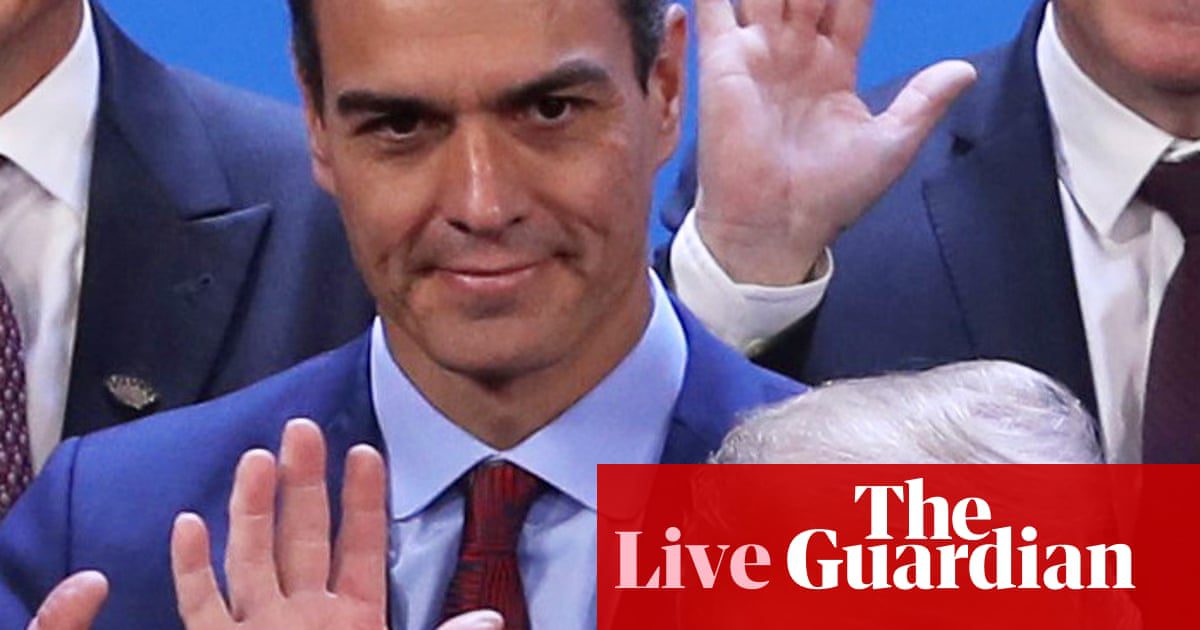
Spain’s prime minister Pedro Sánchez has urged the European Commission to trigger its blocking statute against US sanctions on the international criminal court, which would effectively tell European companies to not comply with the measures.
In a post on X, Sánchez said:
“Spain does not look the other way. Sanctioning those who defend international justice puts the entire human rights system at risk.”
In February last year, Donald Trump has signed an executive order that authorises aggressive economic sanctions against the international criminal court (ICC), accusing the body of “illegitimate and baseless actions” targeting the US and Israel.
As Ashifa Kassam reported in March, to date, 11 of the court’s officials – including the chief prosecutor and eight judges – have been placed under sanctions, subjecting them to measures that include bans on travel to the US and fines and prison sentences for American companies who provide them services.
Ever since, campaigners called on the EU to move against the sanctions, but the bloc did not want to put at risk already fragile relations with the US administration.
Now, Spain’s Sánchez, an outspoken critic of Trump who has already repeatedly drawn his criticism, is the first one to formally request the EU to act.
He said:
“The EU cannot remain idle in the face of this persecution. That is why, today, we ask the Commission to activate the Blocking Statute, to protect the independence of the international criminal court and the United Nations, and their actions to end the genocide in Gaza.”
The EU’s blocking statute is intended to protect Europe from extraterritorial sanctions imposed by other countries. It was used against the US before, in response to its sanctions on Cuba in 1996, and Trump’s first term sanctions on Iran in 2018.
But Sánchez’s initiative comes at an already tense moment for EU-US relations, with the bloc trying to defend itself from the latest threat of new US tariffs on cars and other industries, and looming threat of pulling out some US troops from the continent.
Later today, the EU will discuss the implementation of last year’s trade deal with the US, agreed in Scotland, in the latest push to get it in place before Trump comes up with more ideas on how to affect transatlantic trade.
In other news, I will also keep an eye on Friedrich Merz’s first anniversary as the German chancellor, US secretary of state Marco Rubio’s upcoming trip to Italy, and lots of smaller defence developments expected across the continent today.
Lots for us to cover today.
It’s Wednesday, 6 May 2026, it’s Jakub Krupa here, and this is Europe Live.
Good morning.
Source: https://www.theguardian.com/world/live/2026/may/06/europe-eu-spain-sanchez-trump-icc-sanctions-merz-ukraine-russia-latest-news-updates
About the Author