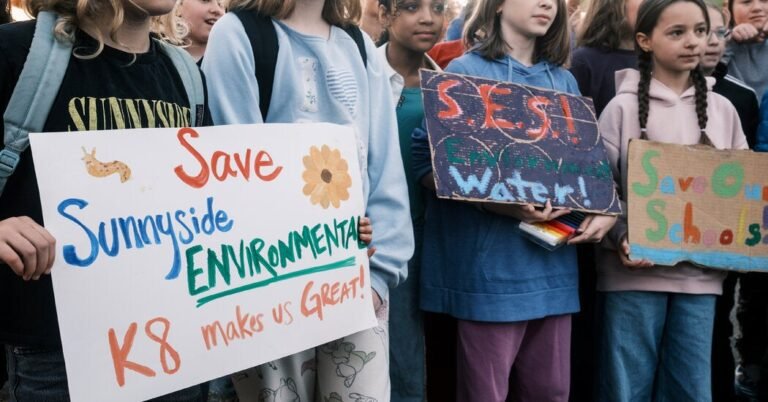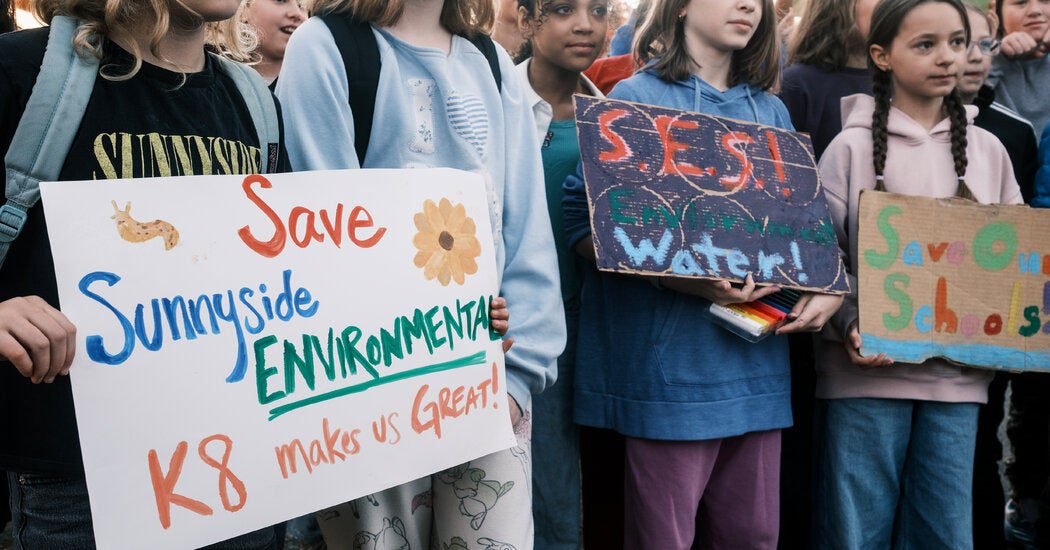
The families show up angry and organized, wearing matching T-shirts and waving protest signs to vent their frustration at a crisis that has largely slipped under America’s political radar: Scores of neighborhood schools are closing.
Since last year, more than 100 public schools across the country have been slated for closure or consolidation, as districts grapple with dramatic enrollment declines that have led to strained budgets and half-empty buildings.
They are the first in a wave of school closures that is expected to accelerate in the years ahead as Americans have fewer and fewer children.
The issue got scant attention during the midterm elections compared with gas prices or the war in Iran. But it has become a personal, consuming fight for thousands of parents, liberal and conservative alike, who have thronged school-board meetings and formed grass-roots groups to argue that closures will scatter students and devastate neighborhoods anchored by local schools.
“It feels like our community is being dismantled,” said Hanna Neuschwander, who bikes her third grader and seventh grader to their neighborhood school in Portland, Ore., where 10 schools are being recommended for closure and others are being broken up and reconfigured.
Almost no type of district — urban or rural, affluent or poor — is immune. Pittsburgh is preparing to close 12 schools, and Tulsa, Okla. recently voted to close or consolidate 17. Five are closing around the Tampa Bay area in Florida, and three in Little Rock, Ark. In Colorado, schools are shuttering in the rich college town of Boulder and next to a mobile-home park outside Denver.
In New York City, the nation’s largest school district, enrollment has plunged from nearly 1 million to about 767,000 students over the last decade. Two small schools in Harlem are now on the potential closure list, and Mayor Zohran Mamdani is facing pressure to find solutions to a growing crisis.
Public-school enrollment is being battered on multiple fronts.
Americans worried about soaring prices and pessimistic about the future are having fewer children or forgoing parenthood altogether, and the Trump administration’s immigration crackdown has meant fewer immigrants are arriving and enrolling their children in public schools.
Public-school enrollment never fully recovered after plunging during the pandemic, and it is also facing pressure as more parents opt for charter schools, home-schooling or voucher-funded private schools.
“It was hard, but it was also necessary,” said Lori Goldstein, who as president of the Adams 12 school district in suburban Denver recently voted to close one middle school and five elementary schools. “People just aren’t having kids. Every year, our kindergarten class is getting smaller and smaller.”
In most cases, districts receive state and federal funding based on the number of students enrolled. Fewer students, districts say, means less money to pay for rigorous academic options, like advanced math, and a full slate of electives, like music, art and STEM, at every school — something districts hope to change by consolidating buildings.
Closures are a “last resort,” said Angela King Smith, a partner at Education Resource Strategies, a nonprofit that consults with school districts on finances. Districts typically start with smaller changes, like adjusting school boundaries or trying to woo new families — by expanding preschool or offering specialized programming, for example.
But “if those things are just not working,” she said, “it’s like, ‘Look, you’ve got to do something.’”
Often, schools in poorer neighborhoods struggle the most to fill classrooms and keep a full slate of options.
In Portland, enrollment has fallen from a peak of nearly 80,000 students in the 1960s to 42,000 today. The district says it has tried spreading music and art teachers out across schools, and it has increased high school class sizes to pay for counselors in some elementary schools. Still, about half of Portland’s students — and even fewer of its students in poverty — are in what the district considers a “sustainable school.”
“How are we going to achieve better for our kids if we maintain the status quo?” said Rashelle Chase-Miller, a Portland board member who believes closing some schools will help the district better serve its most vulnerable students.
For many families, the closures are a gut punch, injecting chaos and disruption to their children’s lives.
Parents are organizing on WhatsApp and Facebook, showing up to school-board meetings in their schools’ colors, and even going to court to try to block closures.
The plan in Portland has been particularly contentious. At a packed board meeting last month, parents and community members shoved past security, shouting “Shame on you!” and “Save our schools!” according to video posted by The Oregonian.
The superintendent, Kimberlee Armstrong, has faced accusations from teachers, parents and local Democratic Socialists of America organizers that she is part of a “right wing” effort to privatize education and hurt public schools.
Dr. Armstrong said in an interview that she was recommending closures as part of her commitment to all Portland students and the “long term stability” of the school system. “That is my job,” she said.
Some parents in Portland said they understood the need for changes but wanted the district to slow down and consider community input. “It’s not about ‘don’t close schools,’ but close schools the right way,” said Matt Coolidge, a parent who co-founded a grass-roots group, Save PDX Schools.
In Fort Collins, Colo., dozens of parents and students gathered outside the offices of the Poudre School District on a recent evening to urge the board to spare their schools.
For some of them, this was their first time joining a protest. But they wanted to come out for their schools and children.
“We’ve never been out to a protest before,” said Shelley Sutton, who brought her three young children to the rally to save Timnath Elementary, home of the Cubs, one of five schools set to be closed.
The district said Timnath’s yellow-brick building — first built in 1919 — did not comply with the Americans With Disabilities Act and needed millions of dollars in upgrades.
But the Suttons said having Timnath in the neighborhood allowed them to walk their third-grader to school. If it closes, they said, many students will have to cross busy roads or an interstate to get to the closest school, making walking or biking dangerous.
“The school is the linchpin in the heart of town,” Ms. Sutton’s husband, Ian, said. “It’s the heart of the community.”
The district’s superintendent, Brian Kingsley, said more closures could loom if the student population continues to fall.
“This problem is not going to go away,” he said in an interview. “Nobody’s being asked to like these decisions, but it’s not the result of a local failure. Birthrates are lower. Fewer families are moving here.”
Some parents say that school boards are closing the wrong schools and putting unfair burdens on rural, immigrant or minority students.
In Minneapolis, a proposal to close up to 16 schools was criticized, in part, for including several schools in predominantly Black, working class neighborhoods.
“I hear parents say they feel angry. I hear parents say the trust in the district is lost,” said Shakiya Carter, a co-founder of Minneapolis Families for Public Schools, which opposed the plan and won a pause while the district considers its options.
Nationally, research shows that high-poverty schools and majority Black schools are more likely to be closed, even when accounting for similar enrollment declines.
Studies have found that closures can hurt students academically and may not save money, often because districts try to avoid laying off teachers and staff, the biggest line item on any district budget. The uncertainty can also spur families to look elsewhere — to private schools, charter schools or other districts — leading to new financial losses.
In Pittsburgh, a closure plan isn’t expected to be a huge cost saver, but the district hopes it will equalize resources.
At Arsenal Middle School, which serves mostly lower-income Black and Hispanic families in the gentrifying neighborhood of Lawrenceville, the student body has shrunk to 134 students, with just 37 eighth graders. That’s too few to offer 8th grade algebra, a pathway to higher level math that is available at some more affluent schools in the district.
With an influx of students from other middle schools, Arsenal hopes to offer algebra next year. David Saylor, a math teacher, said he has students who are ready to take it and that “parents absolutely love an advanced option.”
But as part of the plan, the elementary school on the other side of the building, Arsenal PreK-5, is closing. That will break up a tight-knit school community made up of many immigrant families.
The principal, Ruthie Rea, has been there 18 years, long enough to watch entire families of children come through the school. Next year, her students — her “Arsenal All Stars,” with their names on their lockers, and teachers who greet them with hugs — will be split among three different schools.
“I’m not letting my mind get there,” said Dr. Rea, who was awaiting word about where she and her staff will be reassigned. “We want this last year to be one that is super special.”
Source: https://www.nytimes.com/2026/11/17/us/public-schools-closing-birth-rate-enrollment.html
About the Author