Football and politics are inseparable in the modern world, no matter how many people wish they were not. But whether the beautiful game can ease the ills of our age is another matter. After a week in which the issue of Irish support for the people of Gaza had turned this fixture into a battle of conscience, the outcome of this underwhelming match ultimately felt inconsequential.
In the end the result was indeed a walkover, just not because of a boycott. On Saturday night the question had been whether Heimir Hallgrimsson’s side would take to the field in Hungary at all. If they did, would their heads be in the game? It turned out that a week of internal angst had been enough to produce collective resolve among the Irish squad, or at least those selected to play. Strong and assertive from the off, their forwards each scored in the first half to settle the contest, with plenty of symbolic action to assure those back home of their feelings.
“It’s probably been the toughest days of my coaching career,” Hallgrimsson said after the match. “But it’s not about me. It’s about the players and they’ve shown today how much playing for Ireland means to them. They represented themselves on the pitch with dignity but also with the power of proud Irishmen. They’ve shown today how much playing for Ireland means to them and hopefully they will have the support of the Irish people.”
In a way the atmosphere in Debrecen was reminiscent of a match played during Covid. Every word uttered in the ground was audible and the nigh-on empty stands carried their own oppressive weight. As the nominal home side, Israel had been allowed a small delegation of fans, about 150, who were doing their best to be excitable. Meanwhile, two blocks away were the Irish contingent, around a dozen people who had got into the ground despite the Football Association of Ireland’s decision not to bring an away allocation. They were all stood hands in pockets in a stairway.
This odd, almost haunted mood was heightened further by Ireland’s mannered approach to the pre-match rituals. Irish staff faced away from the pitch when their national anthem was played. Ireland’s players, all wearing black armbands, stared at the ground during Israel’s. There was no exchanging of pennants and no shaking of hands, with both squads hurried away from the centre circle into their own huddles.
The game had come close to being abandoned on Saturday, when the goalkeeper Gavin Bazunu made himself unavailable for selection, his decision prompting emotional exchanges among players and management. Hallgrimsson therefore picked a team with defender Jimmy Dunne nominally a third goalkeeper and also dropped the key forward Finn Azaz to the bench in one of five changes to the team that lost meekly to Kosovo. Azaz’s mother has Israeli citizenship and the Southampton forward was reported to have made an impassioned contribution to Saturday’s discussion. “Today we thought others would fit this game better than him,” Halgrimsson said.
After all the soul-searching, Ireland decided the contest in only 11 first-half minutes. Troy Parrott opened the scoring in the 14th minute, turning home a low shot through the body of Daniel Peretz after impressive work on the right by wingback James Abankwah. Two minutes later the lead was doubled when, running on the shoulder of the last defender, Adam Idah collected a smart through ball from Jack Moylan and wrapped a calm finish inside Peretz’s left-hand post.
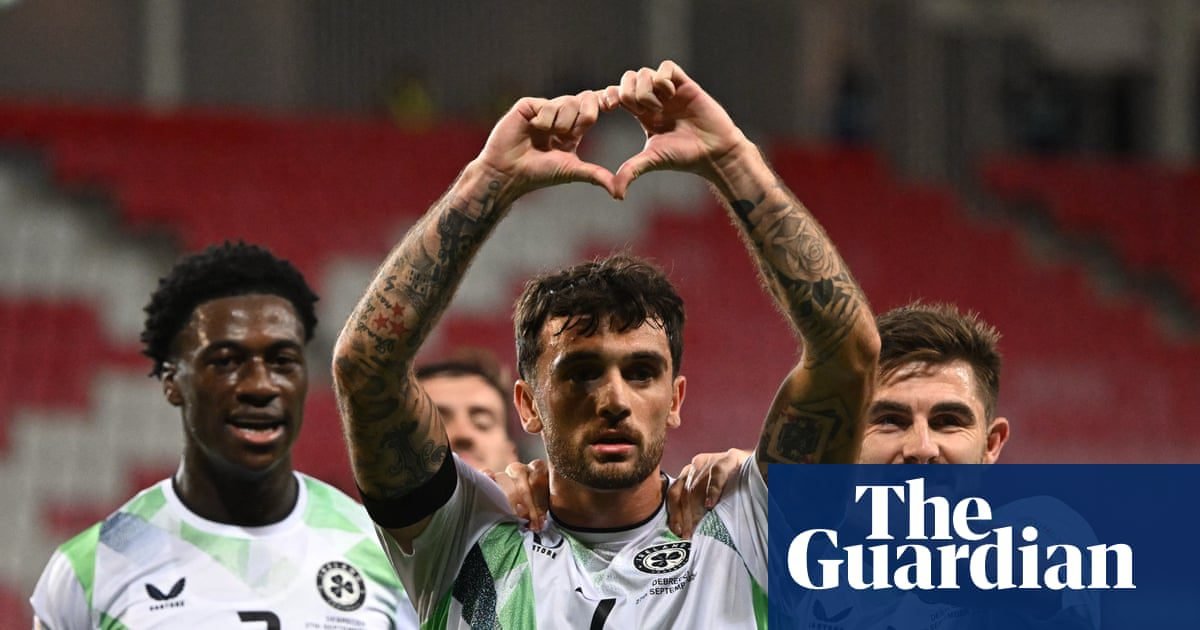
In the 25th minute Moylan got a goal of his own, his fourth in as many caps to continue a stellar start to his international career, driving 25 yards into the box before shooting low into the net. Moylan wheeled away to the corner flag, took off his black armband and kissed it.
after newsletter promotion
Israel raised their levels momentarily in the second half, with the substitute Dor Peretz drawing one excellent save from Caoimhín Kelleher. But ultimately the game deteriorated into just a series of scuffles, cheered on deliriously by the Israeli support who appeared to be chanting for the IDF as the final whistle blew.
Their manager, Ran Ben-Shimon, was asked by Israeli media after the match if he would resign following the defeat, to which he answered no. “We didn’t handle the pressure well that is obvious, we failed mentally, we failed tactically,” Ben-Shimon said. “But in a few days there is another game we will have to find the energy to rise again.”
Source: https://www.theguardian.com/football/2026/sep/27/israel-republic-ireland-nations-league-group-3-match-report
About the Author