A spectacular, internationally important painting of Thomas More and his family is to have its secrets explored as the public look on.
The open heritage science project, scheduled to begin on Thursday, is a UK first and will deploy techniques used at the Rijksmuseum in Amsterdam during its famous public restoration of Rembrandt’s masterpiece The Night Watch.
Visitors to Nostell, a Palladian mansion near Wakefield in West Yorkshire, will be able to watch cutting-edge research normally undertaken behind closed doors in labs, the National Trust said.
Simon McCormack, Nostell’s curator, said they wanted to take the public on a deeper dive into what is a prized and fascinating painting.
“Why are we doing all these things behind the scenes when we are looking after and caring for heritage which ultimately belongs to everybody?” he asked.
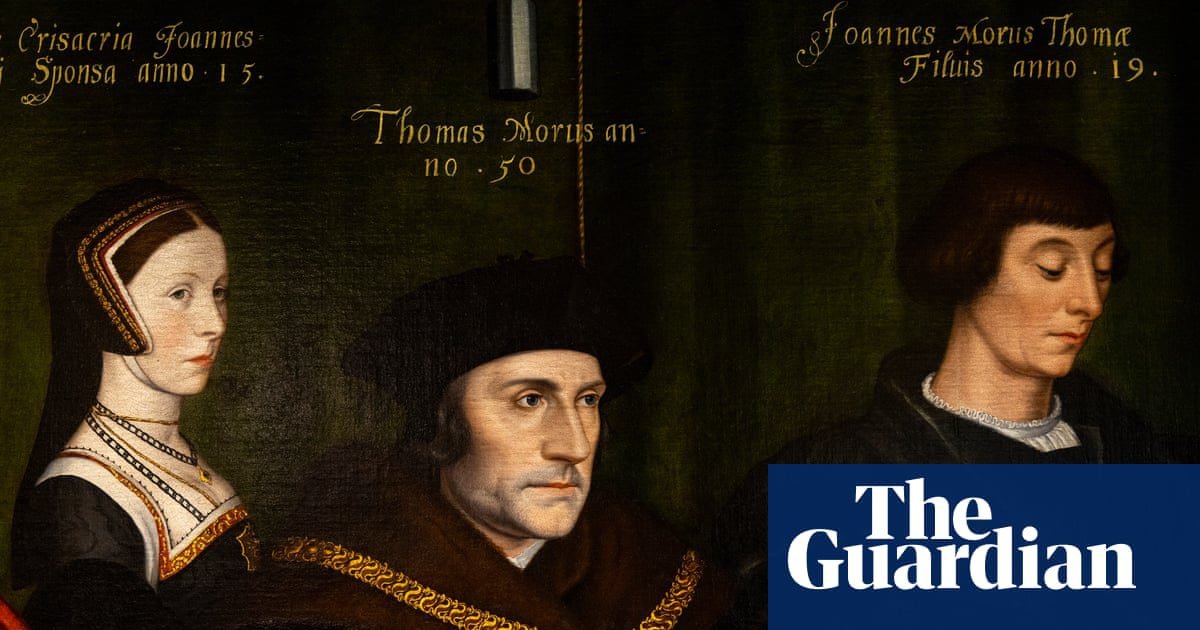
The painting is considered “one of the glories” of the National Trust collections. At 2.5 metres by 3.4 metres, its size meant that for most of the 18th century it stayed in its packing case, as it was too big to get through doors to hang it.
It shows three generations of the More family, Henry VIII’s lord chancellor who was executed for not supporting the annulment of the king’s first marriage to Catherine of Aragon.
Encountering the painting in person is quite something. McCormack said: “It’s lifesize and it is that trompe l’oeil effect where you might feel you’re almost walking into the painting. It’s very visceral, very realistic.”
The work is regarded as the only faithful, lifesize copy of the painting by Holbein, which was destroyed in a fire during the 18th century.
Holbein, widely considered the most important artist working in 16th-century England, was introduced to More by their mutual friend Erasmus.
More commissioned Holbein to paint him and his family, with the result being considered by art historian Roy Strong as “arguably the greatest and most innovative work of Holbein’s English period” and “at least a century ahead of its time”.
McCormack said the Holbein was “arguably the first family portrait in a domestic setting in British art history”.
The Holbein was destroyed in fire in 1752 but a preparatory sketch survives in Basel, Switzerland. Five copies are known about at present, including one in the National Portrait Gallery and a miniature in the V&A’s collection.
McCormack said the Nostell version is “understood to be the most faithful to Holbein’s original and the only same-size version that survives”.
It depicts More with his family, pets, books and musical instruments in their Chelsea home. As with most Tudor-era paintings, it is filled with symbolism and hidden meanings. A tethered monkey next to More’s second wife Alice has been seen as representing discipline and her ability to control the household. More was believed to have owned a pet monkey.
The many books refer to the family’s scholarly reputation and three-petalled irises in the painting allude to faith, valour and wisdom.
The on-site research, expected to last eight days, is being carried out by the Fitzwilliam Museum’s Hamilton Kerr Institute. It will be the first time that macro X-ray fluorescence scanning has been done in public in the UK. Researchers are hoping to uncover any hidden under-drawing as well as discovering and dating later additions to the painting.
Erma Hermens, the institute’s director, said: “We are very excited to use our technical equipment in situ for the first time, taking it from Cambridge to Yorkshire, to help the National Trust in their understanding of this amazing family portrait.”
Money to help fund the project has been provided by the Center for Thomas More Studies at Dallas university.
McCormack is hoping the project will have the same “buzz and drama” as the Rijksmuseum’s Night Watch conservation.
“There are lots of myths and legends around our painting which heritage science may be able to help answer,” he said.
“It may have been at the house for 300 years but we don’t know for certain who painted the Nostell portrait.”
Source: https://www.theguardian.com/artanddesign/2026/sep/03/thomas-more-portrait-public-access-holbein-nostell
About the Author