Key Takeaways
PM Modi’s consistent Christmas outreach signals evolving government-minority relations and policy shifts on social harmony. Delve into political implications and stakeholder perspectives for India Politics.
Overview
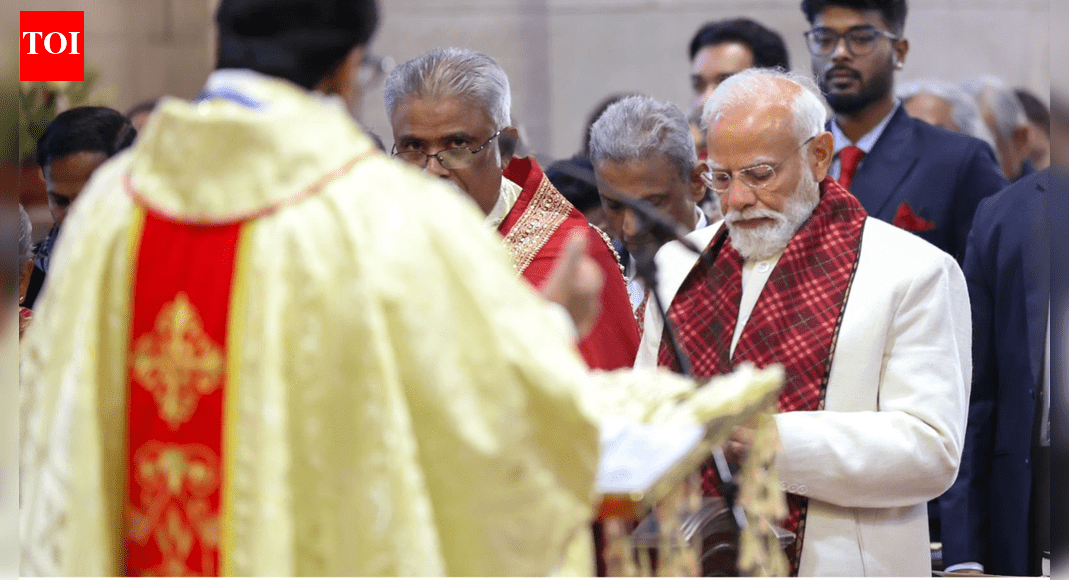
Prime Minister Narendra Modi’s recent Christmas morning service attendance at The Cathedral Church of the Redemption in Delhi, part of a consistent engagement pattern, underscores a strategic focus on social harmony within India Politics. His public messages of “peace, compassion, and hope” reinforce the government’s outreach to diverse communities, impacting governance narratives. (60 words)
For News Readers and Policy Watchers, these actions signify a commitment to inclusivity and mutual respect across India’s varied religious demographics. Noted engagements include PM Modi’s presence at Easter 2023, hosting a Christmas program in 2023, and participating in a Catholic Bishops’ Conference of India (CBCI) Christmas dinner in 2024. (62 words)
This multi-faceted interaction signals potential shifts in government-minority relations, offering crucial insights into evolving policy implications regarding social cohesion and interfaith dialogue. (34 words)
Key Data
| Date/Year | Event Type | Location/Host | Significance |
|---|---|---|---|
| Easter 2023 | Religious Service | Sacred Heart Cathedral | Early outreach pattern |
| Christmas 2023 | Official Reception | PM’s Official Residence | Personal goodwill, hospitality |
| Christmas 2024 | Community Program/Dinner | Catholic Bishops’ Conference of India (CBCI) | Immersion into community life |
| Christmas 2025 | Religious Service | The Cathedral Church of the Redemption, Delhi | Direct solidarity, public visibility |
Detailed Analysis
In a nation profoundly shaped by its diverse religious landscape, Prime Minister Narendra Modi’s consistent participation in Christian festivities marks a notable continuation of a discernible trend in India Politics. Historically, Indian political leaders have often sought to project an image of inclusivity, recognizing the country’s pluralistic fabric. However, the specific, high-profile nature and consistency of the Prime Minister’s recent outreach to the Christian community offer a nuanced perspective on contemporary governance and stakeholder dynamics. This pattern, evolving over several years—from attending Easter programs to hosting and participating in Christmas events—signals a strategic emphasis on fostering social harmony and mutual respect, themes critical to policy discourse. Such engagements are rooted in India’s constitutional commitment to secularism and its legacy of interfaith coexistence, often tested by periodic challenges to communal amity. (138 words)
By actively participating in a Christian religious service and publicly conveying greetings of “peace, compassion and hope,” the Prime Minister is not merely observing a festive occasion; he is actively contributing to a narrative of unity. His message, stressing the strengthening of harmony in society and the enduring values of love, service, and brotherhood inherent in the teachings of Jesus Christ, resonates far beyond the immediate Christian congregation, amplified across national and international platforms. This shapes perceptions of the Indian Government’s approach to minority affairs. The specific details, such as his attendance at The Cathedral Church of the Redemption with a substantial congregation, the inclusion of traditional prayers, carols, and hymns, and a special prayer offered for the Prime Minister by Rt Rev Paul Swarup, underscore the event’s public nature and visibility. This detailed messaging, transcending a mere seasonal greeting, ties directly into broader government policy objectives focused on inclusive development and social cohesion. (173 words)
From a comparative analysis perspective, PM Modi’s engagements with the Christian community align with a broader strategic approach observed in the Indian political landscape, where leaders often undertake visible outreach to various religious and ethnic groups. However, the consistent and high-profile nature of these specific interactions over the last few years differentiates them. Unlike purely administrative interactions, personal attendance at religious services or community gatherings by the Prime Minister carries immense symbolic capital, signaling a direct endorsement and respect for the community’s traditions. This proactive cultivation contrasts with periods where such high-level engagements might have been less frequent. The strategic timing around major religious festivals further enhances the message of respect and celebration of India’s diverse cultural fabric, influencing public perception. Such actions contribute to the ongoing discourse about secularism in India, positioning the government not just as a neutral arbiter but as an active participant in promoting interfaith dialogue. (152 words)
For News Readers, Policy Watchers, Informed Citizens, and Political Analysts, these engagements offer crucial insights into the evolving dynamics of India Politics and governance. In the short-term, the visible embrace of Christmas celebrations by the Prime Minister sends an immediate message of reassurance and inclusion to the Christian community and beyond, fostering goodwill and reaffirming India’s commitment to its diverse heritage. In the medium-term, this sustained pattern could contribute to a more robust framework for interfaith dialogue and strengthen community relations, potentially influencing state and local government approaches towards minority communities. Long-term implications for India’s governance could include a recalibration of how the government interacts with its minority populations, leading to more inclusive policy-making processes that integrate diverse community perspectives. Monitoring the consistency and depth of future engagements, along with any specific policy initiatives addressing minority welfare or interfaith relations, will be key for political analysts. Stakeholders like the Christian community benefit from increased visibility and recognition, while the Government aims to bolster its image as an inclusive and unifying force. Potential risks involve accusations of tokenism if symbolic gestures are not perceived as genuinely backed by substantive policy, emphasizing the need to monitor substantive policy actions alongside symbolic gestures. (246 words)
About the Author