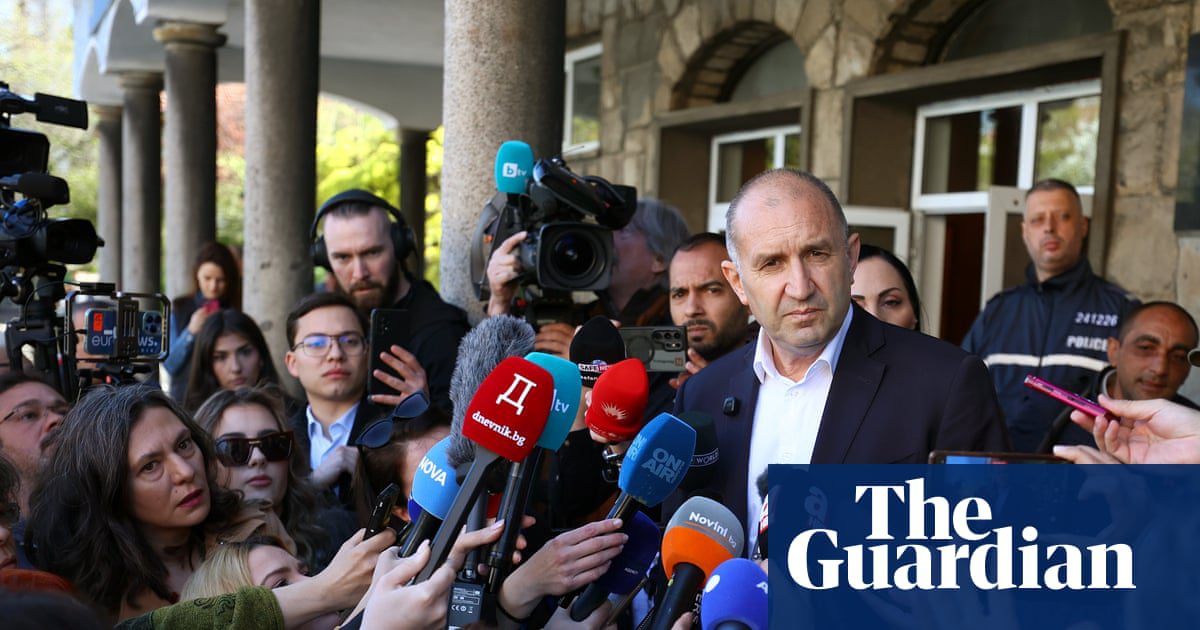
The party of Bulgaria’s pro-Russia former president Rumen Radev has come first in the country’s eighth parliamentary elections in five years, according to exit polls, but without securing a majority.
Radev, who resigned as president in January, ran on a pledge to fight corruption after an anti-graft movement triggered a long political crisis.
The EU’s poorest member has seen successive governments since 2021, when anti-corruption rallies ended the conservative administration of its longtime leader Boyko Borissov.
The centre-left Progressive Bulgaria group of parties gained about 38% of the vote, coming in well ahead of Borissov’s conservative GERB, which slumped to about 16%, and the liberal PP-DB coalition, on about 14%, according to two exit polls.
Borissov appeared to concede in a post on Facebook, but added a note of caution: “To win the elections is one thing; to govern is quite another. Elections decide who comes first, but negotiations will decide who governs.”
Radev, who has called for renewing ties with Russia and opposes military aid to Ukraine, was president for nine years in the Balkan nation of 6.5 million people before stepping down to lead Progressive Bulgaria.
The former air force general, 62, has said he wants to rid the country of its “oligarchic governance model”. He backed new anti-corruption protests last year that brought down the latest conservative-backed government.
“Everything simply has to change,” Stiliana Andonova, a retired engineer, told AFP after casting her ballot in Sofia, listing “the judicial system” and “corruption” among concerns.
Shortly before polling stations closed at 8pm (6pm BST), Radev arrived at his group’s headquarters.
As he entered the office, where windows were covered with campaign branding featuring his portrait, he was greeted with applause by his team waiting inside. He is expected to make a statement later on Sunday.
After voting earlier in Sofia, Radev said Bulgaria had “a historic chance to break once and for all with the … oligarchic model”.
He called for a “democratic, modern, European Bulgaria”. He also said he hoped for “practical relations with Russia, based on mutual respect and equal treatment”.
Radev, 62, has denounced a 10-year defence agreement signed last month between Bulgaria and Ukraine, which has been battling Russia’s full-scale invasion since 2022.
He has also opposed Bulgaria sending arms to Ukraine, though he has said he would not use his country’s veto to block EU decisions.
Borissov, who headed the country virtually uninterrupted for close to a decade, has dismissed suggestions that Radev brings something “new”.
After voting in his home town of Bankya, just outside Sofia, Borissov hailed his party for having an “extremely pro-European position”, underlining its support for Ukraine and Brussels.
Gergana Mihailova, a 47-year-old finance expert, told AFP there was a “huge risk that Bulgaria could change its geopolitical course and orientation”, after casting her vote.
A lack of trust in politics has affected voter turnout, which slumped to 39% in the last election in 2024. But with Radev rallying voters, a higher turnout is expected this time, according to Boryana Dimitrova, an analyst with the Alpha Research polling institute.
Political parties had called on Bulgarians to show up for the polls, also to curb the impact of vote-buying. In recent weeks, police seized more than €1m (£870,000) in raids against alleged vote-buying operations. They detained hundreds of people including local councillors and mayors.
Source: https://www.theguardian.com/world/2026/apr/19/bulgaria-election-rumen-radev-boyko-borissov
About the Author