Key Takeaways
Explore the Operation Sindoor controversy as BJP cites Shashi Tharoor to critique Congress’s stance on India’s foreign policy. Understand political implications and rhetoric.
Overview
A fresh political storm has engulfed India’s political landscape, centering on the BJP’s accusation that Congress leader Rahul Gandhi prioritizes family interests over national concerns, specifically regarding India’s foreign policy and the military operation known as ‘Operation Sindoor’. This intensified debate underscores the deep partisan divisions even on matters of national security.
For News Readers, Policy Watchers, Informed Citizens, and Political Analysts, this episode highlights the strategic use of internal party comments in broader political warfare, shaping public discourse on patriotism and accountability. It also brings into focus the delicate balance between opposition critique and national consensus.
Key points include BJP spokesperson Shehzad Poonawalla citing Congress MP Shashi Tharoor’s remarks on foreign policy to counter Opposition criticism, juxtaposed with former Maharashtra CM Prithviraj Chavan’s controversial statements on Operation Sindoor, and Rahul Gandhi’s earlier claims citing former US President Donald Trump.
The ongoing rhetoric demands a nuanced understanding of how such narratives are constructed, the underlying policy implications, and the potential impact on India Politics and governance.
Detailed Analysis
The recent escalation in political rhetoric surrounding ‘Operation Sindoor’ and India’s foreign policy illuminates the intricate interplay between national security, partisan politics, and public perception in India. The controversy, initially triggered by specific statements from Congress leaders, has rapidly evolved into a broader debate on patriotism, accountability, and the legitimacy of opposition critique concerning sensitive national matters. ‘Operation Sindoor,’ launched by India on May 7 in retaliation for the April 22 terror attack in Pahalgam, Jammu and Kashmir, which claimed 26 civilian lives, targeted terror infrastructure deep inside Pakistan and Pakistan-occupied Kashmir. The government has consistently maintained that no external pressure influenced its conduct, a stance reiterated by External Affairs Minister S Jaishankar and Prime Minister Narendra Modi.
The genesis of the current political storm can be traced back to senior Congress leader and former Maharashtra chief minister Prithviraj Chavan’s remarks. Speaking in Pune, Chavan asserted that India was “completely defeated” on the first day of Operation Sindoor, claiming, “In the half-hour aerial engagement that took place on the 7th, we were fully defeated, whether people accept it or not. Indian aircraft were shot down. The Air Force was completely grounded, and not a single aircraft flew.” He further questioned the necessity of maintaining an army of 12 lakh soldiers in an era dominated by aerial and missile warfare. These comments drew immediate and sharp criticism from the BJP, which accused the Congress of a historical pattern of undermining the armed forces, encapsulated in the phrase “Sena ka apman is Congress ki pehchaan.” Chavan, however, remained defiant, asserting his “constitutional right to ask questions” and refusing to retract his statements. Adding another layer to the controversy, Rahul Gandhi had previously cited former US President Donald Trump’s alleged intervention, claiming Trump “dialled PM Modi and said: Sunn… yeh jo tu kar raha hai isko 24 ghante ke andar band kar… aur Narendra Modi ne paanch ghante ke andar saara ka saara rok diya.” This claim was explicitly rejected by the government.
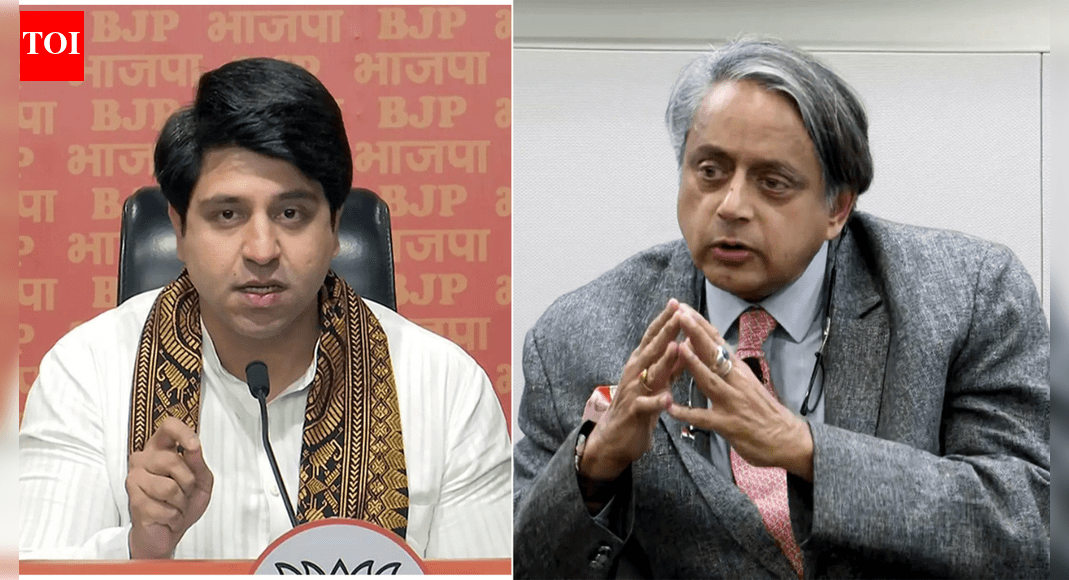
Against this backdrop, BJP spokesperson Shehzad Poonawalla strategically escalated the attack on Saturday, directly accusing Rahul Gandhi of placing “family interests above national interest.” Poonawalla’s central tactic involved citing Congress MP Shashi Tharoor’s past remarks to validate his critique of the opposition. He quoted Tharoor: “Foreign policy is not of the BJP or Congress, but of India. If someone in politics rejoices at the defeat of a Prime Minister, they are celebrating the defeat of India.” Poonawalla then used this statement to directly accuse Rahul Gandhi, stating, “Sadly Rahul Gandhi puts parivarik interest above India’s interest. In his hatred for BJP — he hates India.” This is not an isolated incident; Poonawalla had previously hailed Tharoor as a “Khatron ke Khiladi” for an “insightful” article criticizing dynastic politics, demonstrating a recurring strategy by the BJP to leverage perceived internal dissent within the Congress. This approach seeks to frame the Congress’s critique of the government’s national security actions not as legitimate opposition, but as an act contrary to national interest, fueled by partisan animosity. The deployment of an opposition leader’s own words against a party figurehead represents a potent rhetorical tool in the arena of India Politics, aiming to undermine credibility and foster internal division.
The politicization of national security matters is not new to India’s political discourse, with debates around operations like Kargil and the surgical strikes having seen similar levels of partisan contention. This current episode with Operation Sindoor exemplifies a recurring challenge for governments and opposition parties alike. From the BJP’s perspective, this stance allows them to project an image of unwavering commitment to national interest, while simultaneously casting doubt on the opposition’s credentials on matters of defense and foreign policy. It is a strategic move to rally public support around the government’s actions and discredit dissent as unpatriotic. For the Congress, navigating such accusations proves difficult; asserting the constitutional right to question government actions risks being painted as anti-national, while remaining silent could be seen as abdicating its role as a vigilant opposition. The statements from Chavan and Gandhi, perceived as questioning military efficacy or alleging external pressure, provided the BJP with significant leverage to craft this narrative. This dynamic also has implications for the defense establishment, as persistent political bickering over military operations, regardless of its merit, can potentially impact public trust and even perception of morale, although the military itself typically remains apolitical. The widespread reach of social media further amplifies these political narratives, allowing claims and counter-claims to proliferate rapidly and shape public opinion in real-time.
For News Readers, this ongoing controversy underscores the critical need for discerning between factual reporting and political rhetoric, particularly when national security is invoked. Understanding the motivations behind such statements—whether to genuinely hold power accountable or to score political points—becomes paramount. Policy Watchers and Political Analysts gain insight into the strategic communication tactics employed by major parties. The BJP’s consistent use of Tharoor’s remarks, for instance, highlights a sophisticated approach to exploiting internal party narratives to its advantage, impacting inter-party dynamics and potentially influencing future policy debates around defense spending or foreign relations. For Informed Citizens, the debate serves as a stark reminder of the challenges in fostering a bipartisan consensus on critical national issues, where political scrutiny can easily morph into accusations of disloyalty. This ongoing friction risks a further erosion of trust in the political discourse and complicates the public’s ability to form objective opinions on government actions. Going forward, key metrics to monitor include any further clarifications or retractions from Congress leaders, the BJP’s continued deployment of this narrative in upcoming political campaigns, and the broader public’s reaction to these accusations as seen in media coverage and, if available, future political surveys. This episode cements the reality that national security matters in India remain fertile ground for intense political contestation, presenting an enduring challenge for all stakeholders.
About the Author