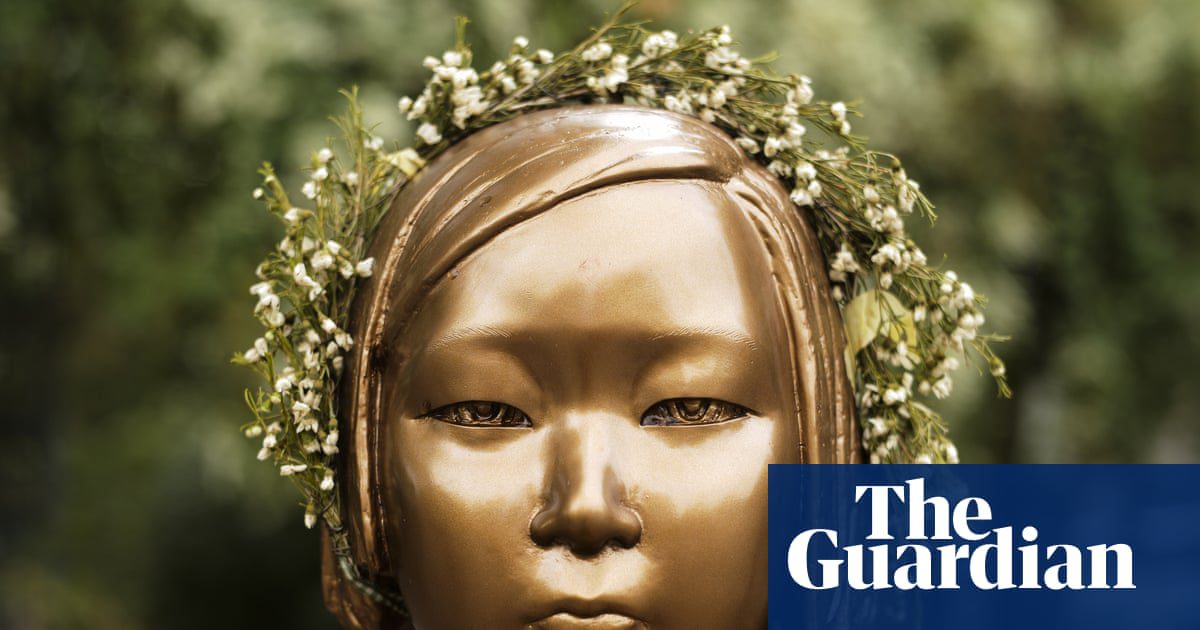
New Zealand officials rejected on Wednesday an application to install a statue commemorating so-called “comfort women” enslaved by Japan before and during the second world war after Tokyo suggested it could harm diplomatic relations.
Japan forced up to 200,000 women from Korea, China and south-east Asia into sexual slavery from 1932 until 1945 and the issue remains a sore point in Tokyo’s relations with its neighbours.
The Korean Garden Trust had sought to install a statue honouring the survivors at Barry’s Point reserve in the Auckland suburb of Takapuna.
But after public consultation the local council declined an application to install the statue.
“This was a difficult decision, and one we did not make lightly,” the council’s board chair Trish Deans said.
“We carefully considered staff advice and the feedback received from the community through a formal consultation process.”
Among the submissions was a letter from the Japanese ambassador to New Zealand, Makoto Osawa, which claimed it could “cause division and conflict within New Zealand’s wonderful multi-ethnic and multicultural society and between Japanese and Korean communities”.
Wellington’s Ministry of Foreign Affairs and Trade said the Japanese government had made “formal representations” about the proposed statue.
Deans said many submitters had supported the statue as an opportunity to learn and reflect on what happened during the war. “We recognise the significance of the history the statue represents, and we acknowledge the survivors whose stories it seeks to honour.”
Some historians say as many as 200,000 women – mostly from Korea, but also China, south-east Asian, as well as a small number from Japan and Europe – were forced or tricked into working in military brothels between 1932 and 1945. They were euphemistically referred to as “comfort women” – a term Japan continues to use, despite survivors having taken issue with the label.
The women were forced to have sex with Japanese soldiers in frontline, makeshift brothels. According to testimony from surviving women, they were forced to have sex with 10 to 30 men a day. Forced abortions were commonplace.
The relationship between Japan and South Korea has become strained since the first survivor went public with her story in the early 1990s. The first “peace statue” honouring the women was erected in Seoul in 2011. Since then dozens more have been erected overseas, prompting Japan to call for their removal.
In 2018, Osaka ended its 60-year “sister city” relationship with San Francisco after the city agreed to recognise a similar statue. In 2020, Japan reacted angrily to statues in South Korea that appeared to depict the former Japanese prime minister, Shinzo Abe, prostrating himself before a young woman. In 2025, a peace statue was removed from Berlin, after a years-long dispute.
Japan insists the “comfort women” issue was settled “finally and irreversibly” by a 2015 agreement reached by Abe – who agreed to provide 1bn yen (US$9m) in “humanitarian” funds to a foundation set up to support the survivors – and then-South Korean president Park Geun-hye, who agreed not to raise the issue in international forums.
Park’s liberal successor, Moon Jae-in, effectively dissolved the fund in 2018, saying it did not take into account the feelings of survivors and the South Korean public.
Successive Japanese administrations have refused to provide official recompense, insisting that all compensation claims were settled under a 1965 bilateral peace treaty.
The proposal for Auckland’s statue received 672 submissions, with 51% of individuals strongly opposing it, and 13 out of 21 organisations also against it, according to the council.
With Agency France-Presse
Source: https://www.theguardian.com/world/2026/apr/29/new-zealand-japanese-comfort-women-statue
About the Author