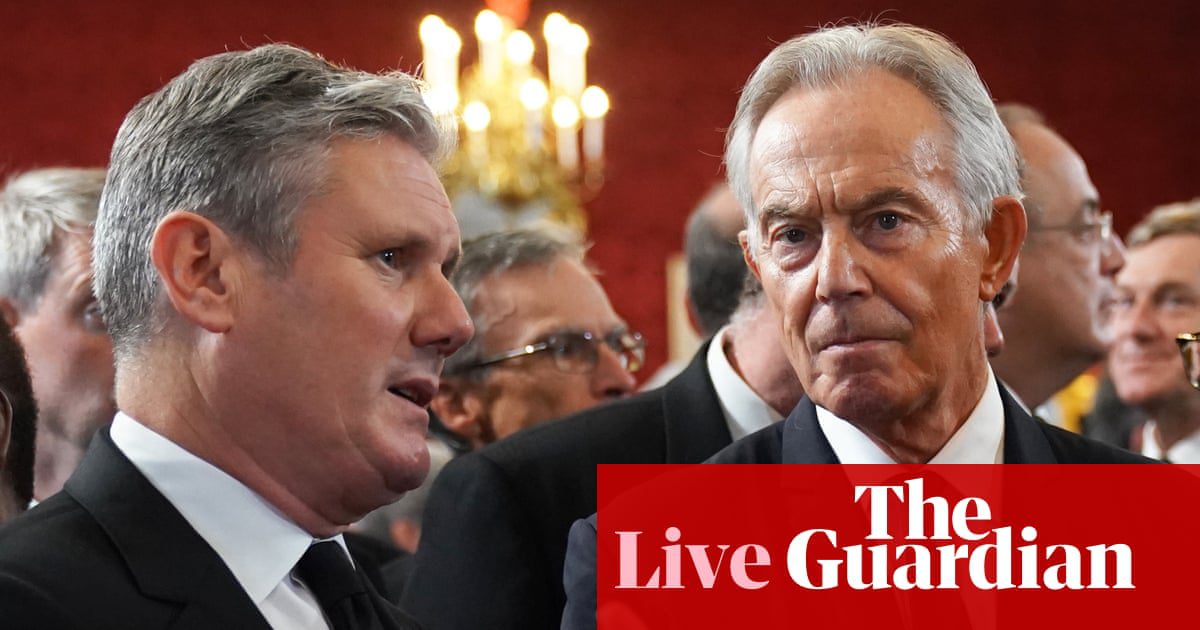
Starmer say he thinks ‘much’ of what Blair had to say about his record yesterday was wrong
Keir Starmer has said that “much” of what Tony Blair said in his 5,700-word essay yesterday criticising the record of the government was wrong.
During a visit to a train depot in west London, Starmer was asked by a reporter how he felt about being criticised by Labour’s most successful prime minister.
Starmer started with a compliment for his predecessor.
Let me start with where I agree with Tony Blair.
I agree with him, that we should be having a discussion about policy and ideas, and that’s what generates politics. That’s where the focus should be. So Tony is right about that.
But then Starmer, who seemed to be enjoying the chance to hit back, then went on to say he thought Blair was mostly wrong. He said:
You won’t be surprised to know that I don’t agree with much what Tony says about what the government is doing.
We can all argue about individual policies, but the real question is, what’s the change, what’s the difference that is happening in a country we inherited two years ago in a very poor place?
We put the policy in place to stabilise the economy and make sure that it grew so wealth was created in every part of the country.
Because of our policy choices, that is happening.
Starmer then launched into a long defence of his record.
We took policy choices that we needed better public services. They were on their knees when we inherited them.
We took policy choices that we would invest in those public services, that we would introduce new technologies, particularly in the NHS. As a result, waiting lists are coming down with the biggest drop for 17 years actually recorded just two weeks ago. So [we took] the right policy choices there.
We also had to address the question of how do we get migration down without affecting economic growth, which is a difficult balance. Again, we took our policy choices and you see the growth figures are up and the migration figures are down, which tells you the change that we brought about in two short years.
And then on the international stage, which is obviously hugely important at such a volatile time, we have in two short years rebuilt our relationship with many countries, particularly in the EU – we’re now a trusted colleague, an ally of our EU partners – but at the same time as maintaining our relationship with the US. And so many people said that wouldn’t be possible.
So actually, my response to Tony is, yes, it’s right to talk about policy, it’s right to talk about ideas, that’s where the debate should be.
But actually, I don’t agree that the policy choices of this government weren’t the right policy choice given what we inherited – very different situation in 2024 to 1997.
And, dealing with what we had to turn around, the policy choices, we’re vindicated by them because those changes have happened.

Key events
-
Implementation of Brexit ‘little short of disaster’, says former cabinet secretary Simon Case
-
Burnham steps back from past calls to end immigration benefits restriction
-
Starmer indicates he would fight any leadership challenge this summer, saying he won’t ‘walk away’
-
Starmer say he thinks ‘much’ of what Blair had to say about his record yesterday was wrong
-
Swinney accused of trying to ‘shut down scrutiny’ as he rejects call for inquiry into Peter Murrell’s embezzlement of SNP funds
-
Brexit rules on food exports to be scrapped, government confirms
-
4 charts from Milburn’s report on Neets showing why he says crisis getting worse
-
A record of failure’: what’s in the first part of Milburn’s Neets report?
-
Scottish Greens urge Swinney to tax wealth instead of axing jobs at first FMQs since election
-
Badenoch criticises British Museum for delaying Jewish event over protest fears
-
UK risks £125bn hit a year from youth unemployment, landmark report says
-
Milburn says employers need ‘new deal’ to help encourage them to hire more young Britons as immigration falls
-
Milburn says UK should learn from Netherlands, where further education system much better and Neet rates much lower
-
Milburn says Ofsted system needs to change so schools incentivised to stop pupils becoming Neets
-
Milburn says migrants not to blame for Neets crisis – but falling immigration creates ‘opportunity’ to help solve problem
-
Milburn says welfare system failing to help get young people into work
-
Milburn says he would like to see benefits spending fall, but via getting more people into jobs not via ‘arbitrary’ cuts
-
Milburn says he’s not interested in blame game, and wants to focus on solutions
-
Milburn warns ‘bad things’ will happen if people conclude politics can’t solve problems like Neet crisis
-
Milburn says Labour policies have not helped jobs situation for Neets – but stresses problem goes back much longer
-
Milburn says ‘great British promise’, that each generation does better than last, ‘is being broken’
-
Milburn says Neet crisis ‘a moral one’, as well as financial, costing Neets £300,000 over their lifetime
-
Neet rate could rise to 1 in 6, says Milburn, as he warns detachment ‘becoming permanent’ for young people
-
Milburn opens press conference saying Neet crisis ‘probably most significant crisis facing country today’
-
Zack Polanski says media scrutiny he gets is ‘incredibly disproportionate’ compared to attention given to Nigel Farage
-
Milburn suggests he favours ban on social media for under-16s
-
More than one million young people not in education, employment or training, ONS says
-
Mitigating Mandelson risks would have been impossible, says former MI6 chief
-
Britain ‘sleepwalking into a food crisis’ without urgent action, experts say
-
Streeting criticises Blair for wanting to leave too much power in hands of markets
-
Minimum wage rise has made it difficult for employers to hire young people, says Alan Milburn
Implementation of Brexit ‘little short of disaster’, says former cabinet secretary Simon Case
Simon Case, the former cabinet secretary, has described the implementation of Brexit as “little short of a disaster”.
That may sound like a statement of the obvious. But given that Case was cabinet secretary while that process was happening, and that ex-civil servants are normally quite reticent about expressing strong political views, it is interesting that he has chosen to speak out this bluntly.
Case delivers the assessment in an essay he has written for The Brexit Effect 2016-2026, a new book being published to mark the 10th anniversary next month of the vote to leave the EU. Edited by the political historian Anthony Seldon, it is a collection of 36 essays written by politicians, officials and academics, from all sides of the Brexit debate.
Case became cabinet secretary in September 2020, when the UK was still negotiating its post-Brexit trade deal with the EU, and stayed until December 2024. He starts his essay with a quote from Lenin saying a revolution “teaches an entire people very rich and valuable lessons”, and he concludes it saying:
Lenin was certainly right in that the UK learnt some rich and valuable lessons from its Brexit revolution. In its implementation, it has been little short of a disaster. The opportunities, as leave supporters would argue, have been left largely unexplored, and the last decade has been a repeated series of efforts focused on the mitigation of the perceived negative consequences. Elsewhere, when revolutionaries fail to take control of the seat of power, the radio station and the airfield, their revolutions are usually very short-lived. Those leading the Brexit revolution have never taken control of all of the key institutions of power in the UK – it took three years to deliver a leave prime minister, and parliament has yet to see a leave majority. Whitehall has never been given clear and consistent instructions that an alternative vision of the country’s future is to be pursued. Whilst the constitutional change has been completed, the vision has never been defined and implemented. The revolution has failed.
This is not a book that tries to come to an overall, considered verdict on Brexit, but it is full of wise and sensible contributions. It is not a light read, though, and if you want more Brexit, and are looking for something a bit more entertaining, do try No Second Chances, a recent book by Morgan Jones about the people who campaigned for a second Brexit referendum. In the Seldon book, the arch-Brexiteer Douglas Carswell says: “Sometimes those most committed to a cause are not its best advocates.” He is making a point about Eurosceptics, but Jones’s book, which is short and fun, is largely about how this was also true of the blue beret brigade obsessives and idealists who tried to get Brexit overturned. Politics books are normally about MPs or advisers. But activists matter too and this is a respectful and illuminating book about a group of players in the political ecosystem who deserve a bit more attention than they’ve had. After all, when Britons remember 2016, Steve Bray, ‘Mr Stop Brexit’ (who merits a whole chapter in the Jones book), will live in the memory long after we’ve forgotten the details of the Grieve amendment.
Burnham steps back from past calls to end immigration benefits restriction
Andy Burnham has rolled back from his previous calls for ministers to scrap a restriction on immigrants claiming benefits as the Makerfield byelection places greater scrutiny on his policy positions, Peter Walker reports.
John Crace has filed his political sketch. He has had a go at writing the campaign diary of Robert Kenyon, the Reform UK candidate in Makerfield.
Starmer indicates he would fight any leadership challenge this summer, saying he won’t ‘walk away’
In his pooled interview for broadcasters, Keir Starmer was also asked if he would be a candidate in the event of a leadership contest this summer.
Using the line he has used before, he indicated that he would, saying he “would not walk away”.
He replied:
I‘ve said many times that, I was elected, we were elected, on a mandate of change in 2024. I’m not going to walk away from that because of the great change that we’ve brought about already …
So there’s a lot more to do. And as I’ve said a number of times, I’m not walking away from the responsibility that was invested in me. People invested in me the responsibility to get on and govern. And I think the vast majority of people want us politicians to get on with the job they elected us to do, which is get on, run the country and improve their lives. And that’s what I’ll do.
Given that polling of Labour party members suggests Andy Burnham would beat Starmer quite easily in a leadership election, many MPs believe that, notwithstanding what Starmer is saying now, if Burnham does return to parliament, Starmer would not want to fight what would be a bitter contest. There is an assumption that instead he would agree a timetable to stand down in the autumn, or even early next year.
But no one actually knows and, if there is a plan, it’s a secret. It is more probable that Starmer is putting off a decision until after the byelection. A lot will depend on Burnham’s standing with Labour MPs at that point.
Starmer say he thinks ‘much’ of what Blair had to say about his record yesterday was wrong
Keir Starmer has said that “much” of what Tony Blair said in his 5,700-word essay yesterday criticising the record of the government was wrong.
During a visit to a train depot in west London, Starmer was asked by a reporter how he felt about being criticised by Labour’s most successful prime minister.
Starmer started with a compliment for his predecessor.
Let me start with where I agree with Tony Blair.
I agree with him, that we should be having a discussion about policy and ideas, and that’s what generates politics. That’s where the focus should be. So Tony is right about that.
But then Starmer, who seemed to be enjoying the chance to hit back, then went on to say he thought Blair was mostly wrong. He said:
You won’t be surprised to know that I don’t agree with much what Tony says about what the government is doing.
We can all argue about individual policies, but the real question is, what’s the change, what’s the difference that is happening in a country we inherited two years ago in a very poor place?
We put the policy in place to stabilise the economy and make sure that it grew so wealth was created in every part of the country.
Because of our policy choices, that is happening.
Starmer then launched into a long defence of his record.
We took policy choices that we needed better public services. They were on their knees when we inherited them.
We took policy choices that we would invest in those public services, that we would introduce new technologies, particularly in the NHS. As a result, waiting lists are coming down with the biggest drop for 17 years actually recorded just two weeks ago. So [we took] the right policy choices there.
We also had to address the question of how do we get migration down without affecting economic growth, which is a difficult balance. Again, we took our policy choices and you see the growth figures are up and the migration figures are down, which tells you the change that we brought about in two short years.
And then on the international stage, which is obviously hugely important at such a volatile time, we have in two short years rebuilt our relationship with many countries, particularly in the EU – we’re now a trusted colleague, an ally of our EU partners – but at the same time as maintaining our relationship with the US. And so many people said that wouldn’t be possible.
So actually, my response to Tony is, yes, it’s right to talk about policy, it’s right to talk about ideas, that’s where the debate should be.
But actually, I don’t agree that the policy choices of this government weren’t the right policy choice given what we inherited – very different situation in 2024 to 1997.
And, dealing with what we had to turn around, the policy choices, we’re vindicated by them because those changes have happened.
Swinney accused of trying to ‘shut down scrutiny’ as he rejects call for inquiry into Peter Murrell’s embezzlement of SNP funds
John Swinney has been accused of “trying to shut down scrutiny” as he again rejected calls for a Holyrood inquiry to be established into Peter Murrell’s crimes, the Press Association reports. PA says:
The former SNP chief executive – and estranged husband of Nicola Sturgeon – this week pleaded guilty to embezzling more than £400,000 from the party.
The issue was raised at first minister’s questions, with Scottish Labour leader Anas Sarwar alleging Swinney – who appointed Murrell in his first stint as SNP leader – had “helped build” a culture in the party that enabled the crime.
Swinney dismissed that as “victim blaming”, adding that Sarwar should be “ashamed of himself”.
But the Scottish Labour leader insisted a parliamentary inquiry was now needed because “secrecy and cover-up go far beyond one individual or one case”.
Sarwar said: “At its heart is an SNP culture where secrecy became normal, dissent dangerous and people learned that speaking out carried a heavy price. All while those at the top of the SNP machine operated without scrutiny.”
He added that a parliamentary inquiry would not consider criminal behaviour, but would instead “look at the culture, the process of decision-making and lessons for the future”.
The Scottish Labour leader insisted it would “answer the many questions that the public have.
But Swinney told him he did not support a parliamentary inquiry, telling MSPs: “We have just had a police investigation which has gone on for five years and that police investigation has identified criminality as the source of this particular issue, and that is now being remedied.
“So, I don’t think there is anything a parliamentary inquiry can add to a five-year forensic police investigation that has resulted in the successful prosecution of an individual and his guilty plea.”
The SNP leader added: “What I would rather do is concentrate on the priorities of the people of Scotland, as I always do.”
Speaking to reporters after FMQs, Swinney said he did not believe Murrell had embezzled public funds.
He said: “I’m satisfied that we’ve gone through all of the accounting processes that are required to secure that money, which is validated by external bodies.”
Asked if Murrell could have falsified receipts and invoices to steal public funds, Mr Swinney added: “I’m satisfied that that has not been the case.”
The first minister was also asked which checks Ms Sturgeon had made when she previously gave assurances that there were no issues with the party’s finances.
He said: “I don’t know all of the conversations that took place but at the heart of this case is a very simple point: there was a betrayal of trust.”
Brexit rules on food exports to be scrapped, government confirms
Brexit rules affecting UK food exports to the EU, including fresh sausages and burgers, will be scrapped from mid-2027 in the first confirmed result of Keir Starmer’s “reset” negotiations with Brussels, Lisa O’Carroll reports.
Asked about the Guardian’s story, the EU spokesperson on EU-UK relations, Balazs Ujvari, claimed that the negotiations had yet to be finalised. “On the SPS, of course there have been negotiations going on for quite a while, and to my knowledge these negotiations are still ongoing, and of course will not be commenting on them as long as they are not fully completed,” he said.
4 charts from Milburn’s report on Neets showing why he says crisis getting worse
Here are four charts from Alan Milburn’s report on Neets that illustrate why he says the crisis is getting worse.
1) How UK’s youth Neet rate is getting worse compared to other European countries
The report says:
The UK now sits above the average youth Neet rate for high-income countries, the EU and the OECD. In 2025 the EU average for 15 to 24-year-olds was 9%, compared with 12.8% for 16- to 24-year-olds in the UK at the end of 2025. The gap is no longer just with the strongest performers. In 2014, the UK was around the European average. By 2025, only Romania recorded a higher rate.
2) How Neet rates are going up by gender
In the past young women were more likely to be Neet than young men, but that has changed. The report says:
In 2012, the UK female Neet rate exceeded the male rate by 1.8 percentage points. By 2024 males were 2.9 points higher, at 14.3% compared with 11.4%. The improvement for women reflects, in significant part, the decline in teenage pregnancy, with the under-18 conception rate in England and Wales falling 66% between 2007 and 2022.
3) How disability rates are rising for Neets, and for all young people
The report says:
In 2024/25, nearly half of young people who are Neet in the UK, 45%, report having a disability – more than doubling from 21.1% in 2013/14. Disability prevalence among all 16- to 24-year-olds has also doubled, from 10% to 19.7% over the last ten years. Young people considered to have special educational needs or disabilities (Send) are around 80% more likely to be Neet than average.
4) Proportion of Neets with particular health conditions
A record of failure’: what’s in the first part of Milburn’s Neets report?
Here is Peter Walker’s guide to what is in Alan Milburn’s report on Neets out today.
Scottish Greens urge Swinney to tax wealth instead of axing jobs at first FMQs since election
John Swinney should tax the wealthy in Scotland instead of axing public sector jobs, the Scottish Greens have said. Co-leader Gillian Mackay warned the government’s focus on “public sector reform” would likely mean slashing budgets and cutting jobs, the Press Association reports. PA says:
Speaking during the inaugural first minister’s questions since the election, Mackay urged the first minister to agree to a bigger rollout of a four-day work week for public workers.
She also called on the SNP leader to work with her party to reform council tax – something long promised but not delivered by the SNP.
Mackay said: “We know public sector reform is badly needed, but trade unions in particular are rightly concerned that reform is usually a euphemism for slashing budgets and cutting jobs.”
Mackay said more money had to be raised from the “super rich” in Scotland and urged the first minister to “explore all options for taxing wealth before cutting public sector jobs”.
She asked the FM to back calls from Tax Justice Scotland to replace council tax by 2031 “at the latest”.
The group, which brings together more than 50 organisations campaigning for tax reforms, also wants the Scottish government to make faster progress on introducing a new levy on private jets.
It made the demands in an open letter to the first minister, with campaigners arguing “bold steps towards tax justice” could help provide funds to reduce inequality, invest in public services and tackle climate change.
Swinney said he was open to reforming or even abolishing council tax in Scotland but the government had to have “reliable means” in place to fund public services.
On reform, the first minister said while he understood concerns from trade unions, Scotland had “to be open to new ways of delivering public services”, saying Holyrood had to be a “bold” parliament.
He said Ivan McKee, public service reform secretary, would look to improve public services while making the government’s finances more sustainable, suggesting services could be delivered better while costing less.
He added: “Of course, without a majority in this parliament, the government is going to have to work with others to come to common positions, and I look forward to taking those discussions forward with many colleagues across the political spectrum.”
Source: https://www.theguardian.com/politics/live/2026/may/28/alan-milburn-neets-review-labour-youth-unemployment-uk-politics-live-latest-news
About the Author