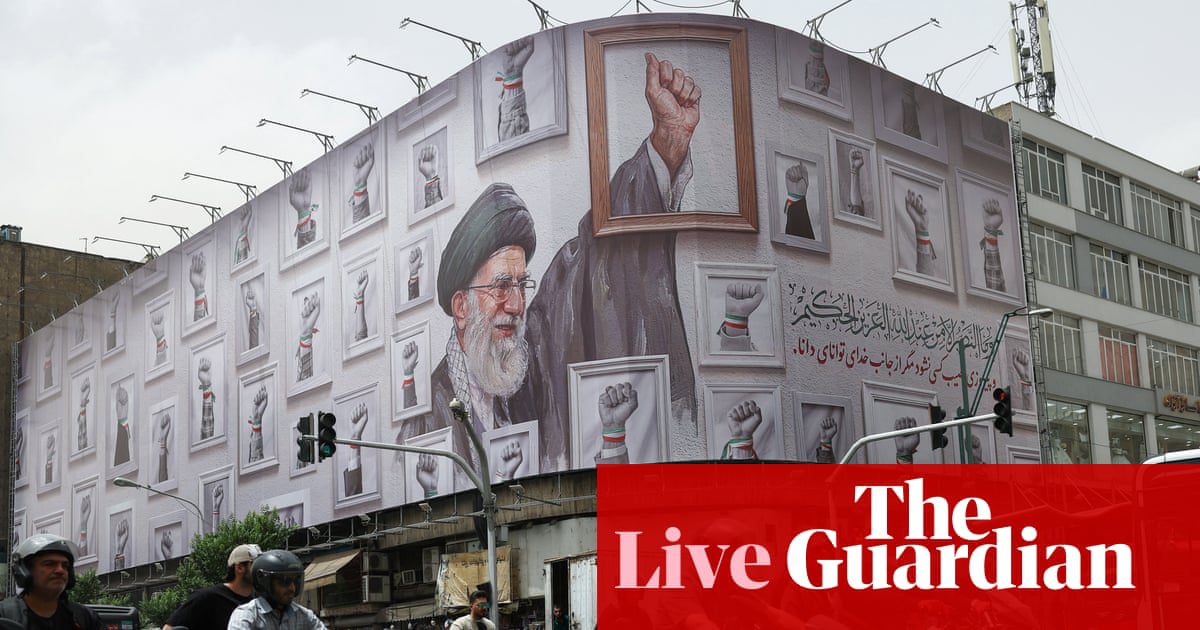
IRGC warns renewed war could extend beyond Middle East
Iran’s Islamic Revolutionary Guard Corps (IRGC) has threatened to extend a renewed war beyond the Middle East if the US resumes attacks against Tehran.
The warning came after Donald Trump threatened to strike Iran again if it did not accept a deal to end the conflict.
In a statement carried by the semi-official Tasnim news agency in Iran, the IRGC said: “Should aggression against Iran be repeated, the regional war that was promised will this time extend beyond the region, and our crushing blows in places you can scarcely imagine will reduce you to ashes.”
The warning comes after US president Donald Trump said Washington could strike Iran again if no deal on a lasting settlement is reached in the coming days.
Key events
The Jordanian military announced it had shot down a drone of unknown origin in its airspace on Wednesday, AFP reports.
No casualties were reported.
“This morning, the Jordanian Armed Forces engaged with a drone of unknown origin that entered Jordanian airspace and was brought down in Jerash Governorate, without any injuries,” the military said of an area located around 50 kilometres (30 miles) north of the capital Amman.
Pakistan’s interior minister heading to Tehran for talks
Mohsin Naqvi, Pakistan’s interior minister, is on his way to Tehran to meet officials, Iran’s Tasnim news agency is reporting.
This will be the second trip to Tehran in a week for Naqvi, as Islamabad continues to lead mediation efforts between Washington and Tehran.
The defacto blockade in the strait of Hormuz is having a knock on effect in Europe where it was today announced that the UK has relaxed strict sanctions on Russian crude due to soaring oil costs.
The relaxed sanctions will allow for the import of jet fuel and diesel refined in third countries amid surging costs.
A trade licence that came into effect on Wednesday permits the imports indefinitely and will be reviewed periodically. It comes at a time of growing concerns over the supply of certain fuels owing to the de facto blockade of the strait of Hormuz since the start of the US-Israeli war with Iran.
For years the UK has led international efforts to put economic pressure on Russia over its war on Ukraine. On Tuesday it signed a G7 statement reaffirming its “unwavering commitment” to imposing “severe costs” on Russia. It had previously announced it would block Russian oil refined in other countries to “further restrict the flow of funds to the Kremlin”.
This week the US treasury secretary, Scott Bessent, extended a 30-day sanctions waiver allowing the purchase of Russian oil shipments already at sea, saying in a post on X that the extension would “provide additional flexibility, and we will work with these nations to provide specific licences as needed”.
New figures show petrol prices have eclipsed the high set during the Iran oil crisis. Relaxing sanctions will allow imports of jet fuel from India, which was previously a key supplier to the UK and Europe. Russian crude is also refined in big quantities in Turkey.
Full story here:
Israeli warplanes have struck the Lebanese town of Jibchit overnight, despite an ongoing fragile ceasefire, the country’s state news agency has said.
An additional strike reportedly targeted the vicinity of an international school in Habboush, it said.
Israeli aircraft also struck the town of Kherbet Silem earlier today, while two separate raids targeted Kfara in Bint Jbeil district.
National News Agency (NNA) said another Israeli airstrike hit a house in the town of Toura, though no casualties were reported.
Israeli airstrikes on southern Lebanon on Tuesday killed at least 19 people, including four women and three children, Lebanon’s health ministry said, the latest in near-daily attacks from both sides that have not stopped despite a fragile, US-brokered ceasefire.
Israel’s military did not immediately comment on the casualties or specific incidents, but said that between Monday afternoon and Tuesday afternoon, it had targeted more than 25 sites of Hezbollah infrastructure in southern Lebanon.
In the latest of our On the ground series, which highlights in-depth Guardian video journalism from around the world, we have a video on Lebanon.
The Guardian travels across Lebanon to find out how the conflict is widening divisions and affecting life across the country.
Watch here:
Meanwhile, in Israel, the Knesset (Israeli parliament) is due to vote on a bill to dissolve itself, potentially triggering earlier elections which polls predict prime minister Benjamin Netanyahu will lose.
The last election was in November 2022 and the next ballot is due at the latest on 27 October. If lawmakers vote to dissolve the Knesset, elections must be held within five months of the vote passing. Political pundits in Israel say elections could happen in the first half of September.
‘Comprehensive ceasefire is of utmost urgency,’ says Xi
The Chinese president, Xi Jinping, has held talks with Russia’s Vladimir Putin in Beijing today, where the leaders discussed conflict in the Middle East.
Russia has sought to cash in on the global energy crisis and soaring gas prices triggered by the Iran war and the effective closure of the strait of Hormuz.
Russia’s foreign minister, Sergei Lavrov, said in April after a meeting with Xi that Moscow could “compensate” for China’s energy shortages, but Beijing has publicly called for an end to hostilities.
“A comprehensive ceasefire is of utmost urgency, resuming hostilities is even more inadvisable and maintaining negotiations is particularly important,” Xi told Putin during talks today, according to Chinese state media.
Putin highlighted the economic ties between Russia and China, saying: “The driving force behind economic cooperation is Russian-Chinese collaboration in the energy sector.
“Amid the crisis in the Middle East, Russia continues to maintain its role as a reliable supplier of resources, while China remains a responsible consumer of these resources.”
IRGC warns renewed war could extend beyond Middle East
Iran’s Islamic Revolutionary Guard Corps (IRGC) has threatened to extend a renewed war beyond the Middle East if the US resumes attacks against Tehran.
The warning came after Donald Trump threatened to strike Iran again if it did not accept a deal to end the conflict.
In a statement carried by the semi-official Tasnim news agency in Iran, the IRGC said: “Should aggression against Iran be repeated, the regional war that was promised will this time extend beyond the region, and our crushing blows in places you can scarcely imagine will reduce you to ashes.”
The warning comes after US president Donald Trump said Washington could strike Iran again if no deal on a lasting settlement is reached in the coming days.
A South Korean oil tanker is passing through the strait of Hormuz, marking the first such case involving a Korea-managed ship since the Iran war began.
“Consultations with Iranian authorities were completed, and the vessel began sailing yesterday. It is passing through the strait very cautiously,” South Korea’s foreign minister, Cho Hyun, said, according to the Seoul-based Yonhap news agency.
He added that the vessel was carrying 2m barrels of crude oil.
Yonhap reported that the tanker began sailing in waters near Qatar yesterday after receiving passage approval from Iran a day earlier. Citing officials, the news agency said no transit fees were paid to Iran for the safe transit of the vessel.
The passage came nearly two weeks after the South Korean-operated HMM Namu was struck by “two unidentified aircraft” in the strait, causing a fire and leaving one of the vessel’s 24 crew members with minor injuries.
The Panama-flagged cargo vessel, operated by South Korean shipping firm HMM Co, arrived in Dubai after the incident for investigation.
Iran has denied responsibility, with its embassy in Seoul saying it “firmly rejects and categorically denies any allegations regarding the involvement” of its forces. Seoul strongly condemned the attack and said it hoped to identify those behind it through an investigation.
Opening summary: US and Iran trade threats
Welcome to our live coverage of events in the Middle East.
Donald Trump warned the US may strike Iran again – a day after he said he had held off a major assault in hopes of a peace deal – but Tehran’s army threatened to open “new fronts” if he went ahead.
Trump told reporters at the White House that he had been just “an hour away” from relaunching Washington’s attacks on Iran before postponing the order, after weeks of a fragile ceasefire and talks to end the war, which began on 28 February.
The decision apparently followed a further peace proposal submitted by Tehran via Pakistan, which has mediated, and may have been motivated by the reluctance of allies, including Saudi Arabia, Qatar and the United Arab Emirates, to see hostilities resume.
“You know how it is to negotiate with a country where you’re beating them badly. They come to the table, they’re begging to make a deal,” Trump said. “I hope we don’t have to do the war, but we may have to give them another big hit. I’m not sure yet.”
Oil prices eased on the apparent positive signals from the White House, with Brent crude falling to $110 a barrel, before regaining much of its losses.
In response to Trump, Iran’s army spokesperson Mohammad Akraminia warned the Islamic republic would “open new fronts against” the US if it resumed its attacks.
He added that Iran’s military had used the ceasefire as an opportunity “to strengthen its combat capabilities”.
Here are the other main developments:
-
The US Senate has advanced a war-powers resolution that would end the Iran war unless Trump obtains Congress’ authorisation. The vote on a procedural measure to advance the resolution was 50 to 47, as four of Trump’s fellow Republicans voted with every Democrat but one in favour. Three Republicans missed the vote.
-
The Israeli military launched a series of strikes across Lebanon, killing 19 people, according to the Lebanese health ministry. One strike, in the town of Deir Qanun al-Nahr in the Tyre district, killed 10 people including three children and three women, the ministry said.
-
The Israeli army in turn said that it intercepted a drone fired from Lebanon. Israel and Lebanon’s central government have twice extended a US-brokered ceasefire, but Israel says it does not apply to its attacks on Hezbollah.
-
Israeli authorities said 430 activists aboard a Gaza-bound aid flotilla were taken to Israel after their vessels were intercepted in international waters near Cyprus. Sailing from Turkey last week, the Global Sumud Flotilla is the latest in a string of attempts by activists to breach Israel’s blockade of the Palestinian territory, with the last convoy intercepted by Israeli forces last month.
-
Russia’s deputy foreign minister, Sergei Ryabkov, said Moscow was ready to help with talks between the US and Iran to end the war, according to the Russian Tass news agency. His remarks came as the Russian president, Vladimir Putin, held talks with Chinese leader Xi Jinping in Beijing.
-
The United Arab Emirates was rattled by a drone attack on its Barakah nuclear power plant last week. On Tuesday the UAE said it originated from Iraqi territory, where Iran backs groups accused of launching attacks on Gulf nations in the war. The UN Security Council on Tuesday condemned the attack. Russia, which often defends Iran, joined the other members.
-
Two Chinese tankers laden with oil exited the strait of Hormuz on Wednesday, according to shipping data.
Source: https://www.theguardian.com/world/live/2026/may/20/us-iran-israel-lebanon-gaza-trump-oil-hormuz-latest-news-updates
About the Author