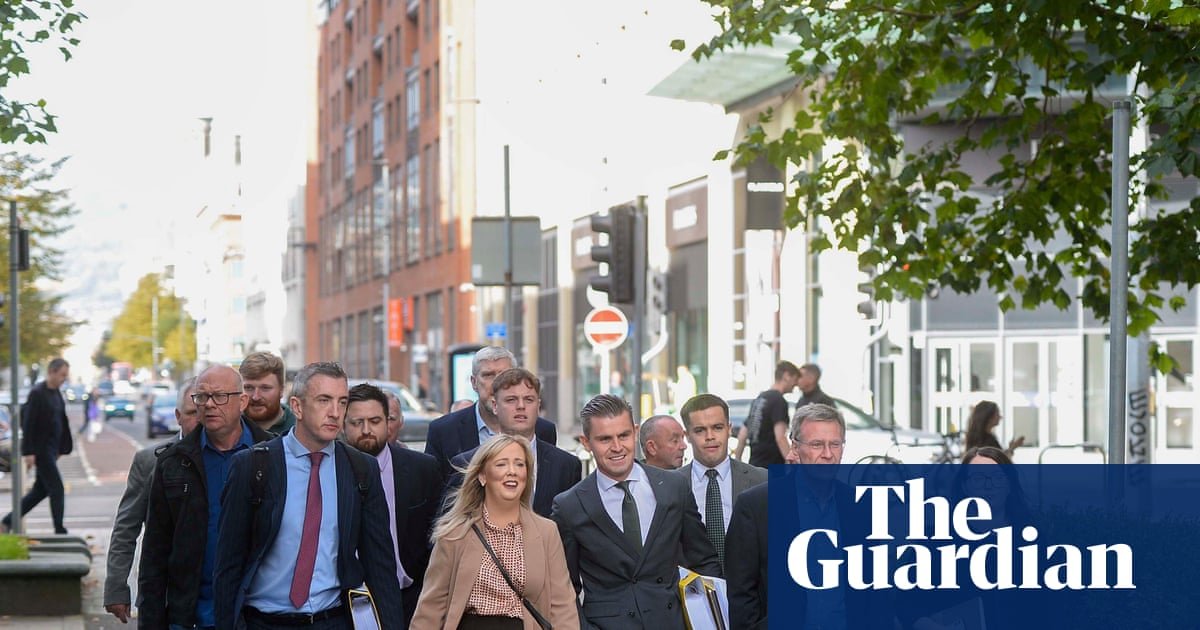
A controversial loyalist parade along a nationalist street in the Northern Ireland town of Portadown has been permitted to go ahead for the first time in nearly 30 years, after a ban was overturned late on Saturday night.
Amid fears the march could unleash fresh sectarian violence, the Orange Order parade down the Garvaghy Roadis due to take place at 8am on Sunday morning, and follows a legal back-and-forth in recent days.
Earlier on Saturday, after a five-hour hearing at a special sitting of the high court, Justice Patricia Smyth issued an order temporarily suspending the parade.
Smyth had urged all sides to “step back from the abyss” and take responsible decisions for “the sake of everyone in Northern Ireland”.
But at 11.30pm on Saturday, at a sitting of the court of appeals, Lady Chief Justice Siobhan Keegan said the high court judge who granted the injunction against the march had “unfortunately erred in law”.
A new application at the high court to stop the Protestant protest from passing through the Catholic area was also dismissed in the early hours of Sunday morning.
The time-limited sitting beginning at 12.20am on Sunday was heard before Justice Michael Humphreys.
He acknowledged the “unusual if not unprecedented circumstances as it is now 1.45am, with a parade scheduled to begin in just over six hours’ time”.
Outlining his decision, Humphreys cited case law that as a public body the courts must respect its judgment and “their decisions will not be lightly interfered with”.
“The picture painted here is of a public body which took evidence from the relevant sources, weighed up the key issues which were in play and arrived at a reasoned decision,” he said.
“The jurisdiction to impugn (a) public body’s decision on that basis is necessarily limited to cases where no reasonable decision could arrive at that outcome and in my view in this case that threshold has not been met.”
The march down Garvaghy Road had been banned for 28 years due to widespread sectarian violence in 1998 outside Drumcree church.
Smyth had warned on Saturday that “this particular long-running dispute has the potential to escalate within Northern Ireland”.
“Be big enough to step back from the abyss,” she had told the parties in court.
Michelle O’Neill, first minister of Northern Ireland, said after the appeal decision late on Saturday: “The decision tonight to overturn the court ruling, and force an unwanted orange march through the Garvaghy Road, is disgraceful.
“This march is steeped in a history of hate, sectarian violence, and murder, and championed by Unionist leaders.
“Our message tonight is clear. There is no going back. Not tomorrow. Not ever. Sinn Féin stands fully with the Garvaghy Road community, and they have the full support of people from right across Ireland in the period ahead.”
The SDLP leader, Claire Hanna, said the parade plan was “provocative”. She told residents she was “so sorry” that some “bad faith actors” were “intent on reopening the hurt and the traumas of the past”.
Fears of clashes increased on Saturday after a request to the commission for permission for a countermarch, a protest that, it was estimated, could be attended by up to 5,000 people, the court heard. That was later revised to 300.
On Friday night, the British prime minister, Andy Burnham, appealed to leaders to “work calmly” through the weekend while the Northern Ireland secretary, Chris Bryant, called for “cool heads”, saying Northern Ireland had “withstood many moments of sharp disagreement over the years” and must do so again.
Before her ruling, Smyth had asked the parties in court, including the Police Service of Northern Ireland and the Parades Commission, to “consider carefully the very important issues to our society” raised in this case, and the importance that they were dealt with properly given the “importance of this case to community relations”.
She also noted that the issues of judicial review were of “such fundamental importance” that it could be unwise to hold a full hearing without all the facts.
The Democratic Unionist MP Carla Lockhart insisted nationalist residents on the road had “nothing to fear” from the march on Sunday, but Sinn Féin leader Mary Lou McDonald described the decision as “utterly reckless”.
The Parades Commission placed a number of restrictions on the procession, including an 8am start and limiting the number of participants to 35 people, but did not impose any restrictions on the route.
Source: https://www.theguardian.com/politics/2026/sep/26/belfast-court-decision-orange-order-march-garvaghy-road
About the Author