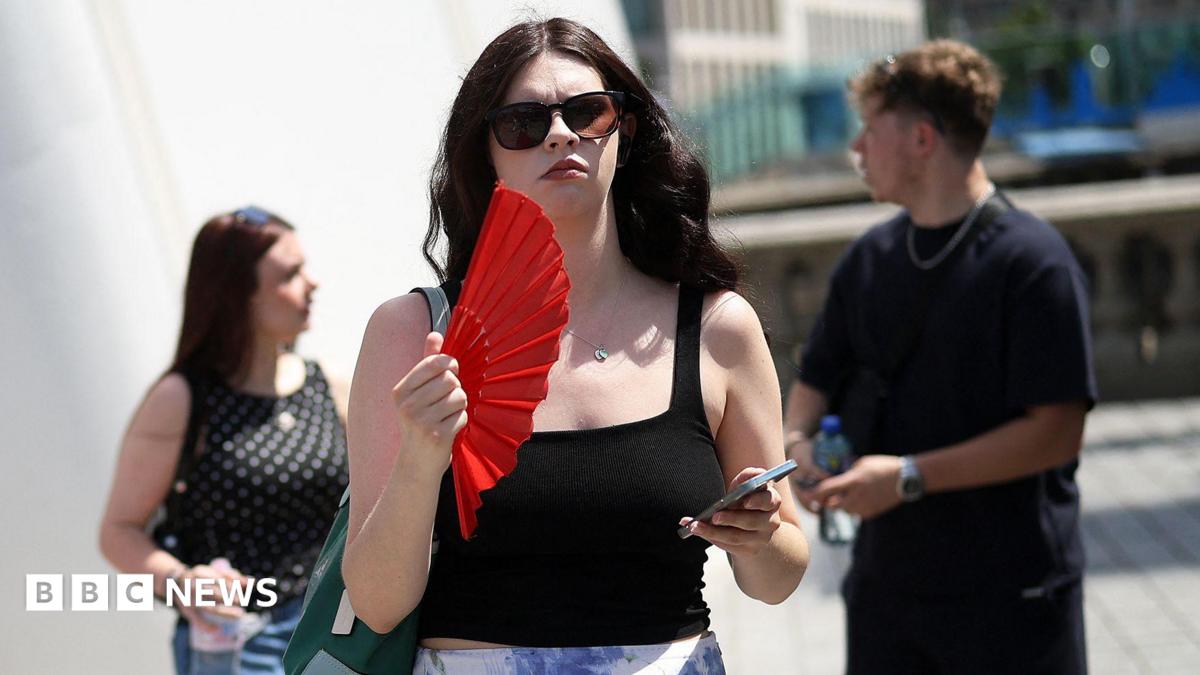
Hundreds of schools have planned for at least partial closures and multiple train operators, including the UK’s largest, have warned people not to travel unless necessary as temperatures climb.
The top temperature recorded on Tuesday was 34.6C in Wisley, Surrey. Northern Ireland and Scotland saw their hottest days of the year, with temperatures reaching 28.1C and 29C respectively, while Wales hit a high of 32.2C.
The heatwave is expected to build, with temperatures forecast to rise to around 37 or 38C in southern England on Wednesday.
A red extreme heat warning has been issued across parts of England and Wales from Wednesday morning to Thursday evening, meaning there is a danger to life.
A rare red extreme heat warning is still expected from 09:00 BST on Wednesday to 21:00 Thursday, meaning there will be an exceptional spell of hot and humid weather in parts of south and central England and south Wales, according to the Met Office.
In southern England, a maximum of 39C on Wednesday is not out of the question.
High humidity levels will make conditions even more uncomfortable – while the air temperature might be 35C, for example, it may feel more like it’s 41C.
The forecaster warns there is a risk of serious illness or danger to life in the impacted areas. Loss of power and other essential services such as water are also likely, due to a greater risk of failure of heat-sensitive systems and equipment.
Significantly more people are likely to visit coastal areas, lakes and rivers, leading to an increased risk of water safety incidents, it says.
The record for the UK’s highest June temperature – 35.6C in 1976 – is likely to be shattered, but maximum temperatures will fall short of the all-time high of 40.3C set in 2022.
The UK had been forecast to experience its hottest June day on Tuesday, but temperatures were around 2C or 3C lower than predicted in south-east England after intense rainfall and flash flooding in some locations overnight.
Overnight temperatures will also remain high this week and some locations will not get cooler than 20C, becoming what is known as a tropical night.
Source: https://www.bbc.co.uk/news/articles/cwyl940y94xo?at_medium=RSS&at_campaign=rss
About the Author