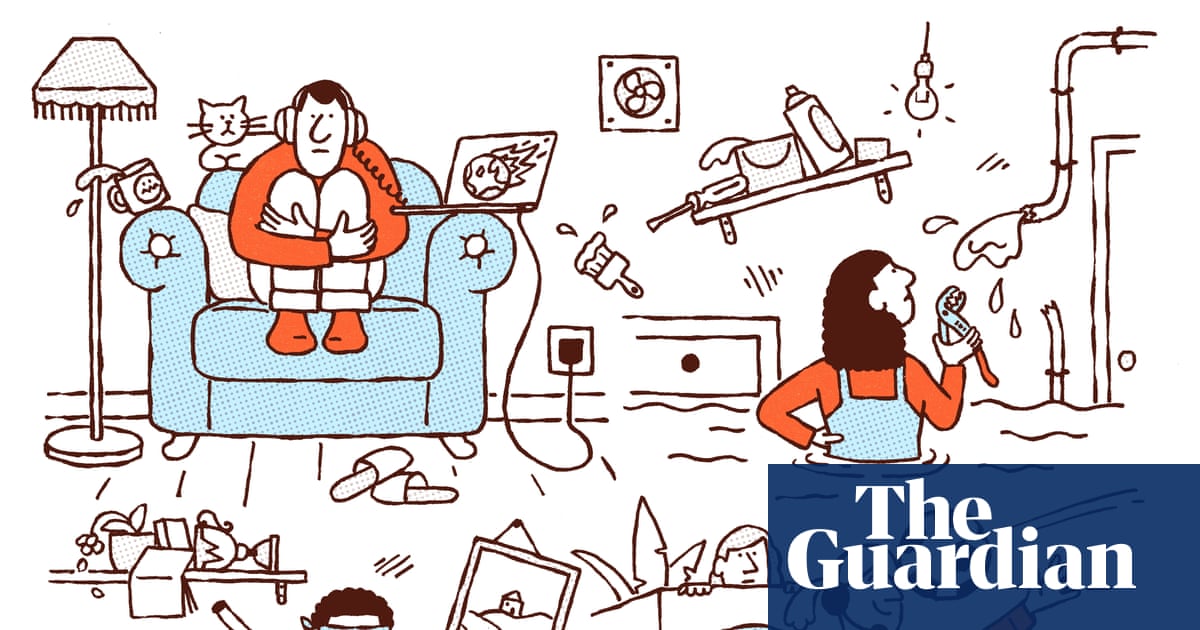
An investigation into what people think about has put the spotlight on the modern mind, revealing thoughts dominated by work, the need for coffee and a strong desire to go back to bed.
It also found evidence for four distinct groups of thinkers who spend more time than most either worrying about the world; mulling on household chores and finances; focusing on the mind and body; or the work-hard, play-hard combination of career and pleasure.
The groups are not definitive and people will move between them, but the finding shows how sampling people’s thoughts at random can provide a nuanced view of human thinking patterns, according to the researchers.
Economists at Claremont Graduate University, in California, and Wuhan University, in Hubei, China, explored people’s conscious thoughts after finding a surprising dearth of work on the topic. “So much of what it means to be human is about what’s going on in our head,” said Dr Joshua Tasoff, a senior author on the study. “The fact that we haven’t really looked at that as economists is really quite extraordinary.”
For the study, 258 volunteers aged 19 to 71 downloaded an app that beeped at eight random times per day for two weeks. On each beep, they were required to write down their thoughts, what they were doing and rate their happiness level.
After gathering more than 23,000 real-time responses, the economists saw that people’s thoughts flowed with the rhythms of the day, steered largely towards work in the day and entertainment in the evening. Roughly half of people’s thoughts were intentional, the rest being intrusive or accidental thoughts from mind wandering or reminders.
Sensory information, including feeling tired and sleepy, and mental impressions, accounted for nearly a fifth of all thoughts. Next came work at 17% and food at 14%. About 10% of thoughts centred on hobbies, games, play and art, with a similar amount focused on relationships.
When thoughts centred on what people wanted, nearly half involved food or drink, especially coffee. This chimed with thoughts that mentioned needs, with 29% seeking relaxation, and naps and sleep in particular.
The mind was rarely blank, the study found, with only a fraction of a per cent of responses claiming no thoughts at all. However, even fewer thoughts appeared to be about sex, leading the researchers to suspect reticence. “There may be things people don’t want to share with us. You know: TMI [too much information],” Tasoff said. Perhaps related, a quarter of beeps went unanswered, according to a preprint of the study, which has yet to be published in a peer-reviewed journal.
Part of the study tested an assertion by the Roman emperor and philosopher Marcus Aurelius, who said: “The happiness of your life depends on the quality of your thoughts.” The researchers found that what people were thinking was more predictive of their happiness than anything else they looked at. “Maybe Marcus Aurelius was on to something,” they said.
The authors cautioned against extrapolating the findings to the global population because the psychology of the volunteers, all classified as western, educated, industrialised, rich and democratic – or Weird – could differ dramatically from other populations.
The four types of thinkers
The analysis of people’s conscious thoughts showed they clustered into four groups, but the categories are tentative and people probably move between them. Tasoff said a longer study with more people was needed to confirm the results. The labels were designed to capture the “vibe” of each group, he added.
The groups are based on common themes in people’s thoughts, but are not defined by a person’s background or what they do. People in different groups did similar activities and there were only minor differences in demographics, such as age, income and education, and socioeconomic status.
The worriers
Worriers thought about world events, politics and social issues about 60% more than average, their minds occupied with concerns over wars, the Covid pandemic when it was raging, and other major events. They thought about their safety and health about 50% more than average. Words that typically appeared in their thoughts included Covid, awake, lonely, pain, hunger and fatigue. Interestingly, the group thought about music nearly twice as often as average, possibly to mitigate the emotional toll of their other thoughts, the researchers speculated.
The domestics
A group focused more on practical and household matters, domestics devote about 50% more thoughts than average to chores, the home, finances, but also stories through movies, books and TV. The words that often described their thoughts were highly variable, however, including solve, process, debate and document.
The bodily thinkers
No other group thinks more about their senses, feelings and mental impressions of themselves and the world than this one. As a group,bodily thinkers are the youngest, with an average age of 32, and nearly two-thirds are women. They have the highest rate of unwanted, intrusive thoughts, at 28%. Words that appear frequently in their thoughts are therapist, ache and overwhelm. The group might exemplify how people can move from one pattern of thinking to another. The higher proportion of women in this group could be due to the effects of the menstrual cycle. It also reflects people who had physical or mental health issues during the study turning their thoughts towards their bodies, symptoms and care.
The work-hard, play-hards
Their minds are largely split between work and leisure, thinking about the job 50% more than average, while still thinking about hobbies, games and art about 25% more. The group has the highest income and happiness scores of all the groups and has slightly more males than females. Key words used to describe their thoughts include relaxation, presentation, flight, nail, project and gym.
Source: https://www.theguardian.com/science/2026/jul/25/four-types-of-thinker-which-one-are-you
About the Author