Reform win in first results to be declared
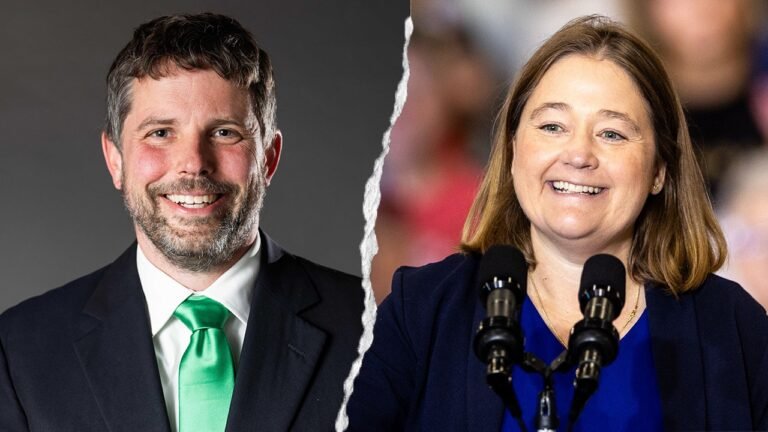
Reform UK has won in one of the first results to be declared, with Philippa Nicholson winning in Brentwood’s Hutton South ward.
She won with 987 votes – 41% ahead of the Conservatives on 785 votes.
Reform also won a seat in Chorley, with Martin Topp securing 778 votes in Chorley East, ahead of Labour on 677.
Key events
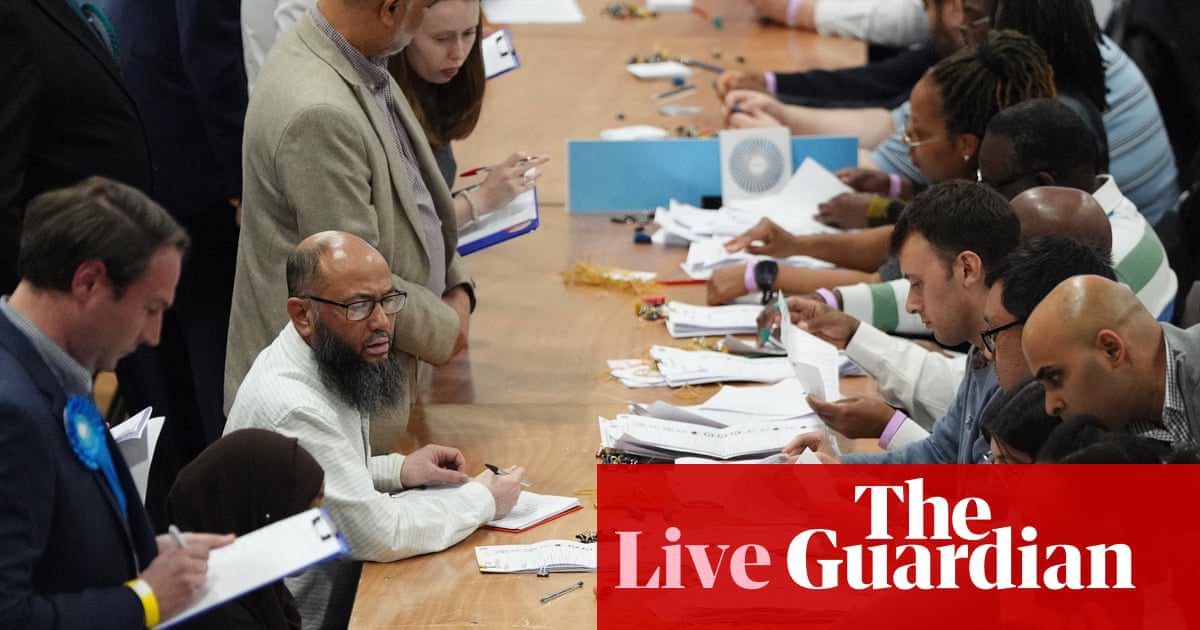
Here are some more images from counts around England:
The Labour group leader in Harlow, which is expected to be one of the first councils in England to declare its local election result, has said he will “lose some really good councillors, some hard-working councillors, this evening”.
James Griggs told the Press Association that “there’ve been some mistakes” since Labour won the general election – and the Harlow constituency in Essex – almost two years ago.
He said:
It’s easy to focus on one mistake, or one or two mistakes, whatever they may be, and forget about the hundreds of really good bits of delivery from the manifesto from just two years ago.
A lot of the stuff will take a while to come through – it is taking time, there’s a lot of repairing to do after the damage of the 14 years in austerity.
Labour is defending five seats out of 11 up for election in the Harlow Council poll.
On the front page of tomorrow’s Times newspaper is a story claiming that Ed Miliband has “privately suggested to Sir Keir Starmer that he should consider setting out a timeline for his departure”. A spokesperson for the secretary of state for energy and net zero said: “We do not accept this account.”
Asked about it on the BBC, David Lammy warns Labour MPs against playing “pass the parcel” by removing Starmer as PM.
I think Ed Miliband has said that he doesn’t recognise that.
But look, let’s be clear, Keir Starmer won a mandate for five years to deliver for the British people, and now some people are suggesting that we should go away and play pass the parcel.
The Tories did that with leader after leader after leader.
He added:
Yes, there are questions that we have to answer, but there is no, there is no circumstances in which the answer to the questions that the British people are raising is to change the leader yet again.
That is not what is coming up on the doorstep. What they want is delivery. What they want is hope. What they want is change, and that’s what we’ve got to deliver.
Reform UK MP Richard Tice, who it’s rumoured could make an appearance at the count in Newcastle-under-Lyme, has just posted this on X:
Early positive vibes through the day being reinforced by early indicators as counting underway in some areas.
Huge thanks to all our amazing candidates, supporters and activists.
And massive thanks to the huge numbers who have voted Reform.
We are making history.
Neha Gohil
In the run-up to yesterday’s elections, candidates and political parties described a climate of abuse, including death threats and intimidation while campaigning.
Labour’s Dan Jarvis, the security minister, condemned “the rising tide of vile abuse, harassment and intimidation aimed towards elected officials and candidates” online and in person. “Anyone engaging in this sort of behaviour is directly attacking our democracy and we all must do more to stop it becoming normalised,” he said.
A spokesperson for the Green party said some candidates had received death threats or been “yelled at or chased down the street”, and some had withdrawn from campaigning in certain areas due to harassment.
“Anecdotally, this has been the worst year in memory,” the spokesperson said. They said the party had been “a focus at this election more than ever before”, with “some wildly false claims being made about the party and its representatives, which some members of the public have accepted on face value”.
Read more here:
We’re getting statements from some of the political parties now as we wait for results.
For the Conservatives, party chairman Kevin Hollinrake said:
We have run an energetic and positive campaign, showcasing that we have a clear plan to get Britain working again and that we have the team to deliver it… We know that so soon after a historic general election defeat and contesting wards won during the Party’s polling highs, that this will be a difficult set of elections for us. But we will continue to rebuild and to show the public that we have changed, to demonstrate that only this new Conservative party is a credible alternative.
Liberal Democrat leader Ed Davey said:
People are deeply disappointed with a Labour government that has been too timid to fix the country, but they are also appalled by the rise of Reform and Nigel Farage’s Trump-style politics. While those on the extremes of the right and the left want to burn everything down, Liberal Democrats want to fix what’s broken. Every Liberal Democrat local champion elected today will fight tirelessly for the communities they serve.
Green party leader Zack Polanski said:
I’ve travelled across England and Wales and I’m hearing the same everywhere I go – confidence that we will win more councillors than ever before. The news from the doorstep is that we will be taking seats from not just Labour but the Tories and Lib Dems too, from all across the country. Voters are responding to the fact that Greens are the only party taking the cost-of-living crisis seriously, with real plans to cut bills, reduce rents and provide genuinely affordable homes, as well as tackling the climate and nature crisis.
A Plaid Cymru spokesperson said:
Throughout this election, we have heard a clear appetite for change. People want a government that will stand up for Wales and focus relentlessly on the key issues affecting their lives. People have told us they have been inspired by Rhun ap Iorwerth’s leadership and driven by a desire for a positive alternative to Reform UK’s chaos and division.
Analysis: results set to have transformative impact on British politics

Andrew Sparrow
In case you missed it on Thursday, my colleague Andrew Sparrow wrote this excellent guide to why these elections could be so transformative for British politics:
We don’t have any results yet, but unless all the opinion polls, and all the council byelections that have taken place over the past 12 months, and all the parliamentary byelections that have taken place since the general election, turn out to be completely unreliable guides to how people vote today, then we already have a rough idea of what the outcome will look like. It will be enough to transform the political landscape of Britain – in at least seven ways.
1) The full arrival of five-party politics in England
Two-party politics has been in decline in British politics for more than half a century. Its high point was in 1951, when 97% of people who voted in the UK general election opted for either the Conservative party or Labour. In recognition of the Lib Dems, people used to talk about England having a two-and-a-half party system. Scotland and Wales have had strong nationalist parties for years, and Reform UK easily won the English local elections last year. Under Zack Polanski, the Greens have now been soaring in the polls and this is the first English election where talking about “main” parties and “minor” parties no longer makes sense. (How can it, when the “minor” parties with least parliamentary representation, Reform UK and the Greens, have been the two best-performing parties in some polls?) Those terms describe the parliamentary situation but not politics outside, where five parties are competitive across England and it is probably more useful to think in terms of legacy parties and disruptor parties.
2) Reform UK’s emergence as a GB-wide party
When Nigel Farage was leading Ukip, it looked like an English nationalist party. Scotland seemed to have a healthy resistance to Faragism and on one occasion, in 2013, he had to be locked in a pub in Edinburgh for his own protection. The Brexit party also never really succeeded in Scotland (although it did make inroads into Wales), but under its new name, Reform UK, it is competing with Plaid Cymru for first place in Wales, and with Labour for second place in Scotland. It should easily win the English locals, and so it is the only party with a realistic chance of coming first or second in England, in Scotland and in Wales. That is why Farage is boasting about his being the “only true national party”.
3) Wales going nationalist
Plaid Cymru, the Welsh nationalist party, is widely expected to be the largest party in the Senedd after the elections and, unless Labour and Reform UK form some extraordinary version of their own Molotov–Ribbentrop Pact, Plaid will be the only party with a realistic chance of forming a government. Rhun ap Iorwerth, the Plaid leader, would be the first non-Labour first minister of Wales since devolution. Assuming the SNP remain in power in Scotland (almost certain), and with Sinn Féin the largest party at Stormont, this would mean nationalists leading the three non-English nations in the UK.
This does not mean Welsh independence is on the cards. Although formally committed to independence, Plaid has never given any serious thought to how independence might be achieved and a government that tried to implement it would find it even more complicated and less popular than the project has been in Scotland, where independence was rejected in a referendum in 2014. But, after that vote, the Scottish parliament got new powers, and the Scottish government started to use them to diverge from UK government tax policy. The Welsh government has fewer devolved powers than its Edinburgh counterpart, but with Plaid in power in Cardiff over time that may change.
4) Labour support collapsing – especially in London
If Plaid win in Wales, it will be the first time Labour has lost a big election there for more than 100 years. It is also expected to lose big in London, where it is the dominant party in local government and where at the last election it won 59 of the 75 parliamentary seats. In fact, it is on course to do badly everywhere, recording its worst result since at least the 1970s. Here is the forecast from Britain Elects, who produce election forecasts for the New Statesman and who have a good record.
Tomorrow you may hear talk from Labour figures of the 1968 London elections. Taking place after devaluation the previous year, they were an utter disaster for Labour, which lost 17 of the 20 boroughs it controlled in the capital. They almost all went Tory. The upside for Labour people looking for a positive message out of this today is that the party recovered and, two years later, Harold Wilson called a general election that he thought he might win. But he lost. And Wilson did not have to contend with Reform UK, or the Greens, or five-party politics, or prolonged austerity, or social media, or any of the other factors that make Starmer’s situation different.
5) Local government getting more pluralist
Local government in Britain used to be dominated by the two biggest legacy parties, the Conservatives and Labour. That picture should take a considerable jolt this weekend. The Liberal Democrats think they will be at least the second largest party in local government by the time of the next election, in terms of councillor numbers, and perhaps even the biggest. And Reform UK and the Greens will have a signficantly bigger presence. This chart, from an excellent preview of the elections by Dylan Difford on Substack, shows how councillor numbers have changed over recent years.
And Open Council Data has full figures.
6) Failure of first past the post
It is increasingly clear that the election system used in UK parliamentary elections, and for local elections in England and Wales, does not work in five-party politics. It functions well for two-party politics, but in multi-party politics it can easily lead to a party winning a far larger proportion of the seats than it merits based on the proportion of the votes it won. This famously happened at the last general election when Labour won 34% of the vote but 63% of the seats. Less well known is how this is increasingly happening at local authority level too. Rob Ford has also written a terrific Substack guide to the elections, and he includes this chart showing how in some cases last year Reform was winning three-quarters of the seats on a council with less than half the votes. Ford says:
The crucial question for the Greens this year, as for Reform last year, is whether they can push their support in target areas above the ‘tipping point’ where first past the post goes from sandbag to springboard. For Reform last year, as the graph below illustrates, that tipping point came around 30% – in councils where Reform won above 30% they were generally over-represented in seats, often taking huge majorities.
The Guardian has an editorial today saying this system must change.
7) Labour’s fightback challenge
We don’t know yet how Labour will react to the results. Keir Starmer may face a leadership challenge. Even if he doesn’t, the party is going to have to come up with a response that goes beyond ‘Keep calm and carry on’. Elections function as transmission mechanisms; they deliver blunt messages to government and – unless the polls are 100% wrong – the message tonight will be that something needs to change.
So it will.
Here are some of the latest images from vote counts in England:
Meanwhile, as polls closed, deputy PM David Lammy said the elections had been “tough”.
He said:
I don’t want to sugarcoat it, the message from the doorstep is this is a tough election cycle.
This is a mid-term set of elections with people concerned about the cost of living and wanting to see the government go faster with quicker pace.
Lammy added that while Labour had run a “positive campaign”, the party’s “message of delivery” had been “drowned out by the politics of grievance”.
Lucy Powell, deputy Labour leader, added:
These elections are tough and took place in a difficult context. After over a decade of Britain being held back, working people up and down the country rightly want to see the whole of our United Kingdom firing on all cylinders in their interests. Labour has started to deliver on that promise and we are determined to make it happen everywhere for everyone.
Keir Starmer has thanked party activists after polls closed.
In a post on X, the prime minister said:
To all the Labour members and volunteers who have supported local campaigns across the country: thank you.Together we will build a stronger and fairer Britain.
These elections are widely seen as the biggest test for his premiership since the general election.
What to look out for in Scotland

Libby Brooks
Libby Brooks is the Guardian’s Scotland correspondent
Although the incumbent Scottish National party is cruising towards a gravity-defying fifth term in office, the fine detail of the results and the subsequent makeup of the Holyrood chamber remains exceptionally unpredictable.
Polls this week showed Reform UK, which has gained considerable momentum in Scotland over the past 18 months, was neck and neck for second place with Scottish Labour, whose rating have suffered from growing public dissatisfaction with the UK Labour government, despite its leader, Anas Sarwar, taking the career-defining decision to call for Starmer to stand aside in February.
Many constituency seats are in the balance, and the SNP is by no means guaranteed a majority. It could then turn to the Scottish Greens – who are anticipating a strong showing thanks in part to a Polanski bounce, although the Green Party of England and Wales is a separate entity – for support to create a pro-independence majority at Holyrood.
The SNP leader, John Swinney, has pledged to hold a vote seeking the powers to hold a second independence referendum on the first day of a new parliament – despite the fact that the UK government has consistently refused previous demands and he can offer no alternative route.
While the first full council result in England isn’t expected until 2am, there may be some smaller results from midnight.
I’ll bring you updates here, but to see the full results for England, Scotland and Wales you can head to our results tracker:
What to look out for in Wales

Bethan McKernan
Bethan McKernan is the Guardian’s Wales correspondent
This week the Welsh parliament will grow from 60 to 96 members under a new, more proportional electoral system. Labour is expected to lose control of the Senedd for the first time since devolution in 1999, with Plaid Cymru’s Rhun ap Iorwerth expected to become the new first minister, putting Welsh independence firmly on the agenda.
Coalition arithmetic makes it highly unlikely Reform will be able to form a government, even if it wins the most seats. If the numbers allow, Plaid Cymru will form a minority government without entering formal coalition agreements with Labour or the Green party.
Labour’s predicted losses are so catastrophic that some polls put the party in fourth place, after the Greens. Several polls suggest Eluned Morgan, the Labour first minister, will lose her seat.
The Senedd’s new list system has razor-sharp margins, making predictions very difficult. As little as 0.06% of the vote could decide the last (sixth) seat in each constituency, according to the pollsters More in Common.
Which results are we expecting first?

Aletha Adu
Aletha Adu is a Guardian political correspondent
The early hours of Friday morning will produce only a handful of declarations but they could shape the mood of the entire elections.
Hartlepool is one of the first major tests of whether Reform UK can convert polling momentum into real council gains. The declaration guide itself flags the possibility of Reform making significant advances there as one of the key storylines of the night.
If Reform performs strongly, Labour strategists will worry less about isolated local setbacks and more about the emergence of a durable anti-establishment challenger capable of eating into Labour’s old coalition in towns the party once considered safe.
Oxford could offer an early sign of how fragmented progressive and anti-Tory voters have become, with Labour, the Greens and Liberal Democrats all competing for similar voters. The declaration guide refers to “a mess of different liberal winners in Oxford”.
Dudley matters because it sits in politically volatile Midlands territory where Labour faces pressure from Reform amid frustration over immigration, living standards and distrust of Westminster politics.
You can see a full election results timeline here:
Polls closed in England, Scotland and Wales
Hello and welcome to the Guardian’s live coverage of election results in England, Scotland and Wales.
Thursday’s votes covered the Scottish and Welsh parliaments and 136 local councils in England, where 5,014 seats were contested, including every one on all of London’s 32 borough councils, more than a dozen borough councils, six unitary councils, six county councils and three district councils. A further 73 councils held elections for half or a third of the seats available.
There were also six mayoral contests – in Croydon, Hackney, Lewisham, Newham, Tower Hamlets and Watford.
So, there is a lot to come…
We’re expecting the first results in England between midnight and 2am, but counting in Scotland and Wales does not begin until around 9am – so those results are some way off.
As ever, we’ll bring you the latest news, colour and reaction throughout the night.
Feel free to get in touch – hamish.mackay@theguardian.com – if you spot any errors. My colleague Andrew Sparrow will take over at 6am, and comments will open from 8am.
Source: https://www.theguardian.com/politics/live/2026/may/07/elections-2026-local-scotland-wales-reform-green-labour-conservatives-live-news-updates
About the Author