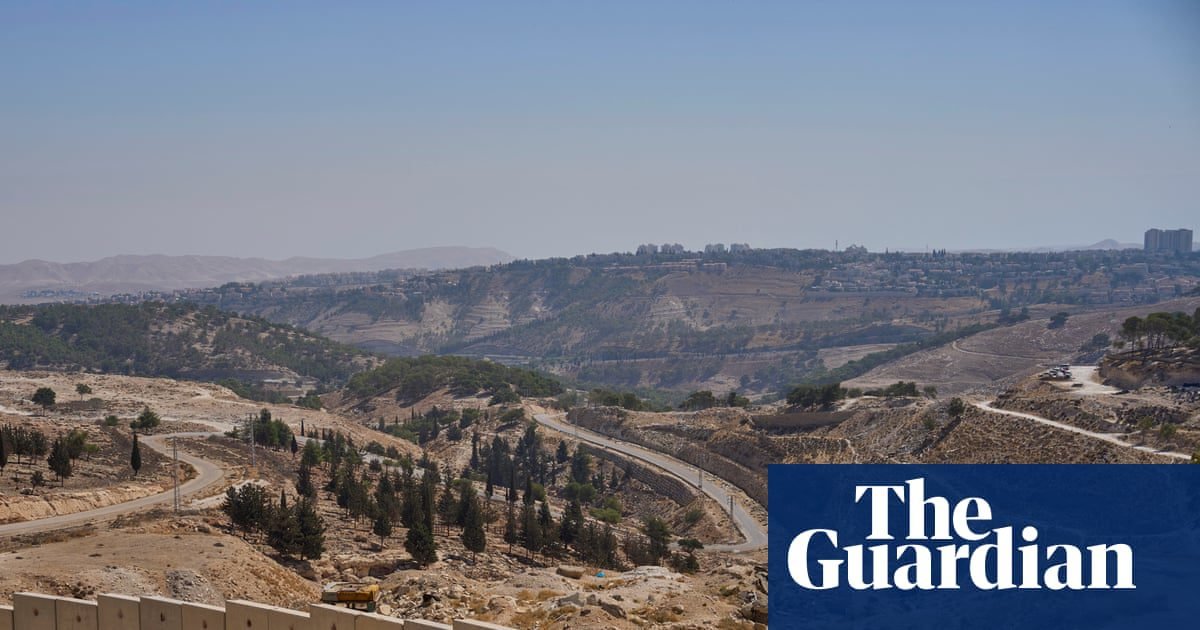
Ed Miliband has announced the first set of sanctions against Israeli companies planning to build illegal settlements in the West Bank, after he pledged to try to prevent settlements that destroy the chances of a two-state solution.
The UK foreign secretary also announced he was placing sanctions on a rightwing activist Israeli group involved in trying to block aid into Gaza as recently as last month.
Miliband announced the measures just before tenders for the large E1 West Bank settlement were due to be allocated by the Israeli government, while saying he wanted to work with a new Israeli government in a more cooperative way.
Israel’s possible new prime minister, Gadi Eisenkot has said that, if appointed, he will take a tougher approach than Benjamin Netanyahu to settler violence.
The sanctions are designed to stop the flow of finance to eight identified construction firms, although in practice the extent to which any of the firms are dependent on British finance is yet to be tested.
On 8 September, Miliband announced an expansion of its Global Human Rights sanctions regime, as well as a complex set of measures, yet to be implemented, designed to ban the trade in goods from illegal settlements. The Foreign Office said that it welcomed and encouraged trade with “green line Israel” and firmly distinguished this with activity in settlements.
The Foreign Office said the current Israeli government had “not only refused to clamp down on illegal settlement, but has facilitated and encouraged them”. More settlements had been approved under the four years of this Israeli government than in the previous 20 years.
The entities targeted by sanctions are Israeli construction, property development and architectural businesses that have helped to plan, build, supply or market housing and public infrastructure in Israeli settlements in the occupied West Bank.
Miliband – who was criticised by some for broadening the sanctions criteria and planning a ban on trade with illegal settlement – said: “Protecting the two-state solution is the north star of this government’s approach.
“That is why my message on E1 is clear: do not bid, do not build, and do not profit from the destruction of the two-state solution. And we will not stand by while those blocking desperately needed aid deepen the intolerable suffering of civilians in Gaza. The status quo in the West Bank and Gaza is unacceptable.”
But he added in a potential olive branch: “We are committed to working productively with a new Israeli government and the Palestinian Authority to advance lasting peace and security for Israelis and Palestinians alike.”
Miliband and his Middle East minister, Stephen Doughty, have repeatedly highlighted the Israeli government’s refusal to let a variety of dual-use goods into Gaza. The Foreign Office said civilians in Gaza were in desperate need of winter supplies, with catastrophic floods leaving nearly 4,000 households without shelter and 1.4 million people living in tents or makeshift shelters.
According to the UN, more than 150,000 tents and 300,000 tarpaulins bought by humanitarian partners and donors are outside Gaza ready to go in, but are being held by the Israeli authorities. The Israeli authorities also continue to block timber from entering, leaving no emergency shelter kits available in Gaza.
The Israeli government claims the blockage of some goods is necessary to prevent Hamas obtaining goods that could be used to attack Israel. The dispute over dual-use goods and closed entry points into Gaza has lasted for more than two years.
Source: https://www.theguardian.com/world/2026/nov/17/ed-miliband-israel-west-bank-settlements-sanctions
About the Author