Key Takeaways
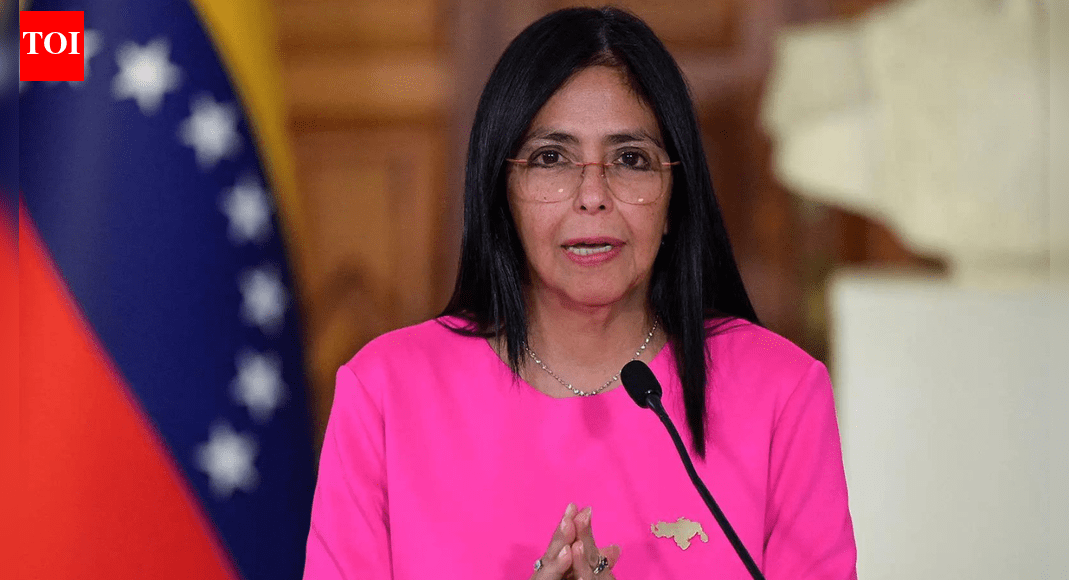
Delcy Rodriguez steps in as Venezuela’s interim president after Maduro’s capture. Explore her background, immediate actions, and the profound political implications for the nation.
Overview
Venezuela has entered a new and uncertain political phase following the capture of President Nicolas Maduro during a US military operation. In an immediate response to the sudden power vacuum, the nation’s Supreme Court directed Vice President Delcy Rodriguez to assume the role of interim president, citing constitutional provisions for a president’s absence.
This swift transition highlights the profound implications for Venezuela’s governance and international relations. Policy Watchers and Political Analysts are closely monitoring the constitutional implications and the immediate reactions from both domestic and international stakeholders.
Rodriguez took charge hours after Maduro’s detention, chairing a National Defence Council meeting with senior ministers and military officials. She vehemently condemned the US operation and demanded Maduro’s immediate release.
The unfolding events set the stage for complex diplomatic maneuvers and internal political realignments, necessitating a balanced political analysis of the short, medium, and long-term implications for the South American nation.
Detailed Analysis
The dramatic turn of events in Venezuela, marked by the capture of President Nicolas Maduro during a US military operation, has plunged the nation into an unexpected and critical power vacuum. The Supreme Court’s swift directive for Vice President Delcy Rodriguez to assume the interim presidency, citing constitutional provisions dealing with a president’s absence, underscores the immediate and unprecedented nature of the crisis. This rapid transition signifies a pivotal moment for a country already grappling with profound political, economic, and social instabilities. Rodriguez’s ascension to interim leadership is not an unheralded event but rather the culmination of a deeply ingrained political career spanning over two decades within the influential “chavismo” movement. Her consistent loyalty and close advisory role to Maduro have solidified her position as a central figure in the government, a political legacy she shares with her brother, Jorge Rodriguez, with their influence tracing back to the foundational era of former president Hugo Chavez. This deep-rooted connection to the incumbent political establishment provides a crucial framework for understanding the current leadership shift and its potential trajectory in maintaining continuity or navigating change.
Hours following the detention of Maduro and his wife, Cilia Flores, Delcy Rodriguez swiftly moved to assert her new, albeit interim, authority. She immediately convened and chaired a meeting of the National Defence Council, appearing alongside senior ministers and military officials, a clear visual message aimed at projecting continuity, stability, and control amidst the profound upheaval. During this televised gathering, Rodriguez delivered a robust and unambiguous condemnation of the US military operation, forcefully asserting that it constituted a blatant violation of international law and a direct infringement upon Venezuela’s national sovereignty. Concurrently, she issued an unequivocal demand for the immediate release of Maduro and Flores, emphatically insisting that Maduro remains the country’s sole legitimate president. Her televised declaration, “There is only one president in this country, and his name is Nicolas Maduro,” aimed to consolidate internal support and project an image of unwavering adherence to the existing political order in the face of significant external pressure. Her extensive prior government roles, including serving as Venezuela’s foreign minister and overseeing key economic portfolios such as finance and the crucial oil sector, demonstrate a comprehensive understanding of both national governance and international diplomacy, equipping her with substantial experience for this interim leadership.
The immediate international reactions to Rodriguez’s interim appointment illuminate a stark dichotomy in global perspectives. Domestically, her firm actions at the National Defence Council meeting signal a resolute stance against what is perceived as external intervention, aligning with the long-standing “chavista” narrative of sovereignty and national resistance. This internal consolidation effort stands in sharp contrast to US President Donald Trump’s surprising public assertion that Rodriguez was “quite gracious” and willing to cooperate with Washington. Trump indicated that she had engaged in extensive discussions with Senator Rubio and had shown readiness to do “whatever” the US needed, suggesting a potential willingness for dialogue or concessions. This significant divergence creates an exceptionally complex geopolitical landscape, where Venezuela’s internal efforts to maintain political order and national integrity are juxtaposed against external overtures that imply a different path. Historically, leadership changes under such duress often lead to either outright capitulation to external pressures or entrenched defiance; Rodriguez’s initial public moves firmly suggest the latter, while the US perspective hints at potential underlying complexities that may yet emerge. This evolving situation presents a critical case study in how nations navigate the intricate balance between sovereignty claims and escalating international pressure, particularly when a sitting head of state is removed by an external force.
For News Readers, Policy Watchers, Informed Citizens, and Political Analysts, the unfolding events in Venezuela necessitate meticulous observation and a nuanced understanding of the evolving political dynamics. Rodriguez’s interim presidency, mandated by the Supreme Court, represents an immediate constitutional attempt to maintain order and governance following the unprecedented external capture of the sitting president. Key areas to monitor closely include the continued stability and allegiance of Venezuela’s military and security apparatus under her leadership, the degree of both internal political and regional support for her interim government, and the precise nature of the international community’s coordinated or divergent responses to both Maduro’s capture and Rodriguez’s rapid ascension. The conflicting narratives presented by Rodriguez and President Trump underscore a volatile and unpredictable diplomatic environment, rich with potential for further escalation or unexpected resolution. The broader implications for regional stability in Latin America, the interpretation and application of international law regarding state sovereignty, and the long-term future of Venezuela’s government structure are profound. Any further statements from the National Defence Council, the official reactions of neighboring Latin American governments, and any subsequent diplomatic efforts to mediate or resolve the current crisis will serve as crucial indicators guiding the path forward for Venezuela.
About the Author