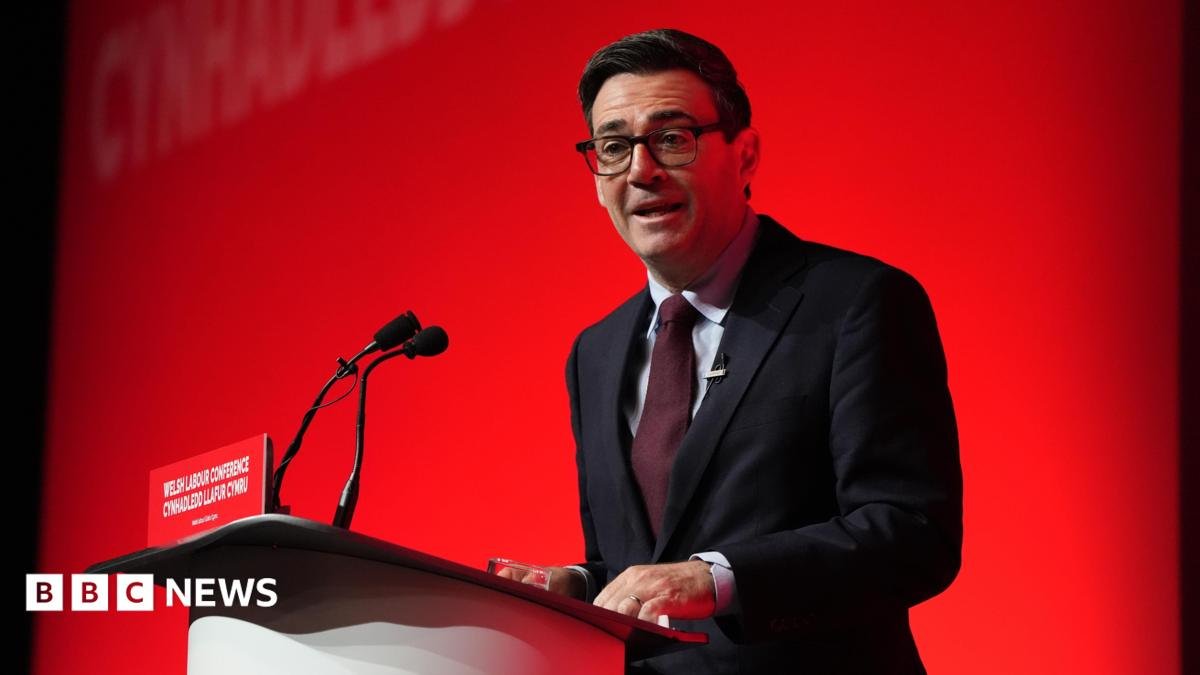
Burnham spoke ahead of the publication of a review of what went wrong at the election.
Since he became prime minister he has been lobbying the Welsh government to devolve more powers to local councils.
“Somewhere along the way perhaps we lost sight of some of the principles that drove devolution in the first place.
“We probably stopped listening as much as we should have, and actually stopped driving power down into every Welsh postcode which is what the vision to me really should always have been about – about people and places.”
He said the party would accept its defeat and “come back stronger” with a “vision for a stronger Wales in a fairer United Kingdom.”
Burnham said he wanted to achieve the sense of a “one Labour team for Wales” where the party is “pulling in the same direction”.
“Where I’m pulling with you and not creating problems for you or going against what Ken or colleagues want to achieve.
“We will put forward a vision for communities up and down Wales, as well as giving Wales a stronger national voice.”
Addressing the event at Venue Cymru in Llandudno, Burnham said he loved “everything about Wales”.
He said his last visit to Wales – to Aberfan – left the “biggest mark”.
Referencing the fight for justice in the years after the disaster, Burnham said he wanted a “country where all people and all places are treated fairly and with dignity”.
He said his vision for the country is a “reindustrialised nation with revitalised high streets”.
Burnham said Labour should be “immensely proud” of the things it achieved in Wales – including free school meals, free prescription and the creation of Transport for Wales.
The prime minister said he wanted to show how “being in the UK is good for Wales because of the partnership that we can develop together”.
Burnham said he had put the full devolution of employment support on the table with the Welsh government.
It was announced at the budget that standing charges for gas will come to an end. Burnham confirmed that the charges will be scrapped in the new year.
Menon’s criticism of Red Welsh Way was one of several findings, including that the party suffered a long-term decline in support, laid bare as Labour took flak for dissatisfaction with public services.
It said “weaknesses in political communication” also left the party without “clear answers when voters wanted them.
The review says Labour should set itself against Plaid Cymru’s “constitutional project”, by seeking more powers based on what they would deliver rather than “debating powers in the abstract”.
Labour has shared most of Plaid’s constitutional demands, including the devolution of policing, the Crown Estate and rail devolution, with the exception of independence.
Plaid beat Welsh Labour in the May election, and was now running the Welsh government.
Morgan sought to differentiate herself from Sir Keir Starmer with a flagship speech in 2025, where she set out her approach called the Red Welsh Way.
Morgan said she was willing to “call out” Westminster Labour, and demanded the devolution of the crown estate to the Senedd.
Menon’s report said it “struggled to land on everyday policy, instead tied up in constitutional positioning and the relationship with Westminster”.
“Demands such as transferring the Crown Estate and devolving policing did not speak to voters on the doorstep, who found themselves more concerned with the economy, cost of living and the NHS.”
He said the Labour campaign shifted from Red Welsh Way to “power in partnership” – attempting to send signals about the relationship with UK Labour in government, “but still did not provide clear policy objectives, whether in terms of common ground or differentiation”.
The report said Welsh Labour “should define standing up for Wales by what it delivers on the issues voters care about most: the NHS, the cost of living and the economy.
It calls for Labour to seek further powers for the Senedd and within Wales “where they would improve delivery or bring decisions closer to people.”
Menon said the result was “not necessarily” about Welsh identity, saying Welsh identity “has been flat for a decade”.
But he added: “Welsh Labour voters who switch to Plaid do score more strongly on their Welsh identity than those who stayed.
“Focus group participants also cited it as a reason for switching, objecting to ‘the lack of Labour standing up for Wales as a separate entity’.
“However, voters tend to judge whether a party stands up for Wales mainly on delivery: the NHS, the cost of living and the economy.
“For the median Welsh voter, identity operates through these issues more than through a clear demand for further devolution, independence or a focus on the Welsh language.”
Source: https://www.bbc.co.uk/news/articles/cmgj340w6g8yo?at_medium=RSS&at_campaign=rss
About the Author