Key events
Q: Some of your MPs are losing faith in Ed Davey. Why is he failing to cut through?
Cooper did not accept the premise of the question. She described Davey as the “most successful ever” leader in the history of the party, and went on:
For as long as we have first past the post, the national polls do not translate into winning seats. And we have proven that under Ed Davey’s leadership we can transfer votes into seats like no other political party. And for as long as we have first past the post that has to remain the goal.
Daisy Cooper rules out Lib Dems cooperating with Greens ‘at national level’ while Zionism motion still stands
Q: Should Liberal Democrat councillors stop power sharing with Green councillors in the light of the Greens’ “Zionism is racism” motion being passed by their conference?
Cooper said she utterly condemned the “horrific, antisemitic motion” passed by the Greens at their conference. She said this was an issue for Green MPs, Green councillors and Green members to sort out.
She said the Lib Dems would “absolutely not work with the Green party at the national level for as long as this remains their position”.
But she did not say what she thought Lib Dem councillors should do in areas where they are sharing power with the Greens.
(The Labour party has told its councillors that they should only cooperate with Green councillors where the local Green party has condemned the Zionism motion.)
Q: These policies suggest you are criticising the budget from the left. Is that fair?
Cooper suggested she did not accept that description. She explained:
We believe that wealth creation and social justice are two sides of the same coin. We have a stronger, pro-growth, pro-business position than the Labour party.
But when it comes to supporting the most disadvantaged, we do believe in having more targeted and deeper support for the most vulnerable in society.
So I believe that we can outstrip the Labour party by being more pro-growth and more pro-business, whilst also being more targeted with support for those who are most vulnerable.
Lib Dems call for £14bn ‘breathing space budget’ with fuel bill cuts, tax cuts for hospitality, and cheaper transport
Daisy Cooper, the Lib Dem deputy leader and Treasury spokesperson, is holding a press conference now.
She says the Lib Dems are urging John Healey, the chancellor, to deliver “a £14bn breathing space budget” next week, saving households £350 on average over the next year and a half.
She says these plans could be “fully funded by windfall taxes on the big banks, a clawback on the energy network monopolies and using the higher tax receipts triggered by inflation”.
The plan has three elements.
On energy, Cooper says:
For the next year and a half, we would introduce an essential energy guarantee, cutting average annual electricity and gas bills by £100, alongside additional support for households with children and disabled people.
On hospitality, she says:
For the next year and a half, we would cut hospitality VAT from 20% to 15%, giving pubs, restaurants and cafes room to keep prices down, protect jobs and stay open. It would make a meal with the kids, coffee with a friend or a pint at the local, just a little bit more affordable.
And, on travel, she says:
For an initial three months, we would cut fuel duty by 10%, cut rail fares by 10%, introduce £1 bus fares and cut VAT on kerbside EV charging to 5%.
Explaining how the Lib Dems would fund these measures, she says:
Our essential energy guarantee would be paid for by clawing back excess support handed to monopoly energy operators, and using that money to cut household bills instead.
Our hospitality package would be funded by a one-off, time-limited windfall tax on the unexpected and unearned profits of the big banks.
And our emergency travel package would be funded through additional Treasury receipts generated through higher prices at the petrol pump triggered by Trumpflation [price rises caused by Trump’s Iran war] because when motorists pay more at the pump, the Treasury shouldn’t get a windfall.
Report on most challenging areas in England to be a child says Middlesbrough worst place, and Cheshire East best place
Here is the chart from Rachel de Souza’s Childhood Lottery report showing the places deemed the most challenging to be a child. (See 9.34am.)
And here is the chart showing the least challenging places to be a child.
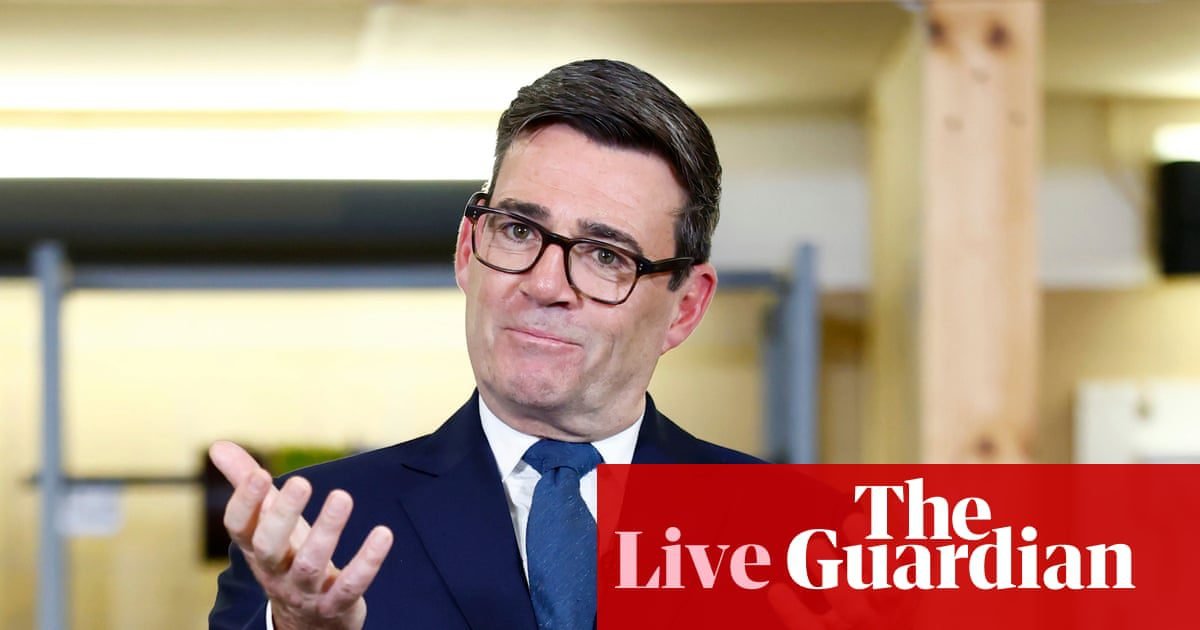
Burnham pledges ‘big changes’ to the way the welfare system works to tackle Neets crisis
Good morning. Children and young people are at the top of the agenda today, with the publication of a hard-hitting report from Dame Rachel de Souza, the children’s commissioner for England, and a Times article by Andy Burnham. They are focusing on slightly different cohorts – Burnham is writing about young people who leave school and enter the benefits system, while the de Souza reports covers the experiences of young children in multiple aspects of their lives – but their overall message is the same: the younger generation is being let down.
De Souza has studied more than 160 datasets to examine how what happens to children as they grow up varies across England and she says the variation is “staggering”. In her report, The Childhood Lottery, she explains:
In four local authorities, the total amount spent on youth services per teenager is the princely sum of £0, £421 less than in the highest spending local authority. Some areas of the country are sending nearly 90% of their looked after children to out-of-area placements, compared to the almost 20% in the areas making least use of these – although given this means being away from family ties, and friends, that is still worryingly high.
But what stands out is not merely these differences, but how much work there is to do to deliver a happy, healthy childhood in every postcode. I have made the difficult decision to highlight the 20 places where it is hardest to grow up. I want to be clear that this is not a review of the local authority, this is an assessment based on a wide range of measures looking at the challenges faced, the full range of services available and the outcomes we see.
We cannot shy away, though, from the fact that poor education outcomes, long health waiting lists or simply feeling unsafe converge in particular places.
The report identifies Middlesbrough as the most challenging place to be a child, and Cheshire East as the least challenging place. I will publish fuller tables shortly.
The overall picture is grim too. Here is an extract from the report’s summary.
The data pulled together in the Childhood Lottery highlights the scale of challenges faced by children across all areas of the country and all areas of their lives. For example that:
-Over 1 million children (1,048,965) had active referrals to children and young people’s mental health services in 2024-25.1
-Most pupils (55%) do not achieve a good standard in their English and Maths GCSEs (grade 5 or better in both) at the end of key stage 4.
-There are around 1 million young people in the UK aged 16 to 24 not in employment, education or training (NEET)
-Approaching half (44%) of looked after children are placed outside their local authority area. Far too many care leavers (40%, plus 6% with unknown activity) are Neets [not in education, employment or training].
-12% of children said they did not feel safe in their local area.
The Burnham article is specifically about Neets. The government was expected to publish Alan Milburn’s final report with recommendations on Neets before the budget. Now it is coming next month, which means the pitch-rolling process ahead of publication is unusually protracted. Milburn has given an interview to the Guardian and, as Anna Bawden and Kiran Stacey report, he is explicit about wanting some benefit payments to be cut to fund more employment support.
In his article, Burnham accepts that many people people today feel “shut out”.
There is no shortage of people lining up to take a swing at the next generation but, if we are honest, the blame for this failure lies with politicians. At the very moment growing up became harder, the support young people relied on was stripped away. Youth services were practically abolished. Children’s mental health services were cut. Families were left to fight for support for children with special educational needs and disabilities.
The pandemic stole two years, and social media is too often taking something much deeper: their confidence and sense of belonging. Add an education system focused on the university route and a job market offering too few opportunities, and we should not be surprised that so many are shut out.
And he signals that he is going to follow Milburn’s recommendations on benefits.
Today, the welfare system provides an assessment, a payment and, after that, a goodbye. Too often there is no support, no offer of skills and no opportunity to get a job …
This will be our offer: a clear guarantee of support. But it will also be matched by an expectation that young people will take up the opportunities made available to them. This will mean big changes to the way our welfare system operates. Benefits will become the backstop, not the starting point. The system will no longer begin by establishing which benefits a young person is entitled to. It will begin with their ambitions and the help they need to achieve them.
Here is the agenda for the day.
10am: Daisy Cooper, the Lib Dem deputy leader and Treasury spokesperson, holds a press conference on Lib Dem budget proposals.
Morning: Andy Burnham is on a visit in South Wales linked to the 60th anniversary of the Aberfan disaster (which is on Wednesday).
11.30am: Downing Street holds a lobby briefing.
2.30pm: Wes Streeting, the defence secretary, takes questions in the Commons.
3pm: Dame Rachel de Souza, the children’s commissioner for England, gives a speech at at the launch of her Childhood Lottery report.
After 3.30pm: MPs debate amendments to the Northern Ireland Troubles bill.
5.30pm: Rhun ap Iorwerth, the Welsh first minister, gives a speech on devolution.
I’m afraid we are no longer able to have comments open below the line every day on this blog. If you want to contact me, please email politics.live@theguardian.com. You can use this email to flag up corrections, comments for publication, questions or complaints.
Source: https://www.theguardian.com/politics/live/2026/oct/19/andy-burnham-labour-children-welfare-neets-kemi-badenoch-conservatives-nigel-farage-reform-latest-news-updates
About the Author