Key Takeaways
BJP accuses Rahul Gandhi of threatening anarchy over democracy remarks in Berlin. Analyze India’s political discourse, institutional integrity, stakeholder views, and policy implications.
Overview
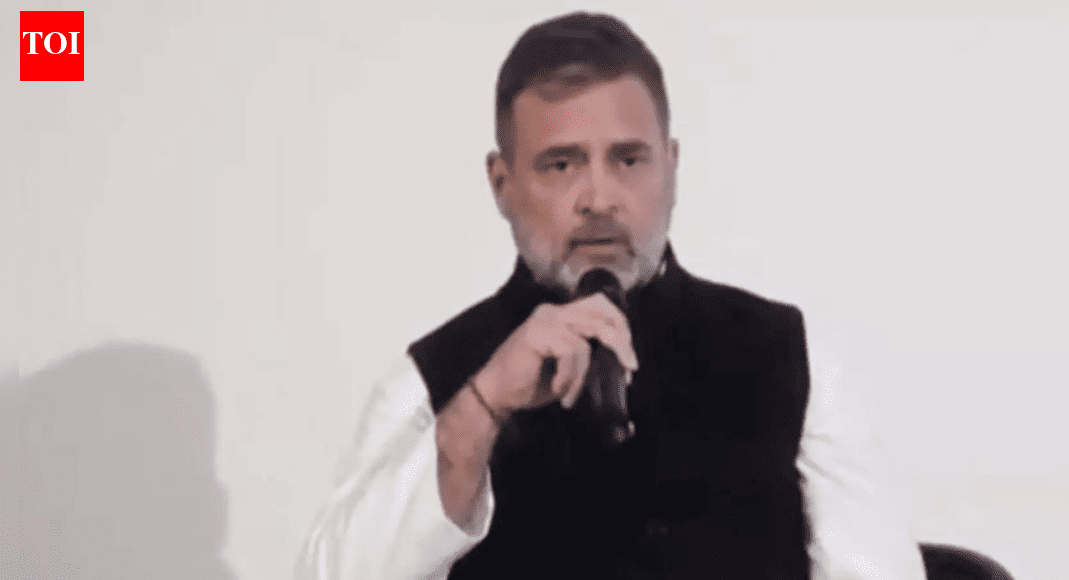
The Bharatiya Janata Party (BJP) on Tuesday launched a scathing attack against Rahul Gandhi following his remarks in Berlin, Germany, accusing the Congress leader of wanting “chaos and unrest in Indian Democracy.” These statements have significantly intensified political discourse, drawing sharp lines between the ruling party and the opposition.
For News Readers, Policy Watchers, Informed Citizens, and Political Analysts, this exchange highlights fundamental disagreements over the state of India’s democratic institutions and economic direction. The debate extends beyond rhetoric, touching upon critical governance implications and stakeholder perspectives.
Key accusations from Rahul Gandhi include the BJP’s alleged “wholesale capture” of institutional frameworks and “weaponisation” of agencies like the ED and CBI. Conversely, BJP spokesperson Pradeep Bhandari cited a 495% growth in total electronics manufacturing over 10 years and a 14-fold increase in automobile manufacturing since 1991, refuting claims of economic decline.
This article will delve into the immediate reactions, secondary consequences, and structural implications of these high-profile political exchanges, offering a balanced analysis of the conflicting narratives and their potential impact on India Politics.
Key Data
| Manufacturing Sector | Opposition Claim (Rahul Gandhi) | Government Data (BJP Spokesperson) | Timeframe |
|---|---|---|---|
| Total Electronics Manufacturing | Declining | 495% growth | Last 10 years |
| Electronics Exports | Implied decline (due to overall manufacturing) | 760% growth | Specific timeframe not disclosed (implied within last 10 years) |
| Automobile Manufacturing | Implied decline (due to overall manufacturing) | 14 times increase | Since 1991 |
Detailed Analysis
SECTION A – CONTEXT & BACKGROUND
The recent political exchange stemming from Rahul Gandhi’s remarks in Berlin underscores a persistent theme in India Politics: the vigorous debate over the nation’s democratic health and economic trajectory. Historically, Indian leaders have often utilized international platforms to articulate their vision for the country or to raise concerns, inviting scrutiny both domestically and abroad. Gandhi’s address at the Hertie School, where he accused the BJP of an “attack on the democratic system” through the “wholesale capture of our institutional framework,” resonates with broader opposition narratives concerning federalism, the independence of constitutional bodies, and the concentration of power. This current debate is not an isolated incident but rather a continuation of an ongoing ideological contest that frequently plays out in public forums, both within India and on global stages. The opposition, particularly the Congress party, has consistently voiced apprehensions about the perceived weakening of democratic checks and balances, while the ruling BJP staunchly defends its governance record and national policies. This discourse gains added significance when it transcends national borders, as statements made abroad can influence international perceptions and diplomatic relations, making the responses from both sides particularly pointed. The context of a leader’s overseas visit often frames such discussions, positioning them against a backdrop of global democratic trends and economic challenges.
SECTION B – DETAILED ANALYSIS
Rahul Gandhi’s criticisms in Berlin centered on two primary pillars: an alleged assault on India’s institutional integrity and a perceived failure in manufacturing that cripples job creation. He articulated concerns about the “weaponisation” of investigative agencies like the Enforcement Directorate (ED) and the Central Bureau of Investigation (CBI), citing a disproportionate number of cases against opposition figures compared to BJP members. Gandhi suggested a quid pro quo system where businessmen, fearing repercussions, financially support the ruling party, thereby undermining fair political competition. He explicitly stated, “If you are a businessman and try to support the Congress, you are threatened.” Furthermore, he argued that India, alongside Western nations, has ceded manufacturing dominance to China, leading to a profound impact on job creation in democracies and fueling political turbulence. His visit to BMW World in Munich reinforced this, where he remarked, “Manufacturing is the backbone of strong economies. Sadly, in India, manufacturing is declining.” This perspective frames the BJP’s tenure as one that has systematically eroded democratic norms and failed to stimulate domestic production, leading to widespread unemployment and social unrest.
The BJP’s response was swift and unequivocal, categorizing Gandhi’s statements as anti-national and threatening anarchy. BJP National Spokesperson Pradeep Bhandari alleged that Rahul Gandhi and the Congress party seek “chaos and unrest in Indian Democracy,” further accusing Gandhi of uniting “Anti India forces” with ideological patrons like George Soros. Bhandari unequivocally asserted, “Congress hates Indian Democracy. Congress hates Bharat’s progress. Rahul Gandhi’s Congress wants Anarchy!” Union Minister of State Shobha Karandjale echoed this sentiment, stating that Gandhi “goes abroad to speak against the nation” and behaves “like a child, not a leader.” Critically, the BJP countered Gandhi’s economic claims with specific data points. Bhandari cited a 495% growth in total electronics manufacturing over the last decade and a 760% increase in electronics exports. He also highlighted a formidable 14-fold increase in automobile manufacturing since 1991, directly refuting the notion of a manufacturing decline and terming Gandhi’s claims as “fake news against India’s growth story.” These counter-arguments emphasize the government’s narrative of robust economic growth and a resilient democratic framework, painting the opposition’s criticisms as politically motivated and unpatriotic.
SECTION C – COMPARATIVE ANALYSIS
The stark contrast between Rahul Gandhi’s assertions and the BJP’s counter-claims illustrates a deeply polarized political landscape in India. While Gandhi presents a narrative of democratic erosion and economic stagnation, the BJP projects an image of national progress and institutional strength. This divergence impacts how News Readers, Policy Watchers, Informed Citizens, and Political Analysts interpret the nation’s direction. Gandhi’s concerns about institutional capture align with broader criticisms from civil society groups and some international observers regarding the autonomy of investigative agencies and electoral processes. His emphasis on manufacturing decline touches upon a sensitive area for India, where job creation remains a significant policy challenge, particularly for a burgeoning youth population. However, the BJP’s rebuttal, backed by specific growth percentages in key manufacturing sectors, offers an alternative view, suggesting that economic dynamism persists despite global headwinds. The government often highlights its policy initiatives such as ‘Make in India’ and Production-Linked Incentive (PLI) schemes as drivers of this growth. This data matrix (see above) provides a comparative snapshot of these conflicting claims. The contrasting narratives also reflect differing approaches to policy formulation: one advocating for greater institutional oversight and social welfare, the other prioritizing economic liberalization and national security. The medium-term ripple effects of such exchanges include heightened political rhetoric in upcoming election cycles and a continued struggle for control over public perception both domestically and internationally. These debates are crucial for understanding the policy implications as they influence legislative priorities, budget allocations, and the overall governance strategy of the country.
SECTION D – AUDIENCE TAKEAWAY
For News Readers, this political sparring in Berlin underscores the high stakes of India’s internal debates, which now frequently spill onto global platforms. It highlights the deeply entrenched ideological differences between India’s major political parties, providing context for the intense political campaigns leading up to future elections. Informed Citizens should critically evaluate the claims from both sides, seeking verifiable data beyond political statements. The manufacturing statistics cited by the BJP offer a direct counter to the opposition’s economic critique, prompting a deeper dive into official economic reports and sectoral analyses to ascertain the true picture of India’s industrial growth and employment scenario. Policy Watchers must consider how these narratives shape governance implications. Allegations of institutional capture, if widely perceived, could influence foreign investment sentiments and international diplomatic relations, potentially impacting India’s standing in global democratic indices. Conversely, robust growth figures, if consistently demonstrated, could bolster investor confidence and validate current government policies. Political Analysts should monitor the long-term impact of such cross-border rhetoric on domestic political mobilization and the shaping of public opinion. The accusation of threatening anarchy and associating opposition leaders with ‘anti-India forces’ represents a hardening of political discourse, which can have lasting implications for democratic debate and dissent. Upcoming events to monitor include further statements from political leaders, official government data releases on economic performance, parliamentary debates, and state or national election campaigns, which will serve as critical litmus tests for public sentiment regarding these competing visions for India’s future. The effectiveness of either side’s narrative in resonating with the electorate will ultimately shape the policy landscape and political direction of the nation.
About the Author