President Trump heads to Asia on Monday for high-stakes meetings with foreign leaders aimed at ending Russia’s war in Ukraine and smoothing over trade frictions with China. But the most tense meeting could take place aboard Air Force One.
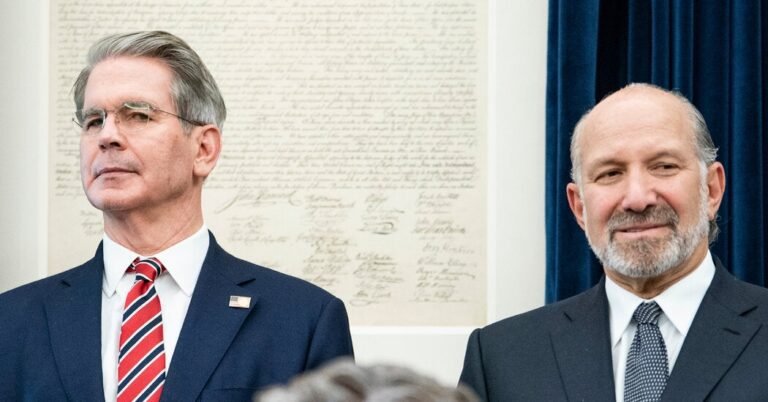
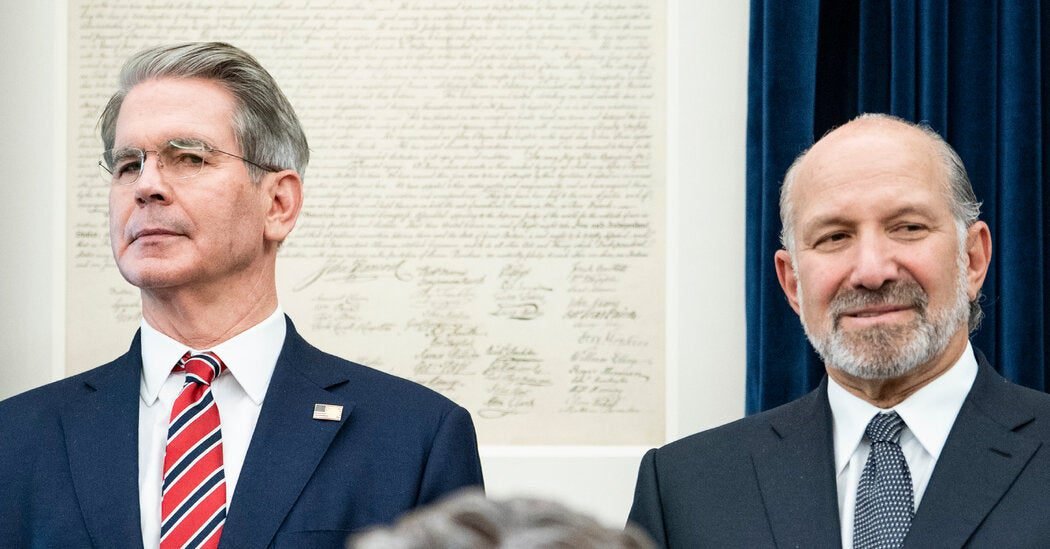
Sequestered together on the journey across the world will be Treasury Secretary Scott Bessent and Howard Lutnick, the commerce secretary, whose long-running rivalry has recently spilled into the open.
Mr. Lutnick is under fire for slow-walking several measures aimed at clamping down on the supply of Nvidia chips to foreign data centers that serve Chinese clients. The controversy has put Mr. Lutnick at odds with Mr. Bessent, who has increasingly taken a hard line on China. While Mr. Lutnick has pushed for policies more favorable to Nvidia, Mr. Bessent has played the foil, going so far as to call for a dramatic shake-up of the company’s leadership.
The Treasury secretary traditionally manages America’s economic relationship with China. After spending much of last year trying to de-escalate tension between the world’s two largest economies over tariffs, Mr. Bessent has taken a more hawkish stance this year amid growing concern over the artificial intelligence race with China and risks that rogue Chinese A.I. technology could pose to the U.S. economy.
The internal clash over China policy has echoes of Mr. Trump’s first term, when the president’s economic advisers regularly argued about how forcefully to confront China over its trade practices. After Mr. Trump imposed steep tariffs on Chinese imports last year, Mr. Bessent called for de-escalation and helped broker a trade truce that stabilized the global economy.
But in recent months, the Trump administration has been frustrated that China has not lived up to its commitments for purchases of American farm products and to accelerate exports of its critical minerals, which are needed for making high-tech electronics and military equipment.
In a call with Vice Premier He Lifeng of China this month, the Treasury Department said, Mr. Bessent “raised concerns about recent Chinese actions” related to the two nations’ agreement and that “continued progress depends on concrete results.”
Michael Pillsbury, a China scholar at the right-leaning Heritage Foundation who advised Mr. Trump during his first term, said that Mr. Bessent’s hawkish turn when it comes to technology exports is part of a broader acknowledgment that tariffs and sanctions are not providing the United States with enough economic leverage when dealing with China.
“It’s the realization that the original plan or hope with China is not working,” Mr. Pillsbury said, adding that Mr. Bessent was being innovative in the “quest for leverage.”
This month the divide over China policy spilled into public view, after Nvidia’s chief executive, Jensen Huang, was revealed to be having an affair with a woman who led a Singaporean data center firm known as Megaspeed. U.S. intelligence believes the woman is a Chinese intelligence asset. The company is under investigation for allegedly smuggling Nvidia chips to China.
Megaspeed said in a statement that it conducts legitimate and lawful business, and designs its operations to comply with all laws.
When he was asked last week about the U.S. government’s failure to sanction Megaspeed, Mr. Bessent took the unusual step of declaring that he and other officials had long been pushing for action and placed blame on Mr. Lutnick.
“Commerce has the pen,” Mr. Bessent told CNBC. “You will have to ask them about their internal processes.”
On Sunday, Mr. Bessent continued to exert pressure on Nvidia and called on the company to explain itself.
“I want to keep coming back to, what was the culture at Nvidia and were they pressing these seemingly illicit sales to goose their revenues and their earnings?” Mr. Bessent told Fox News.
In 2025, Mr. Lutnick rolled out several aggressive measures on U.S. technology exports, which prompted Beijing to take countermeasures that stopped the flow of critical minerals to the United States. He has since taken a more cautious stance and warned that broad rules regulating overseas data centers could upset America’s relationship with China and other countries.
On Monday, after months of fierce internal debate, the Commerce Department issued a sweeping rule that will crack down on Chinese companies that have been remotely accessing advanced A.I. chips through data centers in Southeast Asia.
Mr. Lutnick had proposed a softer version that would have had less impact on Nvidia, whose chips are used in overseas data centers. But Mr. Bessent and others in the administration wanted a stronger provision that would clamp down on Chinese access to A.I. computing power.
The Commerce Department, which has authority over the topic, ultimately conceded and published a stronger rule on Monday. But officials drafting the release made clear that it wasn’t their idea.
A news release issued by the Commerce Department said that the new rule was “written by and at the direction of the Department of Treasury and the National Security Council” — agencies that have both pushed for more stringent rules.
Christopher Padilla, a former Commerce Department official in the Bush administration, said he had never seen the agency publicly disavow responsibility for a rule it was publishing and responsible for enforcing. Only the Commerce Department has the technical expertise or legal authority to write such a rule, he said, but the statement made clear that the agency did not want to issue the rule and did so under duress.
It’s “like open mutiny,” Mr. Padilla said. “That’s unprecedented, and publicly signals a breakdown of interagency cooperation. Not a great signal to send anytime, but especially on the eve of a summit meeting.”
Officials have had limited expectations for the China meetings, which are likely to touch on trade, nuclear weapons and the war in Iran.
In a briefing call on Friday night, administration officials said they did not expect to reach an agreement on nuclear nonproliferation at the summit. They said that the focus of meetings with Xi Jinping, the Chinese leader, and other Chinese officials would be implementing a trade agreement between Washington and Beijing. That would include reducing tariffs and other barriers to trade on each side, and ensuring that China was supplying the United States with rare earth minerals.
In a speech at the National Committee on U.S.-China Relations gala last week, Mr. Bessent said that he was working with his Chinese counterparts to establish an alert system so that the countries could notify each other of serious incidents involving A.I. models. Despite his more hawkish tone, Mr. Bessent said that he did not want to sever economic ties with China.
“As we work toward a more balanced relationship, our objective is to de-risk, not to decouple,” Mr. Bessent said.
For now, Mr. Trump is not publicly taking sides in the rivalry between Mr. Bessent and Mr. Lutnick.
“One view is, you don’t want to insult China,” Mr. Trump said on Monday as he departed for his trip. “The other view is, just go down and dirty and do what you have to do. You can’t say either is wrong or right.”
He added: “I don’t think you want to insult China just before you get there.”
Tony Romm contributed reporting.
Source: https://www.nytimes.com/2026/11/16/us/politics/bessent-lutnick-china.html
About the Author