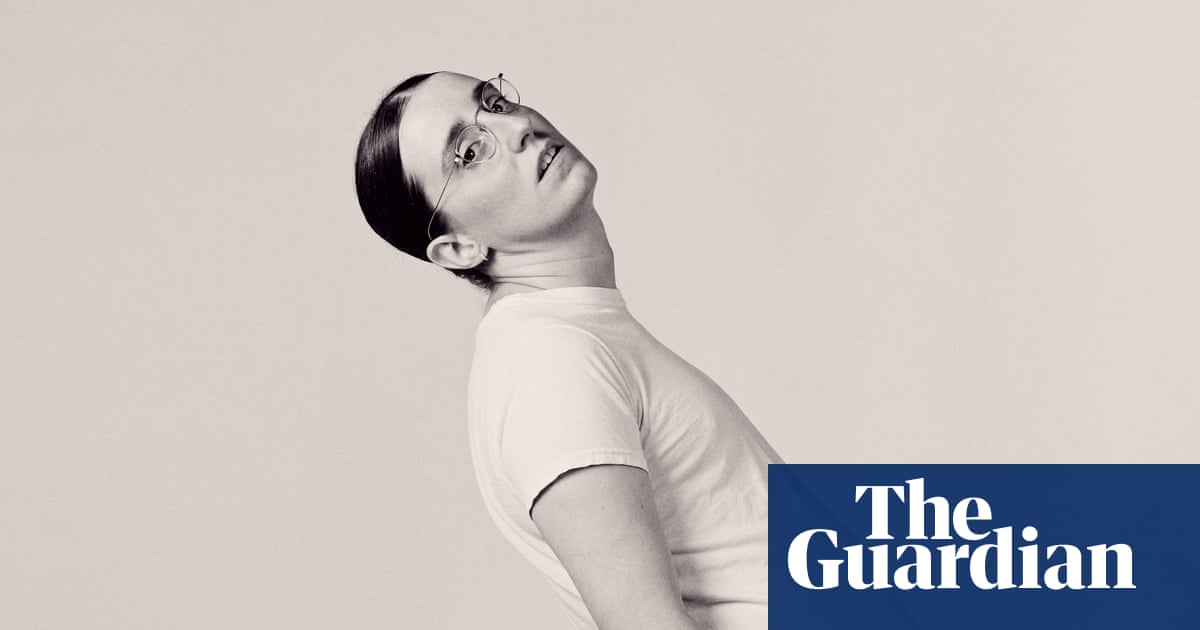
‘Once in a while, you get to see a legend at the absolute top of their game,” booms a voice at the beginning of Robby Hoffman’s Netflix special, Wake Up, welcoming her to the stage. High praise indeed – especially since the voice is that of the leading US comedian John Mulaney, who directed the special, and who clearly thinks this 36-year-old New Yorker is one of the hottest talents around.
He’s not the only one. Over the last year, Hoffman’s star has risen at a stunning pace. She is currently on TV in Rooster, a college campus comedy starring Steve Carell, as well as the fifth season of the critically acclaimed sitcom Hacks. This is only her second season as talent agency assistant Randi, but last year the role earned her an Emmy nomination.
“Last week, I was a Hassidic Lubavitch Jew living in Crown Heights, New York,” was Hoffman’s first line as Randi. “Now I’m in LA, I’m gay and probably an atheist.” Hoffman’s own life has taken a similar about-turn after being thrust into the spotlight. Randi, a role that was created for her by writers Lucia Aniello, Paul W Downs and Jen Statsky and draws on Hoffman’s own background, has been “a life-changing part”, she says on a video call from the home in Los Angeles that she shares with her wife, the reality TV star Gabby Windey. And meeting Carell, one of her childhood heroes, on the set of Rooster was “really good. I mean, he’s a doll.”
Hoffman herself seems like a bit of a doll, too, which might come as a surprise to those who have seen Hoffman’s comedy sets, in which she adopts a boorish, constantly exasperated persona. Wake Up includes gags about “disgusting” women (“always the hottest ones are sickest”) and abortion (“we raise the age of abortion till 10, we got a lot of well-fucking-behaved kids on our hands”). Not to mention the jokes about paedophilia.
But although her punchlines make some audience members bristle, “I just don’t get to choose my thoughts”, the comedian says. “I’m just sharing it with you. I wish I didn’t know some of these things. I truly wish paedophilia was not something that I was introduced to or heard about. I think it’s more democratic that I joke about everything, you know?”
Although Hoffman insists she isn’t trying to offend (“I do think that a lot of my jokes are misinterpreted”), she also doesn’t think being offended is the worst thing: “Being poor is.” She’s speaking from experience: she grew up in a family that relied on welfare payments, the seventh of 10 children.
During the early years of her life, she lived in Brooklyn, where her parents were part of what they would call a Hassidic Jewish community and what she has described in her comedy as a cult. “But I’m also loosey-goosey about what’s a cult,” she says. “I definitely would say it was a fanatic religious sect.” She hasn’t spoken to her father since her early 20s, and even before that, he hadn’t been a significant part of her life for some time. Her mother divorced him and moved back to her native Montreal with the children when Hoffman was in grade school, some time between the ages of five and 11 (she is hazy on the exact timings).
Home life in Montreal was chaotic, living in a house that was “so packed with so many people”, Hoffman says. She would frequently get into physical fights with her brothers and “cried every single day … sometimes I was kicking and screaming on the floor”. She got out as soon as she could, at 17, when she began renting a place of her own, taking on a part-time job to support herself through her Cégep, a type of pre-university college unique to Quebec. After that, “I almost stopped crying for ever”, she says. “It takes me so much to cry now.”
Despite its difficulties, Hoffman’s childhood was “somewhat” stable, she says, thanks to her mother, who would wake up at 5.30am every day to cook, clean and care for her children. Although “emotionally absent”, she was “definitely physically present, which is incredible”, Hoffman says. “No matter what, she was there.” Hoffman does her own bit for the family today by using half her earnings to support her siblings and her mother.
The comedian’s proclivity for referring to women, including herself and her mother, as “bitches” is an aspect of her onstage coarseness that carries over into our call, in which she is otherwise much more mellow and thoughtful. Sure, she doesn’t follow the typical Hollywood script of simpering self-deprecation, instead unapologetically backing herself and frequently talking about how great it is to be rich. But you get the impression that this is self-conscious gaucheness, a send-up of convention rather than outright rudeness.
“I come in hot,” Hoffman admits – especially on stage. But she is not pretending to be something she’s not – unlike, she says, supposedly “kind and nice” figures such as Will Smith, who was banned from the Oscars after slapping the comedian Chris Rock, or Ellen DeGeneres, whose talk show was cancelled after allegations that junior staff had been bullied. Off stage, “you’ll see that I’m a delight”, she says. I can’t argue with that – although I can’t actually see her, since she has refused to put her camera on for our call, her excuse being that she has only just woken up after travelling back from her most recent tour date.
Hoffman is endearingly grateful for her success. “Am I not living one of the greatest lives you’ve heard about?” she said during her recent appearance on Late Night With Seth Meyers. “I really do feel that,” she says. When she started out in comedy, it felt like “such a risk” to pursue a career with no promise of financial stability: “It’s becoming harder and harder to go from no money to money, so when we get one of our guys in, it always feels miraculous.”
She wishes it wasn’t so miraculous – Hoffman is a Bernie Sanders supporter and believes “everybody’s entitled to dignity”. She resents being an example of someone who “did it” – got herself out of poverty via talent and determination. “You shouldn’t have to be this special, you shouldn’t have to be this talented,” she says. (I told you, she backs herself.) Throughout her adolescence, she was “so sick of being poor”, so focused on working hard at the Jewish private school for which her grandfather had helped her win a scholarship, then pursuing a degree in accounting. She briefly worked for the consultancy KPMG after completing her degree at McGill University in Montreal, before swapping accounting for the comedy circuit and TV writing work.
“Comedy was foisted upon me, like Moses or something,” she says. (She makes more than one reference to religion and God in our conversation, although these days her only belief is that “there’s something larger than us”.) She was soon rewarded for following her calling, winning a daytime Emmy in 2019 as a writer on the children’s TV series Odd Squad and recording her first standup comedy special, I’m Nervous, the same year.
By the time she joined the cast of Hacks, she had developed a devoted following, via not just her standup, but also the podcast she co-hosted with the comedian Rachel Kaly, Too Far, and her high-profile relationship with Windey. The pair have become darlings of the LGBTQ+ community, with images of their 20-minute wedding ceremony shared all over the internet after they tied the knot in Las Vegas last year. The whole thing had an air of chic irreverence, including Windey’s Instagram announcement post captioned: “Husband and wife!!”
Despite identifying as a woman, Hoffman has had top surgery, the breast-removing procedure typically associated with transgender men and non-binary people. Using they/them pronouns “would have been a viable option for a person like me”, she tells the audience in a set she recorded for Netflix’s Verified Stand-Up series, before joking at length about the non-binary community.
She is gentler on the topic when we discuss it, although she stands by her gags (“If I can’t talk about it, who can? It’s crazy. You’re only going to let Joe Rogan talk about this shit?”). She says she is respectful of non-binary friends and uses their chosen pronouns (“of course”); when it comes to her own identity, she is “definitely in a genderqueer space”. She is broadly happy with being a woman, although “something is off”, she says, as “most girls don’t want to cut their tits off”. For her, the decision to get surgery came down to her preference for a “boyish physical appearance. I’m a lot more comfortable this way.”
When she feels it’s important, Hoffman is unapologetic about sticking her neck out, as she did in 2023 when the Writers Guild of America (WGA) announced a strike to secure higher pay for writers, better job security and tighter regulation of artificial intelligence. In a statement at the time, the WGA said major studios’ behaviour had “created a gig economy” that risked turning writing into an “entirely freelance” profession. Hoffman questioned that decision, having looked through the union’s financial statements with her accountant’s eye.
“I said: hey, hey, hey, have you sued? Why are we not? We should be paying for lawyers and litigating at every nook and turn and cranny. The idea to go on strike before you’ve exhausted all of our other litigious efforts really felt like a slap in the face.”
Months into the strike, WGA members became interested in her view. “I had so many people, hundreds of people in my DMs, saying: hey, what were you talking about? Or where can I see this information?” But her questions didn’t go down well in WGA’s initial meeting – she was booed – and she says now that “maybe my timing was autistic and off”.
Hoffman has described herself as autistic before, but she doesn’t have an official diagnosis. “But I will say that my wife, we watch Love on the Spectrum, and she feels like she understands me better with each episode.”
Towards the end of our call, I hear Windey’s distinctive vocal fry on the line; she has come to tell Hoffman there is avocado toast and orange juice ready for breakfast. “That is so nice, love. Thank you,” Hoffman says, her voice switching to a softer, more tender tone.
The comedian had been single for a while before she met Windey three years ago outside a bar in LA. “It was a little bar, but it was having a dyke night and I missed most of it because I was out doing standup,” Hoffman says. “But I went at the end of it to meet one of my friends and they were kind of filing out. And I said: let’s bum a ciggy.” So she and her friend headed outside, where Windey was waiting for an Uber: “I met my match.”
After some chatting, “I said: listen, I’m not going to beat around the bush – pun intended at the dyke bar – but I gotta get your number”, Hoffman recalls. It must have been surprising to see the former star of The Bachelorette, who had identified as straight before she met Hoffman, at a lesbian night, I say. “She said she was exploring,” Hoffman says with a laugh. “I heard that one before.”
She continues: “I feel so, so lucky to have met her. We love being together. We love living together. We’re not having kids – she is my family. She is my life and I am hers and we love it.” That’s not to say it’s always sunshine and roses. “We’re not going to live in a relationship where we don’t ever hurt each other’s feelings,” she says. “And that’s OK. Let’s deal with it.”
Hoffman’s refreshing honesty is surely a large part of the reason that audiences can’t seem to get enough of her. She has added 10 dates to her tour and has her own TV show in the works. All of us are “going to live a life of happiness and pain and suffering and joy and all of it”, she says. “I just don’t think it’s my job to spare anyone of anything necessarily.” So what does she consider to be her job? “My job is just to be me. I’m trying to allow myself to be as ‘me’ as possible.”
Hacks is available in the UK on Sky Atlantic and Now
Source: https://www.theguardian.com/lifeandstyle/2026/may/11/robby-hoffman-controversial-comedy-sensation-netflix
About the Author