Introduction: Asian stocks fall as Iran and US exchange fire
Asian stocks have fallen sharply after Iran and the US exchanged their biggest round of fire since a ceasefire was agreed in April.
The US launched strikes against Iran after Donald Trump blamed Tehran for downing a US army helicopter near the strait of Hormuz.
The attacks triggered a wave of retaliatory strikes from Iran on Wednesday morning, with Tehran saying it had targeted Kuwait, Bahrain and Jordan.
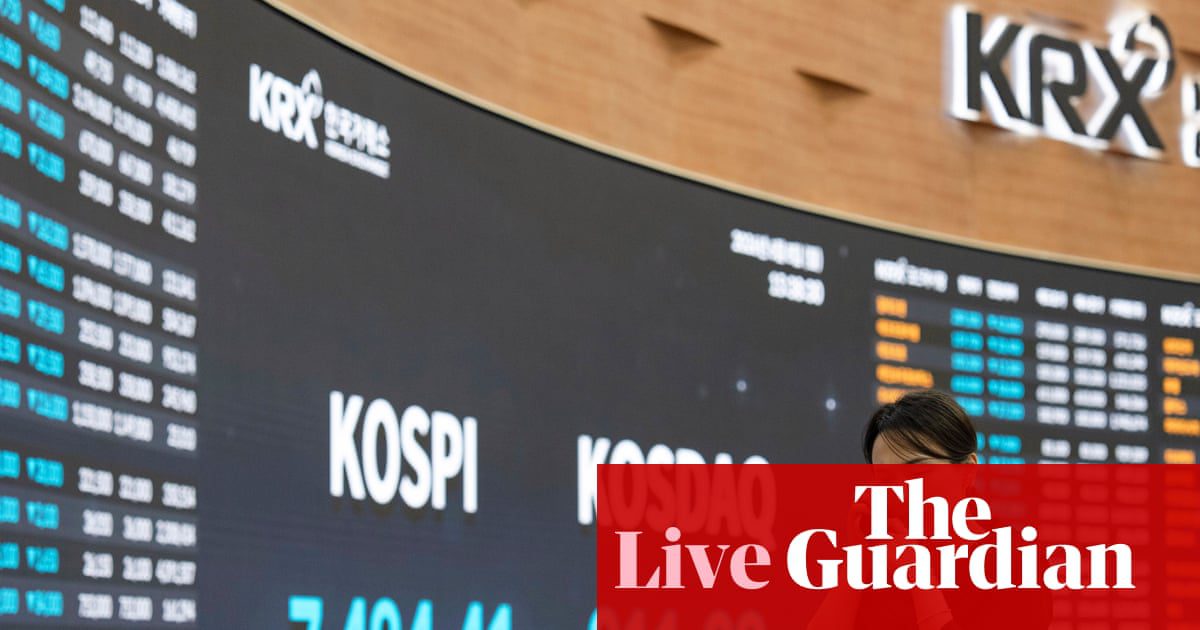
Japan’s Nikkei index dropped 2%, while the tech-heavy South Korean Kospi slumped by about 6% – although it is still up by more than 70% in the year to date.
However, oil prices have actually fallen a bit this morning, with Brent crude – the international benchmark – down 0.2% to $91.28 a barrel.
Jim Reid at Deutsche Bank suggests that while investors are preoccupied with the conflict in the Middle East, “markets are also swinging between 1999-style AI exuberance and 2000-type tech crash fears.”
On the former, Brent briefly fell below $90 for the first time since April 17th yesterday before partially rebounding after Trump vowed retaliation following Iran shooting down a US helicopter. On the latter, the Philly Semiconductor Index fell by as much as -8.62% intra-day before recovering to -1.93% by the close.
European stock markets also look like they are poised for a muted start at the open today: futures for the FTSE 100 are pointing to just a 0.1% fall, while EuroStoxx 50 futures are down 0.1%.
Elsewhere this morning, new figures out of China show its factory gate prices rose at the fastest rate in four years, amid a sharp rise in energy prices triggered by the war in Iran.
The producer price index (PPI) rose 3.9% in May from a year earlier, National Bureau of Statistics data showed on Wednesday, above a 3.8% forecast in a Reuters poll and 2.8% rise in April.
It marked the third consecutive monthly rise in a row and the highest growth rate since July 2022.
Economists at the consultancy Pantheon Macroeconomics say that the rebound is “largely a cost push story, not stronger demand”.
Kelvin Lam, senior China economist, says:
Reflation is expected to continue in the near term due to the lasting impact of the war in Iran on imported energy costs, and of course the fading drag from from negative carry-over effect from last year, which most people forget.
While oil and gas futures markets are no longer pricing in a further escalation in the Middle East, uncertainty surrounding the peace talks and the effective reopening of the strait of Hormuz appears likely to linger in the near term. Despite the acceleration in the annual rate, monthly momentum slowed noticeably, to just 0.5% m/m from 1.7% a month ago.
This probably reflects two things. First, global energy markets are no longer expecting a broadening of the conflict as before, with a $150 per barrel scenario now looking increasingly unlikely, and prices have already fallen back from their highs. Second, China is relatively immune from an inflation pass-through point of view, with subdued domestic demand making it more difficult for producers to raise factory gate prices.
The agenda
-
9am BST: Deadline data for the CMA and Ofcom to report back to government on the Telegraph/Mail deal
-
1.30pm BST: US inflation for May, forecast to rise to 4.2%
-
2.15pm BST: Treasury Committee hearing on student loans
Key events
Susannah Streeter, of the broker Wealth Club, says that the fresh round of conflict in the Middle East has seen “optimism seep away” from the markets – but the key driver today is likely to be the latest US inflation data, which will be released this afternoon.
The CPI numbers are set to show another painful rise in costs for consumers, who are already grappling with sharp increases in the costs of everyday goods.
The expectation is that the headline rate will rise to 4.2% year-on-year with a 0.5% jump in May. The big concern is that elevated wholesale energy costs are spreading and settling into the broader economy. The latest attacks in the Middle East indicate that the conflict is entrenched and increasingly hard to solve.
Introduction: Asian stocks fall as Iran and US exchange fire
Asian stocks have fallen sharply after Iran and the US exchanged their biggest round of fire since a ceasefire was agreed in April.
The US launched strikes against Iran after Donald Trump blamed Tehran for downing a US army helicopter near the strait of Hormuz.
The attacks triggered a wave of retaliatory strikes from Iran on Wednesday morning, with Tehran saying it had targeted Kuwait, Bahrain and Jordan.
Japan’s Nikkei index dropped 2%, while the tech-heavy South Korean Kospi slumped by about 6% – although it is still up by more than 70% in the year to date.
However, oil prices have actually fallen a bit this morning, with Brent crude – the international benchmark – down 0.2% to $91.28 a barrel.
Jim Reid at Deutsche Bank suggests that while investors are preoccupied with the conflict in the Middle East, “markets are also swinging between 1999-style AI exuberance and 2000-type tech crash fears.”
On the former, Brent briefly fell below $90 for the first time since April 17th yesterday before partially rebounding after Trump vowed retaliation following Iran shooting down a US helicopter. On the latter, the Philly Semiconductor Index fell by as much as -8.62% intra-day before recovering to -1.93% by the close.
European stock markets also look like they are poised for a muted start at the open today: futures for the FTSE 100 are pointing to just a 0.1% fall, while EuroStoxx 50 futures are down 0.1%.
Elsewhere this morning, new figures out of China show its factory gate prices rose at the fastest rate in four years, amid a sharp rise in energy prices triggered by the war in Iran.
The producer price index (PPI) rose 3.9% in May from a year earlier, National Bureau of Statistics data showed on Wednesday, above a 3.8% forecast in a Reuters poll and 2.8% rise in April.
It marked the third consecutive monthly rise in a row and the highest growth rate since July 2022.
Economists at the consultancy Pantheon Macroeconomics say that the rebound is “largely a cost push story, not stronger demand”.
Kelvin Lam, senior China economist, says:
Reflation is expected to continue in the near term due to the lasting impact of the war in Iran on imported energy costs, and of course the fading drag from from negative carry-over effect from last year, which most people forget.
While oil and gas futures markets are no longer pricing in a further escalation in the Middle East, uncertainty surrounding the peace talks and the effective reopening of the strait of Hormuz appears likely to linger in the near term. Despite the acceleration in the annual rate, monthly momentum slowed noticeably, to just 0.5% m/m from 1.7% a month ago.
This probably reflects two things. First, global energy markets are no longer expecting a broadening of the conflict as before, with a $150 per barrel scenario now looking increasingly unlikely, and prices have already fallen back from their highs. Second, China is relatively immune from an inflation pass-through point of view, with subdued domestic demand making it more difficult for producers to raise factory gate prices.
The agenda
-
9am BST: Deadline data for the CMA and Ofcom to report back to government on the Telegraph/Mail deal
-
1.30pm BST: US inflation for May, forecast to rise to 4.2%
-
2.15pm BST: Treasury Committee hearing on student loans
Source: https://www.theguardian.com/business/live/2026/jun/10/asian-stocks-fall-us-iran-exchange-fire-middle-east-strait-of-hormuz-oil-prices-latest-news-updates
About the Author