A minivan with darkened windows pulls up at a gym in central Chernihiv and, once the doors have slid open, a stream of youths emerges into the daylight. Inside, Artem Rakitin sits everyone down on the rubber mat for one last pep talk. He has known most of the young men for several years, working with them here twice a week and in effect acting as a mentor. It is a kind of physical and mental training, he explains: self-discipline; resisting vices; preparing oneself, if the moment comes, to defend his country. “One of the main targets is for them not to become alcoholics, drug addicts or anything like that,” he says. “It’s to put their energy in the right places, and to support the right team.”
The team they follow is FC Chernihiv and, on Wednesday evening, the second-tier side will face Dynamo Kyiv in a Ukrainian cup final nobody could have predicted. FC Chernihiv are battling relegation but, to delirious scenes, won their semi-final against Metalist 1925 Kharkiv on penalties despite being reduced to 10 men in the fifth minute. They are one more upset from an improbable Europa League spot; it is a remarkable moment for a city, tucked in Ukraine’s north towards the Russian and Belarusian borders, that has suffered devastating losses since February 2022.
Rakitin knows the significance as well as anyone. During Russia’s siege of Chernihiv, which lasted for more than a month in the early stages of the full-scale invasion, he led the evacuation of about 25,000 women and children from the city. “I trained here, I studied here, everything is here,” he says. “I love my city very much.”
It earned him national renown and, as a special forces officer with the call sign “Rocket’, he later played vital roles in the high-profile liberations of Snake Island and the Boyko Towers gas platforms from Russian control. “A while afterwards I came to the realisation that these were very important events, not only for Ukraine but for the whole world,” he says. “They were the first operations of this kind.” He continued to serve near the frontlines until shrapnel from tank shelling cost him his right eye.
“It’s a crucial moment for us in these circumstances,” he says of the final, which will be played in Lviv. “Drones, ballistic missiles, rockets and sirens have affected sports all over the Chernihiv region. Having a club representing our city and area on this stage makes it the greatest moment in the history of Chernihiv football.”
Earlier this season Rakitin decided to fashion a new ultras group, culled largely from the teenagers he trains at the gym. FC Chernihiv had lacked that kind of active support during their rise from regional football to the first league, which they joined upon the domestic sport’s resumption in August 2022. “At every away game our support is very vocal, very loud,” he says. “We know all of the team’s players personally.”
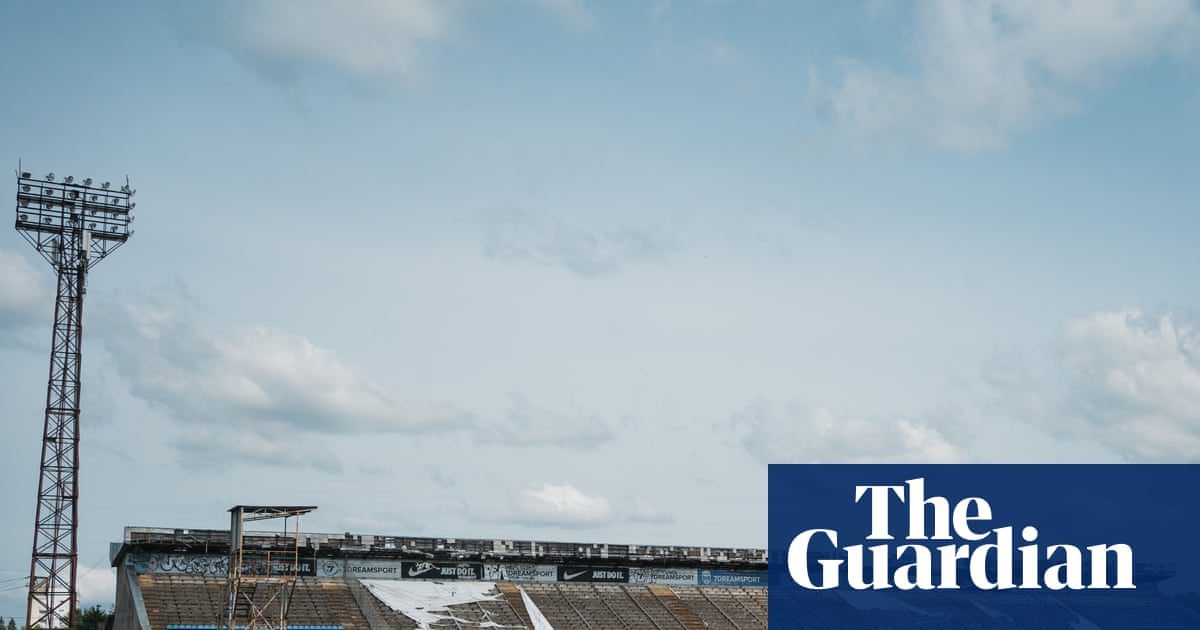
One of the group, Bohdan, remembers watching the city’s famed FC Desna club with his father. In 2017 they looked on at Chernihiv’s central stadium as Desna beat Zirka Kropivnytskyi 4-0 and secured promotion to the Ukrainian Premier League. “It was my first time, a crazy match,” he says. Bogdan was hooked but in March 2022 the venue was reduced to ruins by Russian shelling. Desna would not compete at senior level again. Images of the destroyed arena circulated worldwide: it chillingly encapsulated the decimation of sporting infrastructure in large areas of Ukraine. A walk around its pitch brings home the level of violence inflicted back then.
FC Chernihiv’s ascent, forged by a team and staff composed largely of locals, is a compelling response. Football in this attractive, historic city, which housed nearly 300,000 people at the start of 2022, has bounced back in full view. Yet again, Ukraine has built something new on top of the rubble. Wednesday’s cup finalists have had to contend with damage to their own facilities. Their small, smart stadium and training ground in the city’s north were situated directly between the Ukrainian and Russian forces during the siege. The main pitch was bombed by the latter and, by happy coincidence, its renovation is due to be completed this week. Debris is still visible around its periphery. On Saturday, when Inhulets visit for a crucial league game, the team will play on it for the first time in more than four years.
Bounding around one of the side pitches, Ihor Bobovych is hard at work. It is Monday and the first team, along with the manager, Valeriy Chornyi, and most of his coaching staff, set out on the nine-hour drive to Lviv at 7am. But FC Chernihiv’s academy plays an essential role in offering hope to youngsters from a ravaged region where, otherwise, it may not exist. About 500 children train regularly in their youth system, a number of whom have lost parents during wartime. A greater figure still must grow up while their fathers or mothers serve in the army. Bobovych, once a prolific Desna striker and now a youth coach, is giving an individual session to one of their prospects.
“How can it not be important?” he says of football’s responsibility to local youngsters. “It gives them the opportunity to train, and not to sit in basements and bomb shelters. We do our job as coaches: we can’t replace their parents but we can distract them a little from all of this. It’s better this than they sit and think about whether a Shahed drone just flew over them. An academy can be a beacon of hope.”
Chernihiv remains under attack and the fact is reinforced when, on the 10-minute drive between the club’s base and the city centre, what appears to be a Russian drone explodes overhead. It has been downed by the local air defence in broad daylight; fortunately nobody will discover whether its intended destination was nearby or, perhaps, 90 miles away in Kyiv. FC Chernihiv’s owners, Yurii and Mykola Synytsia, have driven the club’s rapid development despite the surrounding turmoil but their vision of an expanded 4,000-capacity stadium may not be realised until less dangerous times.
The dream of cup glory, though, could not be more immediate. FC Chernihiv’s annual budget of £560,000 is the lowest in their division but they have earned their shot at Dynamo’s giants. About 900 of their fans, clad in yellow and black, will be present inside Arena Lviv; three busloads will depart the stadium at daybreak on Wednesday.
Then, of course, there is Rakitin and his proteges. Back at the gym he runs the rapt group through their plan for the final: departure times and locations along with the visual display, which will represent their city’s heritage, that they have planned to unfurl in the stands. “We have prepared, and we will surprise you,” he says, the hint of a smile breaking out. A city’s story of sporting resilience and renewal may yet find more ways to stir the soul.
Source: https://www.theguardian.com/football/2026/may/20/fc-chernihiv-ukranian-cup-final
About the Author