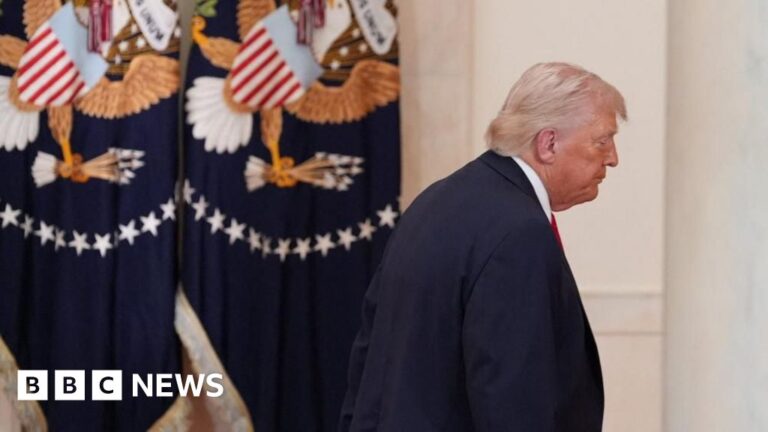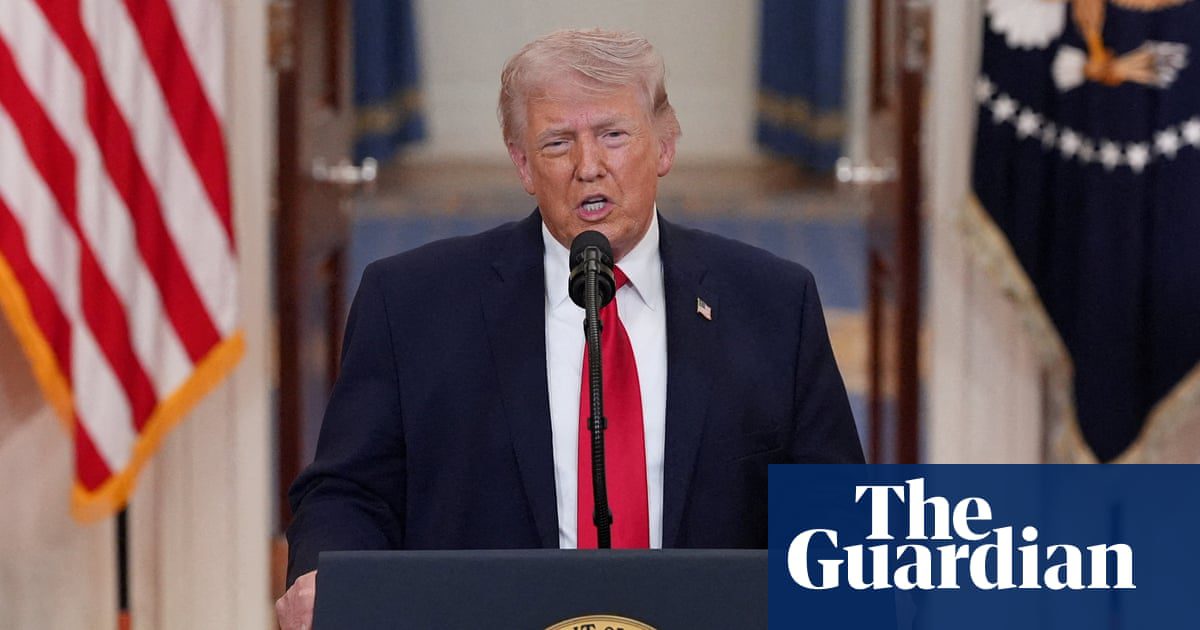
Donald Trump used a primetime address to the nation on Wednesday evening to declare the month-long war in Iran a success “nearing completion”, despite a spiraling conflict that has caused economic turmoil across the globe, fractured transatlantic alliances and eroded the president’s approval ratings.
In remarks from the White House, Trump argued that the US’s “little journey” to Iran had nearly accomplished “all of America’s military objectives”, but offered little clarity on how he planned to wind down the conflict over the next “two to three weeks”.
“We are on the cusp of ending Iran’s sinister threat to America and the world,” Trump said in the 19-minute speech, delivered from Cross Hall of the White House. “We have all the cards. They have none.”
Acknowledging the economic pain caused by the conflict, he blamed a “short-term” rise in gas prices on Iran’s actions, and insisted the US had become energy independent.
Oil prices rose over the remarks, which appeared to have done little to soothe market worries over the closure of the strategic strait of Hormuz, with the US president reiterating his call for governments to help security the global oil chokepoint. “Grab it and cherish it,” he implored the countries who rely on it.
Iran has effectively closed the strait of Hormuz, amid its continued attacks on oil and gas tankers and other merchant shipping since the beginning of the conflict, causing oil prices to soar. In the US, the cost of gas surged past an average of $4 a gallon for the first time since 2022 this week.
Ticking through a list of achievements, Trump said Iran’s navy and air force had been decimated, leaving the country weak and “no longer a threat” to the US and the world. He, however, said the US would continue to hit Iran “extremely hard” for next several weeks.
“We’re going to bring them back to the stone ages, where they belong,” he said, even as he said “discussions were ongoing”.
Yet the war is grinding on, with thousands of deaths in Iran and in countries across the Middle East since the war began on 28 February. Strikes rocked Tehran on Wednesday morning. And Israel said it had carried out two waves of attacks on Tehran and claimed to have killed a senior Hezbollah commander in Beirut.
Iran has continued to retaliate, with missile attacks on central Israel and across the Middle East – including a barrage timed just hours before the start of the Jewish holiday of Passover.
According to estimates from the International Federation of Red Cross and Red Crescent societies, at least 1,900 people have been killed and 20,000 injured in Iran since the war began, though precise figures are difficult to verify.
In Lebanon, more than 1,300 people have been killed, according to the country’s health ministry. Most of those who have died have been Lebanese civilians, but Hezbollah estimates about 400 have been its fighters.
And a total of 19 people have been killed and 515 injured in Israel since the war began.
At least 13 American service members have been killed, with hundreds more troops wounded.
US forces have struck more than 12,300 targets inside Iran since the start of Operation Epic Fury, according to a statement released by US Central Command on Wednesday.
Since the start of the war, the Trump administration has sent mixed and at times contradictory signals about the US’s objectives. Trump has repeatedly claimed that Iran’s leadership was seeking a ceasefire, and in a Wednesday social media post described Iran’s “new regime president” as having “just asked” for one – which Tehran called “false and baseless”.
Furthermore, it was unclear who the US president had spoken to – Iran has a new supreme leader, Mojtaba Khamenei, who succeeded his father, the late Ayatollah Ali Khamenei, after he was killed on the opening day of US-led airstrikes against Iran. Iranian president Masoud Pezeshkian took office in July 2024.
Before the president’s speech on Wednesday, Pezeshkian appealed directly to the American people with a message of his own. “Exactly which of the American people’s interests are truly being served by this war?” Pezeshkian asked in a letter posted in English on his X account. “Was there any objective threat from Iran to justify such behavior?”
Pezeshkian suggested the US had entered the war at Israel’s urging, and insisted that Iran’s attacks on its neighbors was a “measured response grounded in legitimate self-defense”.
“Is ‘America First’ truly among the priorities of the US government today?” he asked.
Complicating the picture further, Trump has lashed out at the US’s allies, citing their refusal to join the war effort and inaction to reopen the strait of Hormuz in a series of escalating social media posts and interviews. In his remarks on Wednesday evening he made no mention of Nato, but earlier in the day he told Reuters he was “absolutely without question” considering withdrawing from Nato.
He also told the Telegraph that he was “never swayed” by the 77-year-old military alliance and “always knew they were a paper tiger”.
Trump has suggested that a ceasefire would depend on Tehran reopening the strait of Hormuz, while indicating that US forces could be “out of Iran pretty quickly”. He left open the possibility of “spot hits” inside Iran if necessary.
In his speech, the president also took pains to distinguish the current conflict from America’s often lengthy past wars, calling the 32-day military campaign “so powerful, so brilliant”.
With the war in its fifth week, key US objectives remain unclear. Trump has downplayed concerns about Iran’s stockpile of highly enriched uranium, dismissing it as too deeply buried underground to matter. He had previously argued that preventing Iran from obtaining a nuclear weapon was a major justification for the war. Analysts have disputed the US president’s claims that Iran was close to building a nuclear weapon.
Meanwhile, thousands of US troops remain positioned in the region, providing the option of a broader ground campaign after weeks of airstrikes targeting Iran.
Source: https://www.theguardian.com/us-news/2026/apr/01/trump-iran-war-address-white-house
About the Author