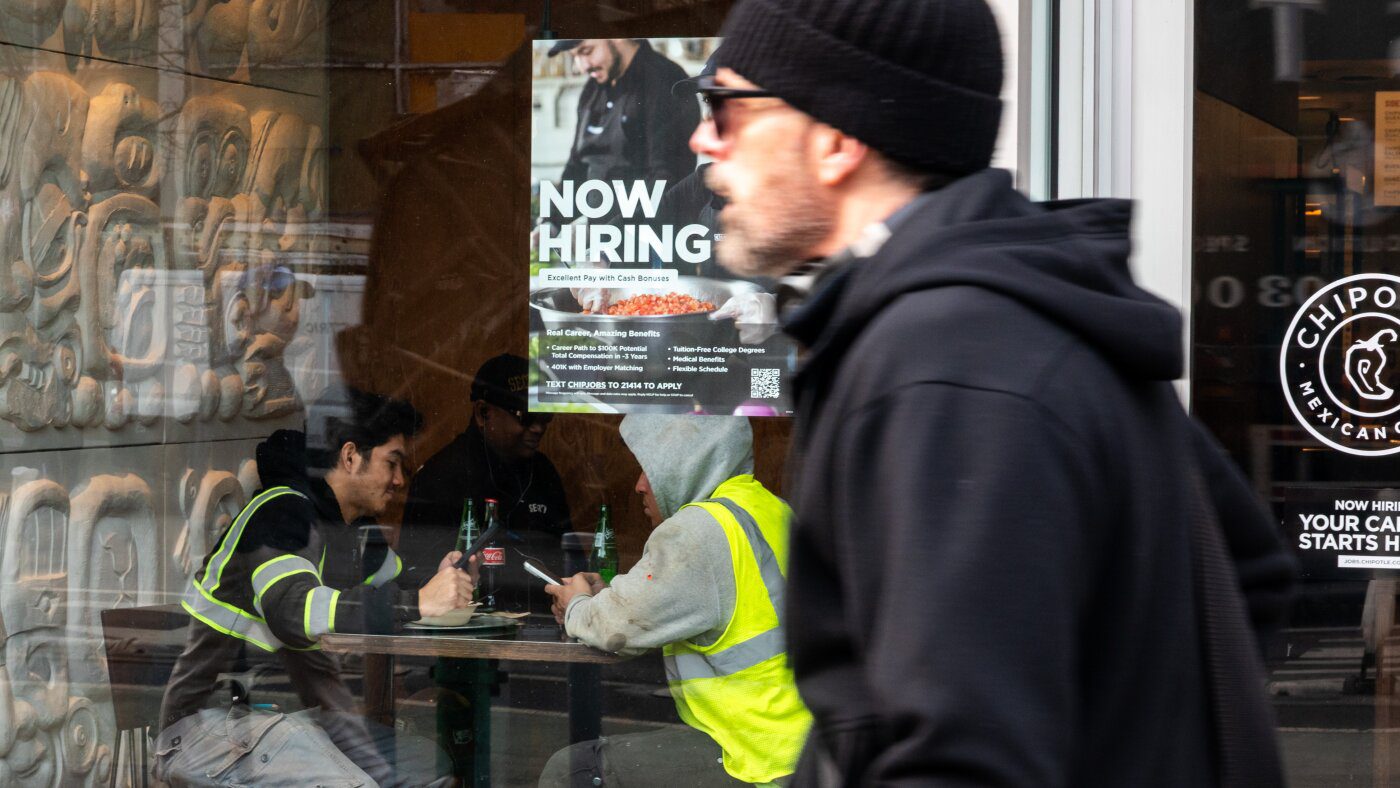

The job market thawed somewhat last month as U.S. employers added 130,000 jobs. The unemployment rate dipped to 4.3%.
Spencer Platt/Getty Images North America
hide caption
toggle caption
Spencer Platt/Getty Images North America
Hiring grew a little warmer last month after a chilly year in 2025.
A report from the Labor Department Wednesday showed U.S. employers added a better-than-expected 130,000 jobs in January — but an annual update shows hiring last year was much weaker than initially reported.
The news comes amid worries that the nation’s jobs engine has been sputtering. Employment gains for November and December were revised down by a total of 17,000 jobs.
Once a year, the Labor Department updates its jobs tally with more accurate but less timely information drawn from unemployment tax records. Wednesday’s revision shows there were nearly 900,000 fewer jobs in the economy last March than originally counted. On average, employers added only 15,000 jobs a month in 2025.
“This does not remotely look like a healthy labor market,” Federal Reserve governor Chris Waller said in a statement anticipating the revision.
Waller urged his central bank colleagues to cut their benchmark interest rate last month in an effort to prop up the sagging job market. But most Fed policymakers voted to hold rates steady in January, after three rate cuts last year.
Health care and construction led way
Health care and construction were among the few industries that saw significant job gains in January. The warehouses and transportation industry lost jobs and the federal government continued to shed workers. Manufacturing added 5,000 jobs while hospitality added just 1000.
The unemployment rate dipped to 4.3% from 4.4% the month before. That’s quite low by historical standards. The unemployment rate among African Americans also fell, but remains elevated at 7.2%.
Some of the weakness in job growth last year may reflect a drop in the number of available workers. The Trump administration has slammed the door on most people trying to enter the country, while aggressively deporting immigrants who have been living in the U.S. illegally. At the same time, many native born baby boomers are reaching retirement age and leaving the workforce.
But Waller says that explains only part of what’s weighing on the job market.
“Employers are reluctant to fire workers, but also very reluctant to hire,” Waller said in is statement. “This indicates to me that there is considerable doubt about future employment growth and suggests that a substantial deterioration in the labor market is a significant risk.”
A few years ago, there were two job openings for every unemployed worker. By December, that had dropped to less than one. That slack in the job market means employers don’t have to pay as much to attract and keep workers. Average wages in January were up 3.7% compared to a 3.8% gain in December.
The monthly jobs tally is usually released on the first Friday of the following month, but the January count was delayed a few days because of last week’s government shutdown.
Source: https://www.npr.org/2026/02/11/nx-s1-5708807/jobs-labor-unemployment-economy
About the Author