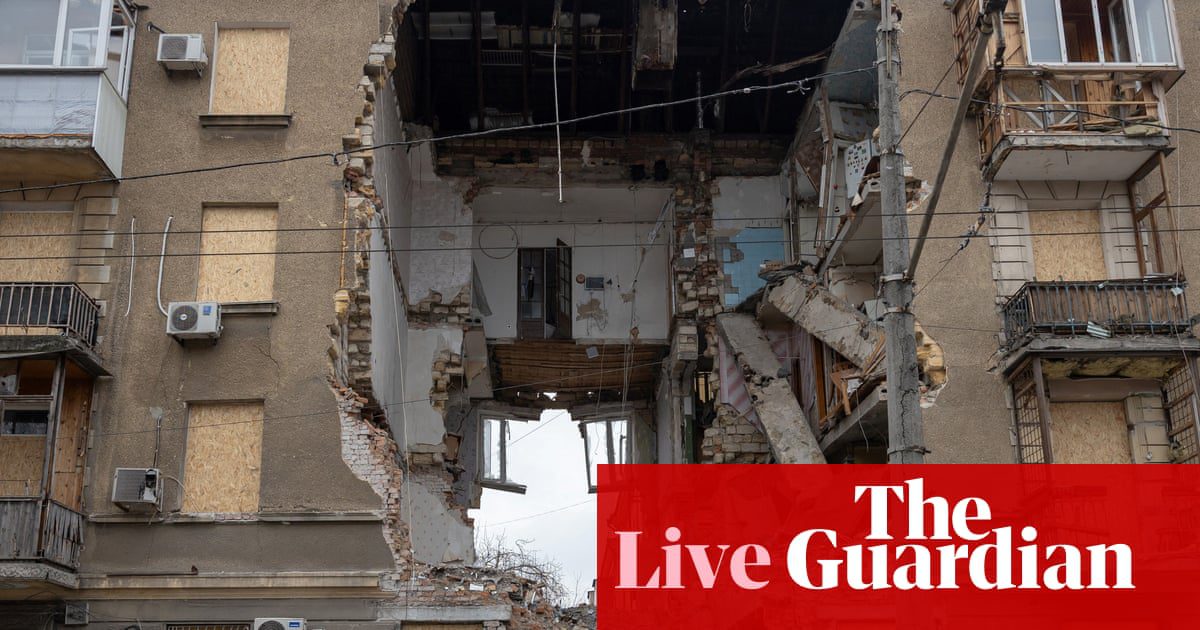
Russia ‘not ready for peace’ with ‘no tangible signs’ of serious engagement, EU says
The EU sees “no tangible signs that Russia is engaging seriously” with the aim of securing peace in Ukraine, its spokesperson said, responding to the latest round of talks in Geneva.
Speaking at the European Commission’s midday briefing in Geneva, EU foreign affairs spokesperson Anouar El Anouni said:
“We see that Russia continues its relentless attacks on Ukraine. This does reflect that Russia is not ready for peace. We still do not see tangible signs that Russia is engaging seriously on peace. …
Even this week, ahead of the peace talks, Ukraine experienced another massive missile and drone strike, according to Ukrainian authorities. …
As long as the bloodshed continues, we will continue to put pressure on Russia.”
He also added that “nothing can be decided about Ukraine without Europe at the negotiating table.”
The EU also confirmed that it was aware that national security advisers from France, Germany, Italy, UK were involved in the talks.
Key events
France repeats its rejection of Trump’s Board of Peace, criticises European Commission for attending
Meanwhile, just as the meeting begins, France has just reiterated its opposition to the body, with its foreign ministry spokesperson insisting Paris will not participate as long as ambiguity about its governance remains, Reuters reported.
The spokesperson also added that the Board of Peace should be recentered on Gaza in line with US security council resolution, and said France was “surprised” to see the European Commission attending as it had “no mandate to go there and participate.”
The meeting of the Board of Peace is now about to get under way, with Trump walking into the venue to Laura Branigan’s 1982 song Gloria, after Albania’s Edi Rama awkwardly vibed in place side-to-side waiting for the host.
“Does everybody like the music? It’s good music,” Trump says.
Erm.
Trump’s Board of Peace meets with 14 EU countries and commission represented – but only Hungary joining as member
Donald Trump’s Board of Peace is about to meet in Washington DC this afternoon, with several European countries in attendance – although most of them merely as “observers”.
Italy, Poland, Czech Republic and Romania are among more than a dozen of countries sending senior officials to the meeting, but only Hungary is actually expected to be part of the board as a member.
The European Commission is also, unexpectedly and somewhat controversially, represented with the commissioner for the Mediterranean, Dubravka Šuica, attending as an observer.
A number of EU countries raised concerns about her presence at the event, Euronews reported.
Responding to the backlash, the commission insisted earlier today the EU was not joining the Board of Peace and Šuica’s presence should not be seen as endorsement of the body, as the EU “has expressed our concerns with some of the issues in relation to the Board of Peace.”
“Our participation is to be seen in the context of our longstanding commitment for the implementation of the ceasefire in Gaza, as well as our commitment to take part in international efforts when it comes to the recovery and reconstruction of Gaza. We do believe that we have an important role to play,” EU spokesperson Guillaume Mercier said.
He added that 14 EU member states are also represented “at different levels.”
For detailed coverage of the meeting, turn to our US blog below with Shrai Popat, but I will also pick up bits related to Europe:
Airbus suggests split solution for Europe’s faltering fighter jet programme
Alex Daniel
In other news, Airbus has suggested splitting Europe’s faltering future fighter jet programme into two separate warplanes, amid a dispute between manufacturers over who leads the €100bn (£87bn) project.
The company’s defence arm – which represents Germany and Spain – and the French partner, Dassault Aviation, are locked in a battle over the jet part of the Future Combat Air System (FCAS), a wide-ranging project that will also include autonomous drones and a futuristic “combat communications cloud”.
Guillaume Faury, Airbus’s chief executive, said on Thursday that the deadlock over the planned next-generation jet “should not jeopardise the entire future of this hi-tech European capability, which will bolster our collective defence.
“If mandated by our customers, we would support a two-fighter solution and are committed to playing a leading role in such a reorganised FCAS delivered through European cooperation.”
Earlier this week, the German chancellor, Friedrich Merz, signalled that the planned warplane did not suit Germany’s needs, in the latest blow to the project. The German military does not need a nuclear-capable fighter, while France does, he said on the German political podcast Machtwechsel, insisting it was “not a political dispute” but a technical one between the two countries.
Europe’s FCAS, announced in 2017, has faced repeated hurdles amid Airbus and Dassault’s power struggle and, more recently, over what the French and German governments want from the project. Germany, France and Spain are expected to decide soon whether to move to the next stage of the programme as planned, or drop the jet and move forward with the other elements.
Dual nationals could use expired UK passports to prove they are British, Home Office says

Lisa O’Carroll
Meanwhile, British dual nationals may be able to use expired UK passports to prove to airlines they are British when controversial new immigration rules come into force, the Home Office has said.
New rules, coming into force on Wednesday, require anyone who is coming into the UK with British dual nationality to present a British passport when boarding a plane, ferry or train or buy a “certificate of entitlement” costing £589 to attach to their foreign passport.
Airlines and other transport operators risk being fined if they board passengers who do not have the right to enter the destination country. Dual nationals are not eligible for the ETA on their second passport so risk being rejected by airlines if they cannot prove their right to enter the UK.
The rules have caused stress, disgust and bafflement among Britons with imminent travel plans whose passports have expired or who do not have a British passport in the first place, including children born abroad.
The Liberal Democrats have called for a grace period to allow Britons affected by the change in rules to get new passports, a process that could take many weeks.
Hungarian opposition leader protest against Orbán’s emotive war ad ahead of key elections
Meanwhile, another controversy has erupted in Hungary, as the country gets closer to the key parliamentary election in April, which could see Viktor Orbán ousted after 16 years in power.
Opposition leader Péter Magyar protested after Orbán’s ruling Fidesz party aired an emotive campaign video showing a little girl weeping at a window, intercut with scenes of her father being executed in war, Reuters reported.
Orbán, one of Europe’s most pro-Russian politicians who was last week endorsed by the US president, Donald Trump, has cast a parliamentary election on 12 April, which could see him ousted after 16 years in power, as a choice between “war and peace“.
He repeatedly asserted that Magyar’s centre-right Tisza party would, at the behest of the European Union, drag Hungary into Ukraine’s war against Russian invasion.
The 33-second video, published on the Facebook page of Fidesz’s Budapest branch, depicts a kneeling, blindfolded soldier in Hungarian uniform being shot on a rain-drenched battlefield.
Without offering any evidence to back up the claim, the video’s caption said:
“This is only a nightmare now, but Brussels is preparing to make it a reality … Let’s not take risks. Fidesz is the safe choice!”
In a statement, Magyar called the video “sickening, unforgivable and deeply outrageous.” “This is not politics, this is soulless manipulation,” he said.
In the last hour, he added:
“No matter how much you lie, no matter how much you incite hatred, you cannot break me. The Hungarian people stand with me. The deeper you sink, the more of us there will be. 52 days left.”
4.1 magnitude earthquake reported north west of Lisbon, Portugal
An earthquake of magnitude 4.1 on the Richter scale has struck near Portugal’s capital Lisbon, the country’s Institute of the Sea and the Atmosphere (IPMA) said.
The epicenter was reportedly located four kilometers west of the municipality of Alenquer, 40 kilometers north-east of the capital.
There were no immediate reports of serious damage.
Sweden pledges new military aid package to Ukraine in response to Zelenskyy’s call for help
Meanwhile, Sweden has pledged about €1.2bn in new military support package for Ukraine, responding to president Volodymyr Zelenskyy’s call for urgent help with air defence and ammunition over the weekend.
Russia ‘not ready for peace’ with ‘no tangible signs’ of serious engagement, EU says
The EU sees “no tangible signs that Russia is engaging seriously” with the aim of securing peace in Ukraine, its spokesperson said, responding to the latest round of talks in Geneva.
Speaking at the European Commission’s midday briefing in Geneva, EU foreign affairs spokesperson Anouar El Anouni said:
“We see that Russia continues its relentless attacks on Ukraine. This does reflect that Russia is not ready for peace. We still do not see tangible signs that Russia is engaging seriously on peace. …
Even this week, ahead of the peace talks, Ukraine experienced another massive missile and drone strike, according to Ukrainian authorities. …
As long as the bloodshed continues, we will continue to put pressure on Russia.”
He also added that “nothing can be decided about Ukraine without Europe at the negotiating table.”
The EU also confirmed that it was aware that national security advisers from France, Germany, Italy, UK were involved in the talks.
EU’s von der Leyen to visit Greenland, Arctic region in March
President of the European Commission Ursula von der Leyen will travel to Greenland next month in a show of solidarity with Denmark and its semi-autonomous territory, it has been confirmed.
The commission’s chief spokesperson, Paula Pinho, said the visit to Greenland – planned for March, but with no exact date set yet – will be a part of a broader trip to the Arctic, which has seen more interest in recent months amid the US president Donald Trump’s interest in the region’s security.
Just last week, Nato announced its new Arctic Sentry mission to secure the region amid talk (somewhat overblown, according to the Danish and Greenlandic officials) about growing Russian and Chinese interest in the Arctic.
The territory has also seen a growing number of high-profile visits and events in recent months, with the Danish monarch, Frederik, visiting it just yesterday, and France and Canada opening their consulates in Greenland.
Kyiv zoo resorts to wood-burning stoves to keep animals warm amid energy blackout

Luke Harding
in Kyiv
Kyiv residents have been battling a particularly harsh winter with limited access to electricity as Russia targets energy facilities supplying the city.
At the zoo, the director, Kyrylo Trantin, said he had studied books about how zoos in Berlin and Soviet Leningrad tried to survive the second world war, when most of their animals perished.
“We use the same techniques as these zoos did. Already in summer we started preparations for the coming winter season,” he said.
The Guardian’s Luke Harding was there to talk to him and meet the animals, including its most famous resident, a 52-year-old gorilla, Toni.
You can also read it here:
Growing number of Americans travel to France, despite Trump’s criticisms of Europe
Meanwhile, despite growing animosity between US president Donald Trump’s administration and the French government, Americans flocked to the country in 2025, with US visits rising 17% on the previous year, the French tourism ministry said, as reported by Reuters.
More than 5 million Americans came to France in 2025, part of a record 102 million foreign tourists during the year, tourism minister Serge Papin said. One hundred million foreigners visited in 2024, when Paris hosted the Olympics.
The jump in US tourists suggests many Americans are nonplussed by Trump’s worsening relations with Europe, Reuters noted.
Meanwhile, there is growing evidence that more and more Europeans choose not to travel to the US…
Poland’s PM tells Poles to leave Iran amid ‘very real’ prospect of war
Poland’s prime minister Donald Tusk has urged Polish citizens to immediately leave Iran, adding that “under no circumstances anyone should be travelling to that country” as he warned that the prospect of active conflict is “very, very real”.
Tusk said that the conflict could erupt within “a few, a dozen or several dozen hours,” and “evacuation may no longer be an option.”
“Please, take this seriously. We’ve had bad experiences in the past with people ignoring these warnings. So, I want to emphasise this one more time: leave Iran immediately or cancel your travel plans. If a hot conflict breaks out, no one will be able to guarantee you a way out,” he said at a press conference.
Kremlin has nothing to add on Geneva talks, despite Zelenskyy’s criticism
The Kremlin said that it had nothing to add about this week’s peace talks on Ukraine in Geneva beyond what its chief negotiator Vladimir Medinsky already said.
Medinsky said on Wednesday that the U.S.-mediated talks had been difficult but businesslike, and that a new round would be held soon, Reuters reported.
Ukraine says it hit oil depot in Russia ‘directly affecting … ability to conduct combat operations’
Meanwhile, Ukraine said it successfully hit a Russian oil depot in the western region of Pskov, causing explosions and a fire, an official from Ukraine’s SBU security service.
“The destruction of oil depots directly affects the enemy’s ability to conduct combat operations, advance and move staff reserves. Such operations are part of a systematic weakening of Russia’s military potential,” the official told Reuters.
Russia downs over 100 Ukrainian drones, with oil refinery among targets
Russian officials said on Thursday their forces had destroyed 113 Ukrainian drones overnight after some of them targeted an oil refinery in the northwest that resulted in a fire in a storage tank, AFP reported.
One of the drone attacks targeted an oil refinery in Velikiye Luki around 500 kilometres (300 miles) west of Moscow, causing “a fire in an oil storage tank”, regional governor Mikhail Vedernikov said in a statement.
According to initial reports, the attack did not cause any injuries among civilians or refinery staff, he added.
Morning opening: Zelenskyy is getting frustrated with Putin – but can you blame him?

Jakub Krupa
Ukrainian president Volodymyr Zelenskyy seems to grow tired of fruitless rounds of negotiations with Russia in which the other side keeps making historical claims about its alleged right to control Ukraine.
In a rare public outburst on Piers Morgan’s YouTube show last night, repeated on social media this morning, he said he does not need all this “historical shit,” blaming Russians for deploying “delay tactics” to stall the talks.
Over the weekend, he urged the US and Europe to introduce sanctions on Russians resident in the west, telling them to, erm, let’s say ‘leave’ to Russia.
Zelenskyy appears to be increasingly losing patience as US president Donald Trump repeatedly seeks to put pressure on Kyiv, not Moscow, to compromise on its positions to get a deal ending the Russian invasion of Ukraine.
Commenting on the latest round of talks in Geneva, he said:
“As of today, we cannot say that the result is sufficient. The military discussed certain issues seriously and substantively. Sensitive political matters, possible compromises and the necessary meeting of leaders have not yet been sufficiently addressed.”
Meanwhile, the US claimed that the talks helped to make “meaningful progress” with pledges “to continue to work towards a peace deal together.”
Separately, Zelenskyy also claimed that “Americans, and maybe some Europeans, are discussing a new document with Russia, between Nato and Russia,” insisting that Ukraine should not be locked out of these discussions.
Let’s see what the day brings us as some European countries are expected to take part in Donald Trump’s Board of Peace event in Washington, with others – including the EU – joining as an observer to see what’s going on there.
I will bring you all the key news lines here.
It’s Thursday, 19 February 2026, it’s Jakub Krupa here, and this is Europe Live.
Good morning.
Source: https://www.theguardian.com/world/live/2026/feb/19/ukraine-russia-zelenskyy-putin-peace-talks-deal-donald-trump-europe-latest-news-updates
About the Author