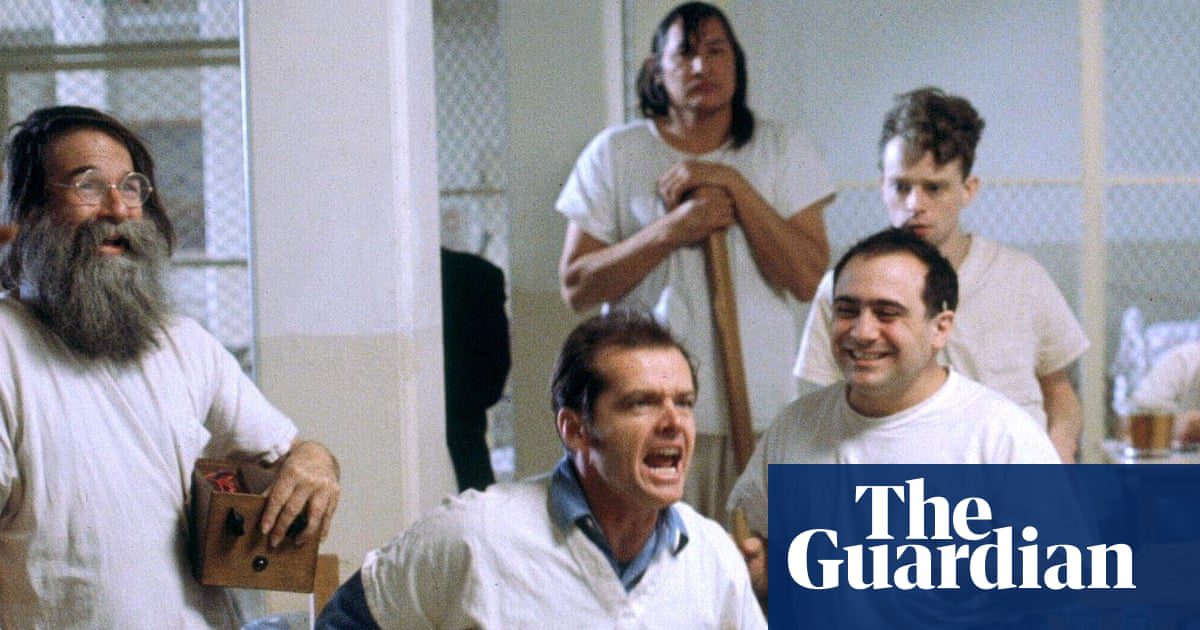
Milo Forman’s One Flew Over the Cuckoo’s Nest (Odeon, Leicester Square) is about an attempted coup in an insane asylum engineered by an inmate called McMurphy who faces and morally defeats the standard-bearer of authority, a hatchet-faced nurse for whom sanctity means order rather than freedom. Taken from a widely read novel by Ken Kesey, it is a prime example of how a subject which must have looked destined for the cultural ghetto of the art circuit can be hoist by its bootstraps into the commercial field and festooned with Oscar nominations.
You can do this of course only by making compromises – by engaging a star with redoubtable box office muscle by jollying your audience along a little before the real crunch comes, and by using as much pure skill as you can muster while working within a fairly conventional framework. Kesey’s book, structured quite differently, made its mark another way. It became, by allowing no compromise at all, a kind of sixties classic that went overground because everybody wanted to be let in on the fashionable secrets of the counter-culture.
The film’s concessions are, however, not overly destructive. It was questionable whether anyone could have filmed the book as Kesey wrote it – certainly not Forman, with his obsessive interest in people rather than ideas and his well modulated naturalistic style which allows flights of the imagination more in the watcher than up there on the screen. And in Jack Nicholson as McMurphy the film has a leading player of true class. Though you can imagine a truer-looking paranoia, it is difficult to think of a performance that could be so riveting and yet so lacking in a star’s insistence on blotting out opposition. Nicholson, unlike so many of the cinema’s favourite leading men, has an extraordinary capacity to fit himself round a part rather than wrap one conveniently round him.
The fact that the film is different from the book, less tough-minded and abstract in handling its allegory about the nature of authority and revolution, should not worry anyone unduly. In the end it makes the same point with something of the same power if through altered means and towards a wider audience. It is not so much about mental institutions as about what happens when institutions of any kind take up an attitude towards those over who they have power that is fundamentally insufferable.
This is where Cuckoo’s Nest connects with most of Forman’s previous work, which includes the American Taking Off and the Czechoslovakian [films] A Blonde in Love and Firemen’s Ball. His chief lesson is not that the nurse and her cohorts are Gorgons but that the evil they do is compounded by the undeniable fact that they think they are doing right. As much like those who control eastern Europe, in fact as capitalism’s grislier lackeys. The film is also about the nature of heroism, and indeed the necessity for it. What do we think, as the director has himself asked, about the man who fights a tank with a broomstick? That’s what McMurphy does, and inevitably he can’t sweep the road clean. But his example is ultimately seen to be the stuff of life-sustaining hope for the rest of us.
The film, made at the Oregon State Institution and populated at its centre by actors and at its edges by patients, is beautifully executed, and not only by Nicholson. Louise Fletcher’s Nurse Ratched is a superbly icy portrait of a right-thinking fanatic, missing only the sexual connotations Kesey found but Forman avoids. The ensemble playing, as usual in Forman films, is achieved so that each of the minor parts has an entity of its own yet neatly dovetails into the whole.
There are indeed disadvantages, areas where Forman’s human sympathies, attractive as they are, encourage laughs that come a trifle too easily and lessons that seem a little too glib – “the business is therapy and the therapy is business,” etc. But the cold wrath of its last section buries these. When it matters the strength is there, together with the feeling that our judgment of who is mad and who is sane is at best faulty and uncertain and at worst downright disastrous. The film makes it tolerably clear that we may be headed down the same road as those Russian bureaucrats who judge as dotty those who don’t agree with them. As McMurphy says, it isn’t so difficult to reach the point when “I think I can help him” really means, “I think I can defeat him.”
Source: https://www.theguardian.com/film/2026/feb/26/one-flew-over-the-cuckoos-nest-reviewed-1976
About the Author