When North Korea’s ruling party held a top-level meeting this month there were predictable boasts of unstoppable nuclear development and, more unexpectedly, a suggestion by Kim Jong-un that his country and the US “could get along” – provided that Washington recognised North Korea as a legitimate nuclear power.
But for many North Korea watchers, the Workers’ party congress – held over several days just once every five years – was a rare opportunity to speculate over the identity of the country’s future leader.
The received wisdom is that Kim has already decided that his daughter, Kim Ju-ae, will succeed him to become the fourth-generation leader of the dynasty that has ruled the country with an iron fist since it was founded in 1948.
But dissenting voices have emerged in recent weeks among experts who say that North Korea’s immutable gender politics could yet block Kim Ju-ae’s path to power.
“The most immediate and insurmountable barricade for Kim Ju-ae is the deeply ingrained patriarchal nature of North Korea,” Mitch Shin, who covers the Korean peninsula for the Diplomat, wrote this month, adding that North Korea functioned “more as a Neo-Confucian monarchy” than as a socialist state.
There is little to suggest that the country’s ranks of ageing generals would accept a woman as “supreme leader”, Shin said. “For these men, many in their 60s and 70s, the concept of swearing absolute and life-and-death loyalty to a young woman is more than a cultural shift. It is a structural anomaly that threatens the internal logic of the regime.”
Instead, Kim may be using his daughter as a “human shield” for the actual successor, Kim Jong-un’s long-rumoured oldest child. “In this way, his son can be shielded from the prying eyes of international intelligence.”
Other experts, though, argue that the patriarchy permeating North Korean society will always be superseded by the non-negotiable principle that a successor must be a direct-line descendant of the Mount Paektu bloodline – a reference to the sacred North Korean peak used to confer legitimacy on the Kim dynasty.
Shreyas Reddy, a correspondent for NK News, also cast doubt on the notion that Kim Ju-ae’s future role as leader was fait accompli, describing her prominence as more performative than political. “State media’s portrayal of Kim’s affection toward his daughter aligns with a growing push to depict him as a loving ‘father’ figure to the entire nation,” Reddy wrote.
“For now, the best course appears to be waiting and watching, rather than declaring North Korea’s next leader before the regime is ready to do so.”
In the absence of official statements confirming Kim Ju-ae’s status as leader-in-waiting, a consensus has formed about her future based on her public profile and proximity to her father, and even her wardrobe.
Despite her increased visibility, North Korean state media have never published her name, referring to her only as the leader’s “respected” or “most beloved” child. There are also disagreements about how to pronounce her given name.
Much of the momentum behind Kiim Ju-ae’s presumed ascension has come from South Korea’s national intelligence service, which this month claimed that Kim Jong-un was close to naming her as the country’s future leader.
Even if that may one day be the case, for now Kim Ju-ae’s main role is as a daughter, according to Leif-Eric Easley, a professor at Ewha University in Seoul. “She is probably not yet old enough to participate in the congress with an official party title,” he said.
There is nothing about mood music coming from the North to suggest that Kim Jong-un will one day spring a surprise on the world similar to his own rapid rise as leader, said Lee Sung-Yoon, a principal fellow at the Sejong Institute in Seoul.
Kim Jong-un has “already established beyond a reasonable doubt that he is grooming his teenage daughter as his successor”, Lee said, pointing to Kim Ju-ae’s presence alongside her father at dozens of official events.
His decision to position his daughter in the centre of the front row on his New Year’s Day visit to the Kumsusan Palace of the Sun – a sacred Kim dynasty mausoleum – should “remove any doubt” that she was being positioned as heir to her 42-year-old father, Lee said.
In 2023, South Korean intelligence officials told lawmakers that Kim and his wife also probably have an older son and a younger third child, whose gender is unknown.
“Kim Jong-un has not told any foreign interlocutor that he has a son,” Lee said, adding that the claim had been based on “flimsy intelligence reports” of boys’ toys and nappies being delivered to the Kim family mansion in Pyongyang several years ago.
Since making her first public appearance, at a long-range missile test in November 2022, Kim Ju-ae has accompanied her father on an increasing number of events, including weapons tests, military parades, factory openings and, last year, on a family visit to a coastal resort. She also travelled with her father to Beijing last September for his summit with the Chinese leader, Xi Jinping.
Her prominence triggered speculation that Kim Jong-un was preparing to add political weight to her symbolic role. The recent congress ended with no sign of the teenager, but she accompanied her father at a military parade in Pyongyang to mark the end of the meeting.
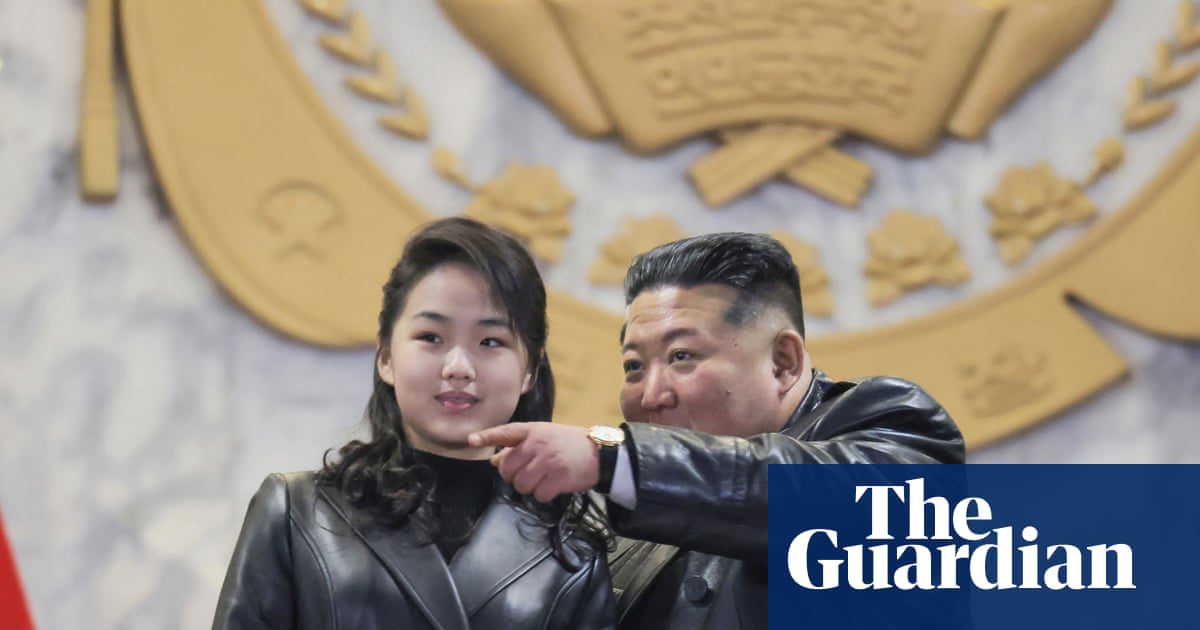
Wearing matching leather coats, father and daughter chatted constantly, pointing at parade formations and singing along with performers. Kim Ju-ae watched as her father and senior military officials saluted fighter jets flying over an illuminated Kim Il-sung Square.
The analyst Lim Eul-chul said the jackets were more than a fashion statement.
“In North Korea’s political symbolism, that look carries weight – it’s tied to the image of the leader as the ultimate guarantor of national security and future prosperity.
“So when that same symbolic attire is put on his young daughter, it’s hard to see it as accidental.”
With Agence France-Presse
Source: https://www.theguardian.com/world/2026/feb/27/north-korea-kim-jong-un-daughter-ju-ae-succession
About the Author