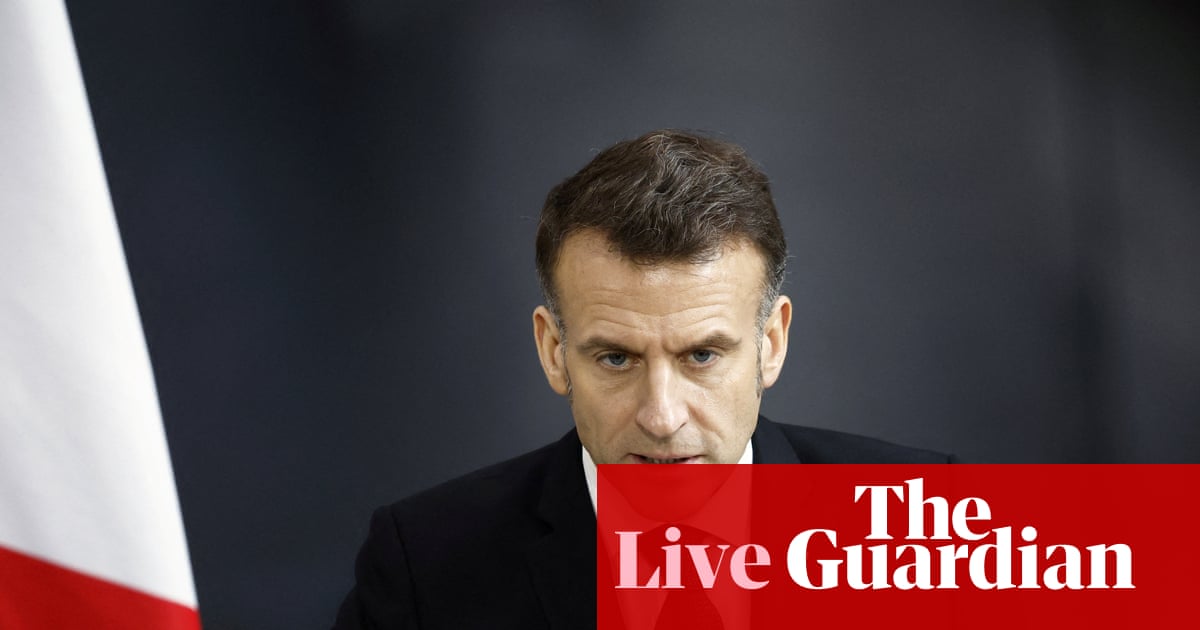
France to increase the number of nuclear warheads, Macron says
In his speech, Macron warns that since the last speech in 2020, “our competitors have evolved, as have our partners,” and this requires a change in the French nuclear doctrine.
He says the deterrent element needs to be “strengthened,” brought “forward” in a more preventative way, and considered in the European context, while respecting the French sovereignty and that the ultimate responsibility for its use will always lie with the French president of the day.
But he says that in recognition of the new challenges, France will need to increase the size of its nuclear arsenal.
He says he has ordered the increase in the number of warheads available to France, but will not reveal the exact number.
Key events
-
Concrete plans to advance French-German nuclear cooperation by end year, Merz says
-
Poland involved in talks with France, others regarding advanced nuclear deterrence programme, Tusk confirms
-
French government will turn Macron’s principles on ‘advance deterrence’ into actions, PM Lecornu says
-
Major moment for European defence cooperation as France seeks to increase number of nuclear warheads, work with more EU partners – snap analysis
-
France to work with UK, Germany on ‘very long-range missile projects’ as part of ‘advanced’ deterrence
-
Number of European allies could participate in nuclear deterrence exercises, Macron says
-
Macron repeats that ‘to be free, one must be feared’ as he speaks of need to step up defence spending, readiness
-
France to increase the number of nuclear warheads, Macron says
-
Macron speaks about France’s nuclear doctrine
-
US defence secretary Hegseth briefing media on US operations in Iran
-
US aircraft leave Spain after government says bases cannot be used for Iran attacks
-
Evacuation of Paphos airport in Cyprus over, authorities say
-
Spain’s Sánchez warns against ‘spiral of violence’ in Middle East
-
Greece to send frigates, F-16 fighter jets to support Cyprus
-
Aktoriti area, Paphos airport being evacuated, Cyprus says
-
Larnaka airport in Cyprus reporting disruptions
-
Two unmanned drones headed to RAF Akrotiri ‘intercepted in time,’ Cyprus says
-
Another security alert at UK base in Cyprus, evacuation at civil airport in Paphos – media reports
-
EU’s von der Leyen calls for lasting ‘diplomatic’ solutions as she urges de-escalation of conflict in Middle East
-
Spain calls for US-Iran talks, warns against further destabilisation in Middle East
-
Italy’s opposition calls for sacking of defence minister after he got stranded on holiday in Dubai hours before war
-
Hundreds more flights cancelled as world faces worst travel chaos since Covid pandemic
-
Stay in place, Ireland tells its citizens, as land evacuation routes not recommended
-
Meeting of EU ministers in Cyprus delayed after last night’s drone incident
-
Czech Republic, Slovakia looking to run limited evacuation flights from Middle East
-
Morning opening: EU meets to consider its response as countries look at feasibility of evacuation plans
Concrete plans to advance French-German nuclear cooperation by end year, Merz says
German chancellor Friedrich Merz also confirmed the plans.
Remember, Macron said that Germany was a “key partner” in the programme, and both leaders had previously hinted at their cooperation in this area, most recently in their Munich Security Conference speeches.
Merz said on X:
“[Emmanuel Macron] and I have established a nuclear steering group in which we coordinate on deterrence issues. We intend to take concrete steps before the end of this year, including conventional German participation in French nuclear exercises.”
Poland involved in talks with France, others regarding advanced nuclear deterrence programme, Tusk confirms
Poland’s prime minister Donald Tusk has just responded to Macron’s speech, confirming Poland’s involvement in the proposed new doctrine.
In a post on X, he said:
“Poland is in talks with France and a group of closest European allies on the programme of advanced nuclear deterrence. We are arming up together with our friends so that our enemies will never dare to attack us.”
French government will turn Macron’s principles on ‘advance deterrence’ into actions, PM Lecornu says
On the back of Macron’s speech, the French prime minister, Sébastien Lecornu, said his government will “translate” the principles outlined by the president into actions in terms of “budgetary allocations, modernised capabilities, and increased support for our industrial and technological defence base.”
He says the new proposal on “advanced deterrence” will define the new framework, which “strengthens collective security while maintaining the ultimate decision at the national level.”
Major moment for European defence cooperation as France seeks to increase number of nuclear warheads, work with more EU partners – snap analysis

Jakub Krupa
This is a very big moment for European deterrence, and one which will have significant consequences for a number of European countries which Macron said want to be a part of this new “advance deterrence” strategy.
To remind you, that’s Belgium, Denmark, Germany, Greece, Poland, Sweden, the Netherlands, the United Kingdom.
There will be many questions as to how exactly all of this is going to mean and how it is going to work, so expect to hear more in the coming weeks.
For one, the Danish government – despite technically being fully in the campaign mode ahead of next month’s parliamentary elections – has just called an emergency press conference to discuss the implications for Denmark.
France to work with UK, Germany on ‘very long-range missile projects’ as part of ‘advanced’ deterrence
Macron also says that France will work with the UK and Germany on “very long-range missile projects” as part of this closer, enhanced cooperation.
He also laments Europe “becoming accustomed to their security depending on rules made by third parties.”
He makes a point warning about the dramatic changes regarding the use of nuclear deterrent, saying “everyone has taken liberties,” with the US and Russia withdrawing from some treaties or letting them lapse, and Iran and North Korea seeking to establish their own programmes.
He ends a speech with a strong call to act, saying that France needs to keep alive the “precious legacy” of nuclear deterrence and make it fit to today’s challenges, before ending with his customary:
Long live the Republic, long live France!
The audience then proceeds to sing the French national anthem.
Jakub Krupa
By the way, it’s quite a backdrop for his speech, as he stands in front of the Triomphant-class ballistic missile submarine of the French Navy, Le Temeraire.
Number of European allies could participate in nuclear deterrence exercises, Macron says
Macron says that France leads discussions on how the French nuclear system could work more broadly to protect Europe as part of what he defines as “advanced deterrence”, with other countries potentially involved in relevant exercises and temporary deployment of France’s nuclear-armed aircraft on their territory.
He says the work on this is being conducted in “full transparency” with the US and “in coordination” with the UK.
He lists a number of countries involved in discussions, including Germany – “a key partner” – but also Belgium, Denmark, Greece, Sweden, the Netherlands, Poland.
The ultimate decision for using the system would still at all times remain with the French president, he says.
Macron repeats that ‘to be free, one must be feared’ as he speaks of need to step up defence spending, readiness
In his remarks, drawing among other on Russia’s activities in Ukraine and Europe, Macron also stressed the need to improve France’s – and the continent – broader ability to detect threats and acts against them as he says that “to be strong in our nuclear deterrence, we must be strong in our conventional capabilities.”
He stresses his regular point that Europe needs to step up its defence capabilities.
“To be free, one must be feared, and to be feared, one must be powerful. This increase in our arsenal is proof of that.”
France to increase the number of nuclear warheads, Macron says
In his speech, Macron warns that since the last speech in 2020, “our competitors have evolved, as have our partners,” and this requires a change in the French nuclear doctrine.
He says the deterrent element needs to be “strengthened,” brought “forward” in a more preventative way, and considered in the European context, while respecting the French sovereignty and that the ultimate responsibility for its use will always lie with the French president of the day.
But he says that in recognition of the new challenges, France will need to increase the size of its nuclear arsenal.
He says he has ordered the increase in the number of warheads available to France, but will not reveal the exact number.
Macron speaks about France’s nuclear doctrine
French president Emmanuel Macron is speaking in Île Longue, the naval base of the French nuclear programme, outlining his thinking on how France could use its nuclear deterrence programme in the future.
I will bring you all the key lines here.
Nato secretary general Mark Rutte has been speaking to BBC in the last half hour.
He said the Europeans were “stepping up” their political support for the US, specifically pointing to German chancellor Friedrich Merz’s trip to Washington tomorrow and UK prime minister Keir Starmer’s decision to allow US military to use UK bases for defensive operations.
He repeatedly declined to say if he had known about the US plan to attack Iran in advance, saying he was bound by confidentiality of his engagement with the US.
He said he did not expect Nato forces to be involved, as it continues to be a US-Israeli operation, but he said that the alliance’s view remained that the Iranian regime was a “threat.”
US defence secretary Hegseth briefing media on US operations in Iran
US defence secretary Pete Hegseth is now briefing the media on the US operations in Iran.
Here are his key points:
-
“We didn’t start this war, but under president Trump, we are finishing it.”
-
“The former regime had every chance to make a peaceful and sensible deal, but Tehran was not negotiating,”
-
“This is not Iraq. This is not endless. I was there for both. Our generation knows better, and so does this president”
If you want more detail on his presser, it’s here:
US aircraft leave Spain after government says bases cannot be used for Iran attacks
We are also hearing more from Spain, with the country’s foreign minister José Manuel Albares saying the country would not allow its military bases to be used for attacks on Iran, which Spain has condemned.
15 US aircraft have left the Rota and Moron military bases in southern Spain since the US and Israel launched weekend attacks on Iran, maps by flight tracking website FlightRadar24 showed, as reported by Reuters.
“Spanish bases are not being used for this operation, and they will not be used for anything not included in the agreement with the United States or for anything that is not in accordance with the Charter of the United Nations,” Albares said, speaking to Spanish broadcaster Telecinco.
Evacuation of Paphos airport in Cyprus over, authorities say
In the meantime, the Cypriot government has confirmed that the evacuation of Paphos airport is now over, but the airport continues to report disruptions in its flight schedule for this afternoon with delays and divertions.
Spain’s Sánchez warns against ‘spiral of violence’ in Middle East

Sam Jones
in Madrid
Spain’s Pedro Sánchez has warned against “spiral of violence” in the Middle East.
In a post on X, he said:
“In the past few hours, Iran has attacked Saudi Arabia, Bahrain, Qatar, Cyprus, the United Arab Emirates, Iraq, Israel, Jordan, Kuwait, and Oman. We forcefully condemn all illegal and indiscriminate attacks against the Gulf Cooperation Council countries and other countries in the region. We also condemn Hezbollah’s missile launch and Israel’s attack on Lebanon.
Violence only leads to more violence. Bombs hit military targets, but also streets, airports, schools, and the homes of innocent civilians.
This spiral of violence must be stopped immediately, and there must be a return to the framework of diplomacy and dialogue.”
Greece to send frigates, F-16 fighter jets to support Cyprus
Greece will send two frigates and two F-16 fighter jets to Cyprus “to contribute to its defense against the threats it faces,” Greek defence minister Nikos Dendias has confirmed.
He said he will also travel to Cyprus tomorrow.
The move was also confirmed by the Cypriot government, saying the decision was made after a phone call between the Greek prime minister Kyriakos Mitsotakis and the Cypriot president, Nikos Christodoulides.
Aktoriti area, Paphos airport being evacuated, Cyprus says
The Cypriot interior ministry has just confirmed that “instructions have been issued for the evacuation of the Akrotiri municipal district and Paphos airport,” with residents in another area told to “limit unnecessary movements” and “remain in their homes.”
Larnaka airport in Cyprus reporting disruptions
Civilian Larnaka airport in southern Cyprus also appears to be facing disruptions amid warnings over Cypriot airspace with three flights – from Belgrade, Rome and Heraklion in Greece – redirected to either Athens or back to Heraklion and dozens more cancelled this afternoon.
Source: https://www.theguardian.com/world/live/2026/mar/02/eu-response-middle-east-conflict-evacuate-citizens-europe-live-latest-news
About the Author