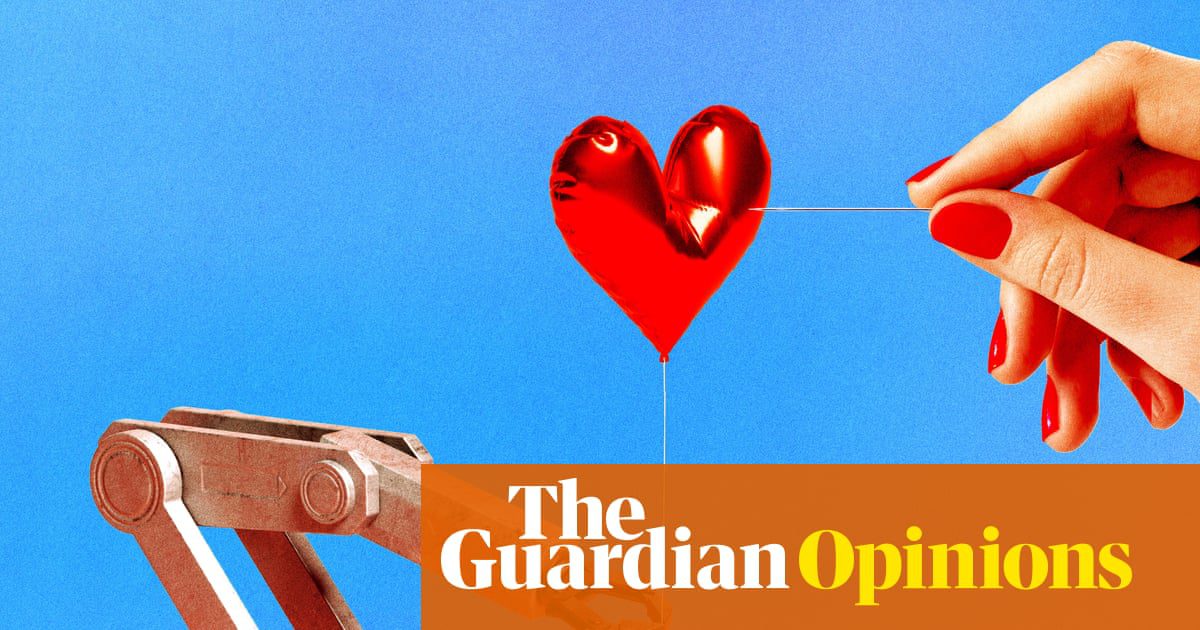
The Guardian reported on the arrival of “Fate” and, friends, I laughed. Or maybe I cried.
It’s apparently the first “agentic AI dating app”. An AI personality named “Fate” interviews users, runs data matches on their hopes and dreams, then suggests five potential matches based on the hard data of observable complementary language patterning, “No swiping involved!”.
It has been followed by similar AI-based matching platforms Sitch and Keeper in the US. In the platform variations, you can detail preference data down to hair colour, you can be coached in how to approach your date by the animated electronic voice of a dataset, and you can weep for the end of human connection and the loveless wasteland of consumer narcissism we have built for ourselves. When the most profound and transformative of human emotions is an automated transaction in an online shop, the techlords have won.
In the depths of my growing neo-Luddite despair I am obliged to admit that in what is now a common-denominator story, consumers did not actually demand this.
What people wanted from AI in dating apps has been superseded by what some data-hungry, rich-dork megacorp thinks that they should need. Studies in Europe showed users just wanted AI tools to “weed out fake profiles and flag toxic users”.
You know, how writers just wanted contextual proofing tools from AI but and got machines insisting on the superiority of rewritten, flattened text. Or how academics just wanted a tool to index their references and got hallucinations that invented a few sources that didn’t actually exist, but the machine thought maybe should.
Insert your own industry experience here, and all of us in sad recognition that the forced AI-ification of everyday life continues with a robotic efficiency that, dear Christ, is outsourcing the messy human weirdness that made us fascinating and exotic to one another – and sexy and wonderful.
We’re clearly adopting the universal deadening of human experience because, as the Guardian piece reveals, people are using these new apps – in love, in work and in an educational setting that ensures students learn how to prompt and little else.
I conjecture humanity just can’t handle the mess or wonder of ourselves any more and, as is habit, the internet is to blame.
The problem with AI as a romantic channel used to be the risk of falling in love with the mirror-machine. With a few personalised prompts you could create a fantasy soulmate that flattered your vanities and ignored your faults as it spoke back to you and you wanked. It was just like a real relationship but without the obliged mutual self-reflection that encourages intimacy and growth.
It was only a few minutes ago that we thought encouraging this was destructive digital narcissism. Now I keep wondering if there’s a human self-survival instinct in it after all, given what our self-subscription to the mass digital surveillance state is doing to us socially.
It wasn’t long ago that social media introduced us to the concept of digitised network oversharing. From the video of the dude who wondered what it would be like to pash his sister (no, I will not share it) to the health of novelist Joyce Carol Oates’ feet (no, again), we all seemed to be learning way too much about one another.
Now, from an abundance of caution, we know less. As every stray, 10-year-old tweet can be weaponised, so it seems many are retracting to a new paranoia when it comes to self-revelation. Well may we say “publish and be damned” but you can’t impose privacy controls on your ex.
I’ve written before about this new undersharing. Today it’s disquieting to feel nostalgia for the pre-Fate era privacy appeal of digital Heathcliffs and text-based waifus who were only ever going to share your most intimate secrets with the, um, billionaires who own them rather than consolidate a dataset to manifest them into your life.
But whether you choose to love the robot or prompt the robot to do the loving for you, the Canadian media theorist Marshall McLuhan predicted these unnatural transhuman intimacies more than half a century ago in Understanding Media: The Extensions of Man. He warned back in 1964 that interactive media would take a lease of “our eyes and ears and nerves” and I think about it all the time.
McLuhan’s work was the inspiration for David Cronenberg’s 1983 body-horror, Videodrome. Given that a study from Italian researchers has proved that if you’re still dipping into the ideological pissoir known as X, you are wilfully brainwashing yourself with hard-right piss, on the Videodrome scale of remaining in objective reality to believing you are being blown by a television, it’s fair to say that the remote control is in our hand and the TV has entered the chat.
Can we put it down? Perhaps not without the help of intervention by the law, given arguments made in a landmark case before a jury in Los Angeles, in which plaintiffs insist that social media platforms are “defective products engineered to exploit vulnerabilities in young people’s brains”, as reported by NPR.
The outcome may indeed compel governments to pursue further the platform regulation that has inspired social media bans for children in Australia, Malaysia and elsewhere.
Do we have to wait until “AI-rranged marriage” becomes a thing before governments realise we’re running out of time?
Roll over, humanity. Fate is here.
Source: https://www.theguardian.com/commentisfree/2026/feb/24/fate-ai-dating-sites-apps-marriage-dystopia
About the Author