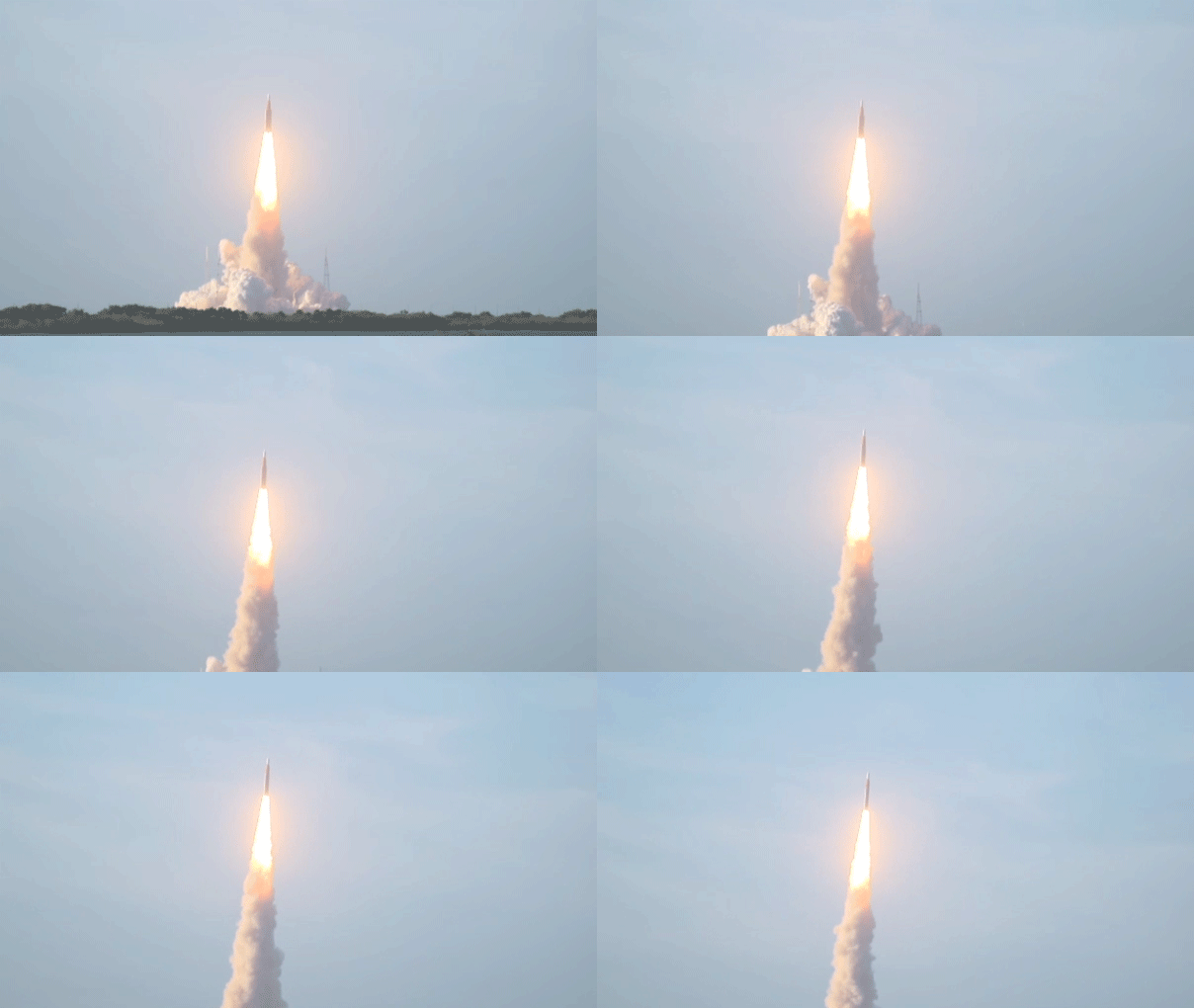
The Artemis II mission
Artemis II is the second flight, and first crewed mission, of the core component of Nasa’s Moon to Mars initiative, which aims to build a permanent, habitable lunar base as a prelude to eventual human flights to the red planet.
Assuming a successful launch on Wednesday, it will be a 10-day fly past of the moon, with no landing, in which the four astronauts will travel farther into space, just short of 253,000 miles, than any human beings before them.
The objectives are to test crucial spacecraft and life support systems, monitor extensively the astronauts’ health during a long-duration spaceflight, specifically the enhanced effects of radiation and microgravity, and confirm the ability of the Orion capsule to withstand temperatures up to 3,000F (1650C) at re-entry.
The highlight for the crew will be on flight day six, when Orion will slingshot around the moon and pass between 4,000 and 6,000 miles from the lunar surface, providing opportunities to photograph the moon’s south pole where the next human landing will take place as early as 2028.
Nasa has published a comprehensive, day-by-day schedule of the Artemis II mission timeline here.
Key events
I’ve been talking with Arizona senator and former space shuttle commander Mark Kelly, who says he would join the Artemis II crew in a heartbeat.
Kelly, who flew on four shuttle missions between 2001 and 2011, was watching the astronauts walk out from the Neil A Armstrong operations and checkout building on their way to the launchpad, a view from the other side of metal security railings from which he was used to.
“If something happens in there, they need somebody to replace one of them, I’ll be ready,” he said.
More seriously, Kelly addressed the benefit of this spaceflight to the US, and the wider world:
Us as a species, especially as a country, we’re doing something positive for humanity.
When you make a decision to climb in a rocket ship and lift off with over eight million pounds of thrust on your back, you don’t take the decision lightly.
But the upside for us as a nation is so consequential that most of us , you know, we make the calculation that it’s worth doing. There’s tremendous downside personally because of the risk involved, but for our nation there’s tremendous upside.
Safety system issue resolved, countdown continues
Here’s the update on the malfunctioning flight termination system… it’s good news. The launch attempt is officially a go.
Whatever the fix was, and mission control gave no clear details, it worked.
“It was a fix to clear the range and work the FTS. That is no longer a constraint,” Nasa’s launch commentator, Derrol Nail, has just announced.
Nail said that combined with the fact that ground systems engineers were also working no constraints, “it’s great news. The range is green and we’re continuing with the countdown”.
A quick weather update: there’s still a little “feisty” weather activity, showers and some wind nearby, but still far enough from the launch window for it not to be an issue, Nail said.
We are a little more than an hour from the launch window opening.
The future
While we wait for news about the technical issue threatening today’s launch, let’s take a look ahead at Nasa’s big plans for the future of its Artemis program beyond this mission.
In February, the space agency’s new administrator, the billionaire private astronaut Jared Isaacman, announced a strategy shift for forthcoming missions, including pushing back the next human landing to the Artemis IV mission scheduled for 2028.
His plan is for a more incremental approach to launches, and a more sustainable mission timeline that will set Nasa on what he hopes will be a steadier course towards the ultimate goal of a human landing on Mars before the end of the next decade.
Then last month he followed up with another bombshell announcement: that Nasa would abandon plans for the Lunar Gateway, an orbital research and transfer station for lunar crews, and build instead a $20bn moon base.
The ambitious plans are in keeping with Donald Trump’s first-term Space Policy Directive of 2017 designed to preserve US supremacy in space, and specifically to stay ahead of China, which has sent a number of robotic landers and has plans for its own human landing before 2030.
Isaacman told reporters earlier this year:
Nasa was established to undertake big, bold endeavors in air and space, to undertake the near impossible.
Next up is America’s return to the lunar environment. What we learn from that mission is going to help enable America’s return to the lunar surface. When we arrive to the moon, we’re there to stay
Read more:
Artemis engineers working safety system issue
Nasa’s mission control is reporting a technical issue that is threatening Wednesday’s launch opportunity of Artemis II.
According to mission managers, there is a problem with the flight termination system (FTS), a crucial safety system designed to destroy the rocket if it veers off course or poses a safety threat.
The system uses powerful explosives, and is armed just minutes before launch as a safeguard to people on the ground.
Details are few so far, but it seems that a vital piece of equipment or component necessary for it to work properly is malfunctioning, and engineers have been despatched to find or examine a “heritage” replacement part from the space shuttle era of more than a decade ago, to see if a workaround can be found.
Many parts of the Space Launch System (SLS) rocket of Artemis II are modified or reused from space shuttle parts, so the request is not as unusual as it sounds.
It’s also unclear how significant a problem this might turn out to be, certainly in terms of scrubbing tonight’s launch opportunity, but we do know from Nasa that, as things stand, it is a “no go”.
We’ll bring you more details when we find out more.
Leyland Cecco
A professor of Earth sciences at Western University, who worked with Canadian astronaut Jeremy Hansen on geological components of the Artemis II mission, has been recounting their time together.
“There’s a lot you learned about a person sharing a in a tent in the Arctic,” Gordon Osinski, also a member of the first Artemis lunar surface science team, said.
Osinski recently worked with astronauts at Nasa and the Canadian Space Agency to study a lunar impact crater in Labrador similar to what astronauts will experience on the moon.
“The most valuable thing that was brought back from the Apollo missions were the [rock] samples,” he said, noting scientists still worked on them decades later.
“In fields like geology, there’s a strong belief that the best place to learn is in the field.”
Osinski and Hansen have worked together for 15 years.
“There is a sense of trepidation. There’s a sense in which the public has grown complacent about the risks about these sorts of missions, especially because putting humans near the moon has become so rare.
“This mission is a reminder that rocket science is very difficult.”
Trump hails “our brave astronauts”, snubs Canadian
Donald Trump has posted on social media his appreciation of the three American astronauts on board Artemis II, but did not recognize the fourth member of the crew, Canadian Jeremy Hansen.
“Tonight at 6.24pm EST [sic], for the first time in over 50 YEARS, America is going back to the Moon! Artemis II, among the most powerful rockets ever built, is launching our Brave Astronauts farther into Deep Space than any human has EVER gone,” the US president wrote on Truth Social in a trademark mix of capital letters and questionable grammar.
“We are WINNING, in Space, on Earth, and everywhere in between – Economically, Militarily, and now, BEYOND THE STARS. Nobody comes close! America doesn’t just compete, we DOMINATE, and the whole World is watching.
“God bless our incredible Astronauts, God bless NASA, and God bless the Greatest Nation ever to exist, the United States of America! President DONALD J. TRUMP.”
As a minor aside, the president also has the launch time wrong. Scheduled lift-off is 6.24pm eastern daylight time, not eastern standard time, as his post states.
Moon mission history
Artemis II and its crew of four will bridge a 54-year gap. The most recent time anybody traveled beyond lower Earth orbit were the three astronauts aboard Apollo 17 in December 1972, also the last time humans set foot on the lunar surface.
In fact, only 24 people, all Americans, have ever been as far as the moon, and only 12 of those ever landed, during six Apollo missions between 1969 and 1972.
The ill-fated Apollo 13 mission of April 1970 would have been a seventh but suffered an oxygen tank explosion and was forced to abort, prompting the famous but often incorrectly remembered phrase, “Houston, we’ve had a problem”.
Only four moonwalkers, now all in their 90s, are still alive. The most famous is Buzz Aldrin, 96, who joined the first man on the moon, Neil Armstrong, on the “one giant leap for mankind” Apollo 11 landing in July 1969.
David Scott, 93, (Apollo 15, July-August 1971); Charles Duke, 90, (Apollo 16, April 1972); and Harrison Schmitt, 90, (Apollo 17, December 1972) are the only other survivors.
Waning public interest and budgetary constraints led President Richard Nixon to announce in 1970 that the Apollo program was to be abandoned, and its three final moon landing missions canceled.
There’s potentially alarming news from AccuWeather about a solar flare, which the forecasting service says could affect the Artemis mission.
While not an official Nasa source for weather and climate information or predictions, AccuWeather has been monitoring launch day conditions, and is reporting them on its own blog.
Its meteorologist Brandon Buckingham just reported the following:
An X1.5 solar flare that occurred early on March 30 produced an Earth-directed coronal mass ejection that is now entering into the Earth’s atmosphere. As the day progresses, moderate to strong geomagnetic storm conditions are possible as a result of the coronal mass ejection impacting Earth’s atmosphere.
Communication between ground control and members aboard the rocket, and precise GPS tracking, can be at risk during strong geomagnetic storming.
Nasa’s weather officials have not addressed the solar flare, but ARE reporting that showers of rain are beginning to move close to the Kennedy Space Center.
Artemis II crew seated in Orion capsule
All four astronauts are now in their assigned seats in the Orion crew capsule, and have completed successful “loud and clear” communications checks to make sure all is working well ahead of their scheduled launch at 6.24pm ET.
Nasa’s close-out crew that secured the crew into their seats and completing their final checks on the capsule, including the sealing of the hatch, and are preparing to leave the launchpad.
The next humans the astronauts will see will be the recovery crews plucking from the Pacific ocean in 10 days’ time after splashdow, assuming tonight’s launch proceeds as planned.
Artemis II is now also fully fueled for flight. Nasa said that tanking of more than 700,000 gallons of liquid oxygen and liquid hydrogen has been completed.
What to know about the spacecraft
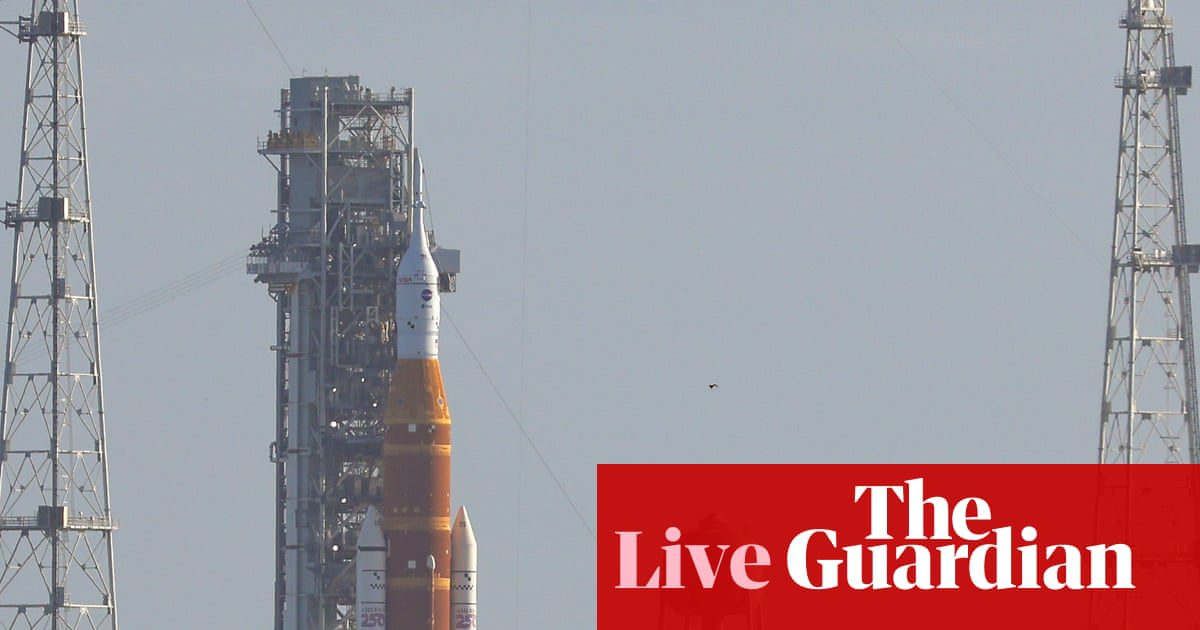
The Artemis II launchpad stack comprises Nasa’s Space Launch System (SLS) rocket, and the Orion crew capsule, a five-meter diameter craft with the interior volume similar to that of a small camper van.
The height of the rocket assembly is 322ft (98m), slightly higher than the Statue of Liberty (305ft), and London’s Elizabeth Tower, commonly known as Big Ben, at 316ft.
Four RS-25 engines, remnants from Nasa’s space shuttle program that ended in 2011, will provide almost nine million pounds of thrust at lift-off, making SLS the most powerful fully operational space rocket in history.
Two solid rocket boosters and the main tank fuel fall away after main engine cut-off and stage separation early in flight, and Orion will be powered to the moon by the European Service Module (ESM), built by Airbus for the European Space Agency.
The ESM will separate from Orion about 45 minutes before the crew’s splashdown in the Pacific ocean at the end of the 10-day mission. Unlike the solid rocket boosters at the start of the mission, which will be recovered, the ESM is designed to burn up on re-entry to Earth’s atmosphere.
The Artemis II crew will be arriving at the launchpad shortly after an emotional farewell with their families at the Neil A Armstrong operations and checkout building at Kennedy Space Center.
They posed for photographs and waved their goodbyes with heart signs and air kisses, not being allowed to hug their loved ones because of quarantine protocols.
Commander Reid Wiseman thanked the throngs who gathered to see them off. “It’s a great day for us. It’s a great day for this team,” Wiseman called out.
The astronauts boarded a silver astrovan for the journey to launchpad 39B, with military helicopters overhead and several security vehicles following at a close distance.
The next launch milestone will be the crew walking around and checking out their 322ft (98m) rocket ship from the ground before ascending in the elevator to the Orion crew capsule.
The Artemis II mission
Artemis II is the second flight, and first crewed mission, of the core component of Nasa’s Moon to Mars initiative, which aims to build a permanent, habitable lunar base as a prelude to eventual human flights to the red planet.
Assuming a successful launch on Wednesday, it will be a 10-day fly past of the moon, with no landing, in which the four astronauts will travel farther into space, just short of 253,000 miles, than any human beings before them.
The objectives are to test crucial spacecraft and life support systems, monitor extensively the astronauts’ health during a long-duration spaceflight, specifically the enhanced effects of radiation and microgravity, and confirm the ability of the Orion capsule to withstand temperatures up to 3,000F (1650C) at re-entry.
The highlight for the crew will be on flight day six, when Orion will slingshot around the moon and pass between 4,000 and 6,000 miles from the lunar surface, providing opportunities to photograph the moon’s south pole where the next human landing will take place as early as 2028.
Nasa has published a comprehensive, day-by-day schedule of the Artemis II mission timeline here.
First photos of Artemis II crew in their space suits
The first photos of the Artemis II crew on launch day are appearing on the news wires now. Canadian astronaut Jeremy Hansen and Nasa astronauts Victor Glover, Reid Wiseman and Christina Koch were posing for pictures with their families before they’re expected to set off on a 10-day journey around the moon.
They were seen smiling and waving to the crowd ahead of the launch later expected later today:
Who is on the Artemis II crew
Three of Artemis II’s four crew members are Nasa astronauts and spaceflight veterans extended stays on the international space station (ISS).
Commander Reid Wiseman, 50, is a retired US Navy captain from Baltimore, Maryland. He was selected as an astronaut in 2009, spent six months on the ISS from May to November 2014, and is a former chief of Nasa’s astronaut office.
He has two daughters with his wife Carroll, who died in 2020 from cancer. He has said he is taking a notepad and pencil with him to space to record his thoughts during the mission.
Pilot Victor Glover, 49, will become the first astronaut of color to fly beyond lower Earth orbit. From Pomona, California, he joined the astronaut corps in 2013, and flew to the ISS on the maiden operational flight of SpaceX’s Dragon capsule in 2020.
He is married with four children. His callsign, Ike, is an acronym bestowed lovingly by colleagues for “I know everything”. Glover said he will carry his Bible, wedding ring, and book of quotations from Apollo 8 astronaut Rusty Schweickart.
Mission specialist Christina Koch (pronounced Cook), 47, is already a record holder for the longest single spaceflight by an American woman, 328 days on the ISS from March 2019 to February 2020.
Koch, from Grand Rapids, Michigan, is a married engineer who became an astronaut in 2013. She will become the first woman to travel to the moon. Her personal items in space will be handwritten notes from loved ones.
Mission specialist Jeremy Hansen, 50, is the only non-American crew member, and has no previous spaceflight experience. A fighter pilot in the Royal Canadian air force, Hansen was recruited to the country’s astronaut training program in 2009.
Hansen is married with three children. Born in London, Ontario, he plans to take with him four moon-shaped pendants for his family, and maple syrup and cookies.
How to watch the Artemis II mission
Unlike the Apollo moon landings from 1969 to 1972, when millions of people had to gather around small TV sets to watch missions unfold in often grainy and ghosting black and white video, every moment of Artemis II will be a fully online, high-resolution multimedia experience.
The Guardian has a live feed at the top of this blog you can follow.
Nasa has countless webpages dedicated to every aspect of the flight from its homepage at nasa.gov, and the space agency has a significant presence on numerous social media platforms including X, YouTube, Instagram and Twitch.
Additionally, it runs a free, on-demand streaming channel, Nasa+, which will provide live coverage from before launch to after splashdown, including all press briefings. It also has a dedicated app for smart devices.
The Artemis II commander Reid Wiseman maintains a prominent social media presence, and has been posting prolifically ahead of the flight, although it remains to be seen how often he is able to update during the mission itself.
Also worth keeping an eye on is the X account of the new Nasa administrator Jared Isaacman.
How the launch is expected to unfold
A two-hour launch window for Artemis II opens at 6.24pm EST (11.24pm BST) after an almost four-hour fueling process. Nasa’s final weather briefing on Tuesday reported an 80% chance of favorable conditions for launch.
Mission managers will be watching closely data from launchpad 39B at the Kennedy Space Center, as well as real-time and forecast weather information. Any last-minute technical issue or weather violation can cause a scrubbed launch attempt, or a delay, right up to T-0 (the moment the countdown clock reaches zero).
After lift-off, the 322ft (98m) rocket will take about 6.5 seconds to clear its tower, and accelerate quickly to 17,500mph and an altitude of about 531,000ft. Once there, main engine cut-off and core stage separation take place a little more than eight minutes into flight.
The real journey to the moon begins on flight day two, after several revolutions in Earth’s orbit, with the so-called translunar injection burn, the final major engine firing of the mission.
Welcome to our launch blog for Wednesday’s scheduled launch of Artemis II, Nasa’s first crewed lunar rocket in more than half a century that is set to lift-off from Florida’s Kennedy Space Center at 6.24pm ET (11.24 BST).
I’m Richard Luscombe at the press site in Cape Canaveral with a close-up view of launchpad 39B, where the Space Launch System (SLS) rocket and Orion crew capsule will depart on their 10-day, 685,000-mile journey to the moon and back.
Hundreds of thousands of spectators will pack the beaches and causeways of Florida’s space coast to watch humans travel beyond lower Earth orbit for the first time since the final Apollo mission in December 1972.
Three Nasa astronauts, Americans Reid Wiseman, Victor Glover and Christina Koch, join Jeremy Hansen of the Canadian Space Agency on a mission that will slingshot around, but not land on the moon, before returning to a Pacific ocean splashdown.
Follow our coverage as we bring you the latest from the space center leading up to the opening of tonight’s two-hour launch window.
Read our preview of the mission here:
Source: https://www.theguardian.com/science/live/2026/apr/01/artemis-ii-launch-nasa-orion-moon-trip-live-updates
About the Author