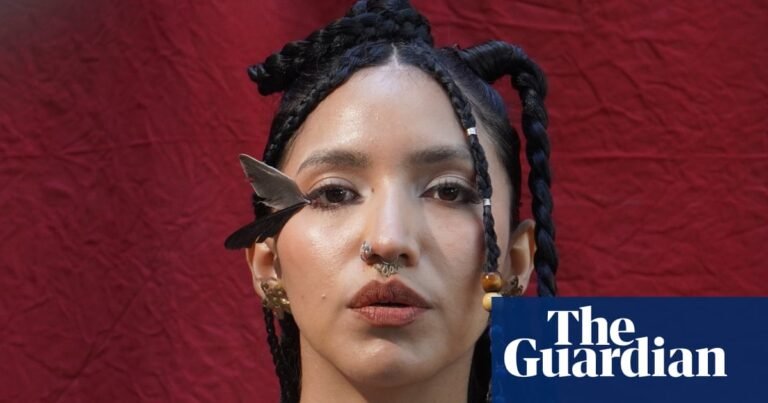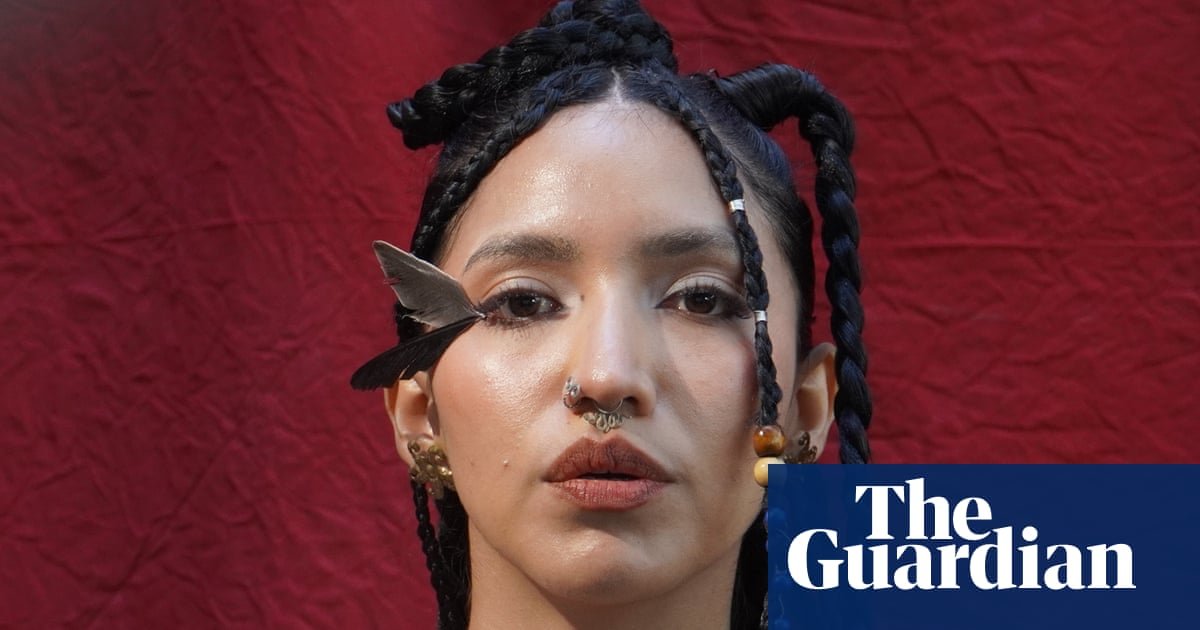
With her long black hair braided into beaded plaits, a delicate silver nose ring, and intricately patterned Andean textile draped around her chest above baggy, low-riding jeans, Renata Flores is a visual reflection of her music: a fusion of traditional and transgressive, old and new, rural and urban.
Nicknamed the “queen of Quechua rap”, Flores, 25, has earned global recognition for mixing Peru’s main Indigenous language and Andean instruments with the urban beats of trap, rap, hip-hop and reggaeton.
She rose to fame as a teenager singing covers in Quechua, the language used by the Incas and South America’s most widespread Indigenous language, with 8 million speakers along the spine of the Andes, half of them in Peru.
Her version of Michael Jackson’s The Way You Make Me Feel, which she translated into Quechua with the help of her grandmothers, became a viral hit on YouTube, launching her into the limelight at the age of 14.
Since that early start, she has molded her musical identity around Quechua, a language she chose to learn from her grandmothers, as her parents did not teach her due to social stigma and the fear that she could face discrimination.
“I feel happy and free when I sing in Quechua, with a strong sense of identity and empowerment,” she said. “Before, I’d say to myself: maybe I should sing in Spanish or English so that more people would listen to me. But I decided to carry on singing in Quechua.”
Her music now tackles darker, more complex themes: marginalisation, women’s rights and state oppression. It focuses on her identity as a Quechua woman and pays homage to the legacy of her forebears.
“I grew up hearing my grandmothers and my mother sing [in Quechua] but rap gave me the chance to say a lot of powerful, difficult things; to protest, too; and to tell the truth.”
Flores is finishing her second album, Kachnanikuraqmi, which means “we are still here” in Quechua. It is a message of hope, resilience and identity for the younger generation, she said.
Following Flores’s example, a vibrant and youthful Quechua-speaking artistic movement has taken hold in Ayacucho, nestled in the southern Andes, with many emerging artists choosing to reclaim the marginalised language.
“Renata is a major pioneer who represented – and continues to represent – our Quechua culture,” said Kayfex, an Ayacucho-born DJ and music producer, who won a Latin Grammy in 2023 and was later signed by Warner Music in the US.
“Music is very global these days and I think expectations are changing too,” he added as he mixed a booming bass track with the plaintive Andean harp and the chiming metallic clink of the iron rods used by traditional Quechua scissor dancers on one of Flores’s songs.
Ayacucho was at the centre of Peru’s bloody conflict between the fanatical Shining Path insurgents and brutal state security forces in the 1980s and 90s, during which nearly 70,000 people died. Tens of thousands more lost loved ones or were forcibly displaced, like Flores’s grandparents.
Patricia Rivera, Flores’s mother and her manager, said: “If you spoke Quechua, people assumed you were from a rural area, and if you were from a rural area you were a terrorist – it was like that. So the fact that people now sing and speak Quechua is a way of reclaiming the language. To say ‘we are Quechua’ with pride – we’re not terrorists.”
Flores is too young to remember that period, but political violence in Peru is by no means over. In December 2022, 10 people were killed and more than 60 injured when soldiers opened fire on protesters in Ayacucho during demonstrations against the government of the then president, Dina Boluarte.
“It was heartbreaking for many families,” said Flores, whose new album includes a song dedicated to the families of the victims. “Let’s say that I’m a transgressor and traditional – I like it when people tell me that I can be both,” she added.
Source: https://www.theguardian.com/world/2026/nov/18/quechua-rapper-renata-flores-indigenous-language-incas
About the Author