Rich countries accused of offering ‘crumbs’ to help poor ones adapt to climate breakdown

Damien Gayle

Rich countries have been accused of offering “crumbs” to a fund for the developing world to adapt to climate change at Cop31.
At a pledging session on Tuesday night in Antalya, just $50m was pledged to the Adaptation Fund, compared to $135m pledged in Belém last year.
The Adaptation Fund finances projects and programmes to help vulnerable communities in developing countries adapt to climate change. It has operated since 2010 and is financed largely by government and private donors.
Developing countries have repeatedly emphasised their need for finance from wealthier countries, but negotiations to unlock climate finance have stalled, with wealthier countries saying they are unwilling to make any more spending commitments.
“Rich countries are offering crumbs to the Adaptation Fund while blocking the negotiations that should provide the money countries need,” said Mohamed Adow, director of the climate thinktank Power Shift Africa.
“Listening to ministers praise the Adaptation Fund before giving next to nothing, you have to wonder how they expect it to do the work they say is so important. They applaud it with one hand and starve it with the other.”
Adow said the EU was playing a leading role in blocking new finance commitments, and that its intransigence was “undermining its claim to climate leadership”. “They need to end the blockade on climate finance,” he said.
Adaptation can mean the difference between life and death, said Teresa Anderson, climate justice lead at ActionAid International. “Early warning systems mean people can get to high ground before a flood,” she said. “Resilient farming practices reduce the risk of hunger during droughts. Better infrastructure can cope with cyclones.
“It’s heartbreaking that as the need for adaptation grows, the money on offer is shrinking. This can’t continue if humanity wants to ensure its collective survival.”
Key events
‘Phantom forests’ used for carbon offsets in Cop31 co-host Australia, study says

Adam Morton
A fight over the legitimacy of Australia’s climate change policy has reignited after researchers claimed “phantom forests” in the semi-arid outback are being used to create offsets that allow fossil fuel companies to keep pumping out pollution.
A group of academics, including professors from the Australian National University and the University of New South Wales, said they had examined 50 forest regeneration projects used to create carbon credits.
Led by Prof Andrew Macintosh, the former federal government carbon credit scheme integrity chair and the director of ANU’s Centre for Environmental Markets, the researchers said they found only a small increase in forest and tree crown cover in the areas over the past five years despite wet conditions.
They said the conclusions were consistent with their previous peer-reviewed studies that found Australia’s method for creating carbon credits from forest regeneration was doing little to nothing to help address the climate crisis.
The research was published in a report released on Wednesday by the Australian Conservation Foundation. Prof David Eldridge, one of the report’s authors and a former principal research scientist with the NSW environment department, said he was “gobsmacked” that “phantom forests” in outback areas north-west of the remote town of Bourke could earn carbon credits for forest regrowth.
“Some of these areas have never grown forests; they will never grow forests,” he said.
The findings were rejected by companies that manage what are known as human-induced regeneration projects in north-western NSW. “These are some of the most closely examined carbon projects in the country, and the evidence on the ground shows they are working,” a spokesperson for Green Collar, a business that manages carbon credit projects, said.

Fiona Harvey
In an interview with the Guardian in Antalya, Irene Veléz Torres, the former Colombian minister in charge of this year’s Santa Marta conference to transition away from fossil fuels, called for the discussions on an electrification target to specify the use of clean energy. At present, the first draft of a potential Cop decision includes a goal to derive 35% of final energy from electricity by 2035.
Veléz, like some other campaigners at the talks, would like to see language that ensures this electricity comes from renewable or low-carbon sources. “I’m very scared that [the target] is not going to be explicit about clean green energy, because it may imply that they are going to lock us in future dependencies on grey [gas] and coal power,” she said. “If we don’t explicitly declare that that electricity is going to be powered by green and clean energy, we may make a mistake.”
Experts on electricity have told the Guardian that even if the target were met from fossil fuels, it would represent an improvement in greenhouse gas emissions, because electricity is so much more efficient – in vehicles, heating and industrial uses – than fossil fuels. Countries supporting the target have also noted that there is already a target, agreed at previous Cops, to triple renewable energy generation by 2030.
The Guardian understands that more than 60 countries, including the EU and the UK, are explicitly supporting the electrification target, and some influential countries – including China – are also supportive, though without making a public declaration.
But it is opposed by Saudi Arabia and the Arab Group, and some of its allies.
Velez welcomed Brazil’s publication of a global roadmap to “transition away from fossil fuels”, just before this Cop began. “That’s crucial,” she said. “If it is not named, it doesn’t exist. And today it exists because it has been named by the co-authority presidency and I think that has been the job of Lula [the recently re-elected leftist president of Brazil].”
There are now fights over whether to officially recognise that roadmap, in the final “cover decision” text.
The Guardian understands that one of the fiercest opponents of having any language on the “transition away from fossil fuels” in the final text is South Korea. South Korea may also bid to hold Cop33, in 2028, as China is no longer proposing to offer to host.
Velez is hopeful that the geopolitical mood is changing, from one of fear to a cautious optimism. “In the geopolitical context before Lula was re-elected and before the [US] midterm elections, there was a lot of tension and a lot of fear in the room. And talking about fossil fuels in a drill-baby-drill era, it’s very difficult. It’s just scary. But that scenario is changing. I don’t know if it is going to have the impact that we would prefer in this Cop, but I am sure that the geopolitics is going to change from now on.”
Gabrielle Canon
California Governor Gavin Newsom was a big presence in Antalya last week, serving as the head of a US delegation that attended unofficially due to President Donald Trump’s withdrawal from the international summit.
Widely seen as a top presidential contender for 2028, Newsom’s strong rhetoric in support of a fossil fuel phase out and other top climate priorities inspired hope that there’s a future for the US – the world’s second biggest emitter – in negotiations. That of course, depends on who ends up as the next resident of the White House, but Newsom made big promises regardless, as the head of California – the world’s fourth largest economy.
“The climate crisis is not complicated; it’s a fossil fuel crisis,” Newsom said before he left Cop31 last week. “They have delayed the implementation and the application of the solutions that are already at hand, and they need to be called out, and they need to be held accountable.” He also told the Guardian that California is “100%” behind the coalition of more than 50 countries that’s called for a transition away from oil, gas, and coal.
But California is also falling behind on its pledges, according to a new report from the Environmental Working Group. The state set a goal of transitioning fully to clean energy by 2045 under Newsom’s predecessor, Governor Jerry Brown. By the US nonprofit research and advocacy organization’s analysis, “even if the state returns to its historic pace of building clean energy on rooftops, as well as in greenfield locations, it won’t achieve the goal until 2063 at the earliest”. If things continue to lag that goal won’t be possible until 2069.
EWG relied on a review of California’s electricity usage forecasts and generation data to highlight where things are going wrong, according to the report, and found that robust leadership is needed to get the state – which is already being hammered by the effects of global heating – across the finish line.
Rich countries accused of offering ‘crumbs’ to help poor ones adapt to climate breakdown
Damien Gayle
Rich countries have been accused of offering “crumbs” to a fund for the developing world to adapt to climate change at Cop31.
At a pledging session on Tuesday night in Antalya, just $50m was pledged to the Adaptation Fund, compared to $135m pledged in Belém last year.
The Adaptation Fund finances projects and programmes to help vulnerable communities in developing countries adapt to climate change. It has operated since 2010 and is financed largely by government and private donors.
Developing countries have repeatedly emphasised their need for finance from wealthier countries, but negotiations to unlock climate finance have stalled, with wealthier countries saying they are unwilling to make any more spending commitments.
“Rich countries are offering crumbs to the Adaptation Fund while blocking the negotiations that should provide the money countries need,” said Mohamed Adow, director of the climate thinktank Power Shift Africa.
“Listening to ministers praise the Adaptation Fund before giving next to nothing, you have to wonder how they expect it to do the work they say is so important. They applaud it with one hand and starve it with the other.”
Adow said the EU was playing a leading role in blocking new finance commitments, and that its intransigence was “undermining its claim to climate leadership”. “They need to end the blockade on climate finance,” he said.
Adaptation can mean the difference between life and death, said Teresa Anderson, climate justice lead at ActionAid International. “Early warning systems mean people can get to high ground before a flood,” she said. “Resilient farming practices reduce the risk of hunger during droughts. Better infrastructure can cope with cyclones.
“It’s heartbreaking that as the need for adaptation grows, the money on offer is shrinking. This can’t continue if humanity wants to ensure its collective survival.”
Dozens of human rights groups have urged Turkish authorities to release four LGBTI activists ahead of a hearing that is scheduled to have just begun at an Istanbul court.
Four founders of an civil society group, the Social Policy, Gender Identity and Sexual Orientation Studies Association (SPoD), are among dozens of human rights defenders who have been imprisoned or subjected to criminal investigations in a crackdown that began on 12 September, according to the Turkish branch of Amnesty International. It said the operation has targeted activists under a law on associations and for criminal code provisions such as ‘obscenity’.
Esther Major, Amnesty International’s Deputy Regional Director for Europe, urged authorities to immediately drop all charges and end attempts to dissolve associations for their human rights work.
“Prosecutions of LGBTI human rights defenders and actions to dissolve associations mark a dangerous escalation in efforts by Türkiye’s authorities to criminalize LGBTI rights and must be condemned and rejected,” she said. “These actions threaten not only the organizations directly targeted, but can also have a chilling effect on independent civil society organizations and human rights defenders more broadly in Türkiye. People must be able to defend LGBTI rights without fear of punishment.”
On the weekend, Turkish LGBTQ+ activists and climate protesters from around the world marched together in Antalya in defiance of the Turkish government’s crackdown.
Cop31 aiming to ‘protect mechanisms more than goals’ – former Colombian environment minister
Fiona Harvey
The main aim of Cop31 appears to be to protect the UN climate negotiating mechanisms than to achieve real progress, the former Colombian minister in charge of this year’s Santa Marta conference has warned.
Irene Veléz Torres oversaw the Santa Marta meeting in April of more than 50 countries pledging to “transition away from fossil fuels”. Under that “coalition of the willing”, countries are producing roadmaps to phase out fossil fuel extraction and use. Eleven countries have now published such plans, including Germany, France, the Netherlands and Ireland.
However, Colombia’s government has changed since the Santa Marta conference, with Abelardo de la Espriella, a right-wing populist and ally of Donald Trump, taking power. He has dumped many of the environmental policies of the previous government.
Veléz said Cop31 was lacking in ambition. “It’s like the main aim is more to protect the mechanism than to protect the goals or to be more ambitious about the goals … I agree that multilateralism has to be protected, but this is not enough. Protecting the mechanism is not going to save us from overshooting [the 1.5C temperature target of the Paris agreement].”
Colombia hosted the Santa Marta conference because of an exasperation with the slow speed of the Cop process, which proceeds by consensus and so can be held to ransom by bad actors. “The production of fossil fuels continues to be a taboo [at Cops],” Veléz said. “Santa Marta tried to break down the taboo and we made a great success by bringing together 57 governments and more than 2,000 people, but is difficult to bridge to this scenario if it has to go to the negotiations [of a Cop]. It won’t happen in the negotiations.”
Colombia’s change of government means it will no longer take a lead, but the baton has passed to Tuvalu, which will host the next meeting, and Ireland, which will assist. In Colombia, said Veléz, “it’s a 180 degrees change in the political spectrum. We are now being run by a president who has given our sovereignty to the United States. It’s actually very close to the White House and particularly in relation to mining and in relation to fossil fuels.”
The previous administration declared Colombia’s section of the Amazon a “fossil fuel free zone”, but that has been reversed. “So 42% of our territory, which is located in the Amazon Bioma, was going to be free from fossil fuels by 2040, by not allocating any new mining title and by not allocating any new oil and gas contract,” said Veléz. “However, the new government reversed that decision and is basically opening the Amazon for extraction with the risk of creating a new sacrifice zone that will not only affect Colombia but the whole Latin American region.”
This was “terribly heavy” for her, she added. “I have given my heart to social change and environmental justice … We made a government dedicated to social justice and climate action. So to see that all that effort is now going to crumble, it’s just very difficult. And they are doing it very fast.”
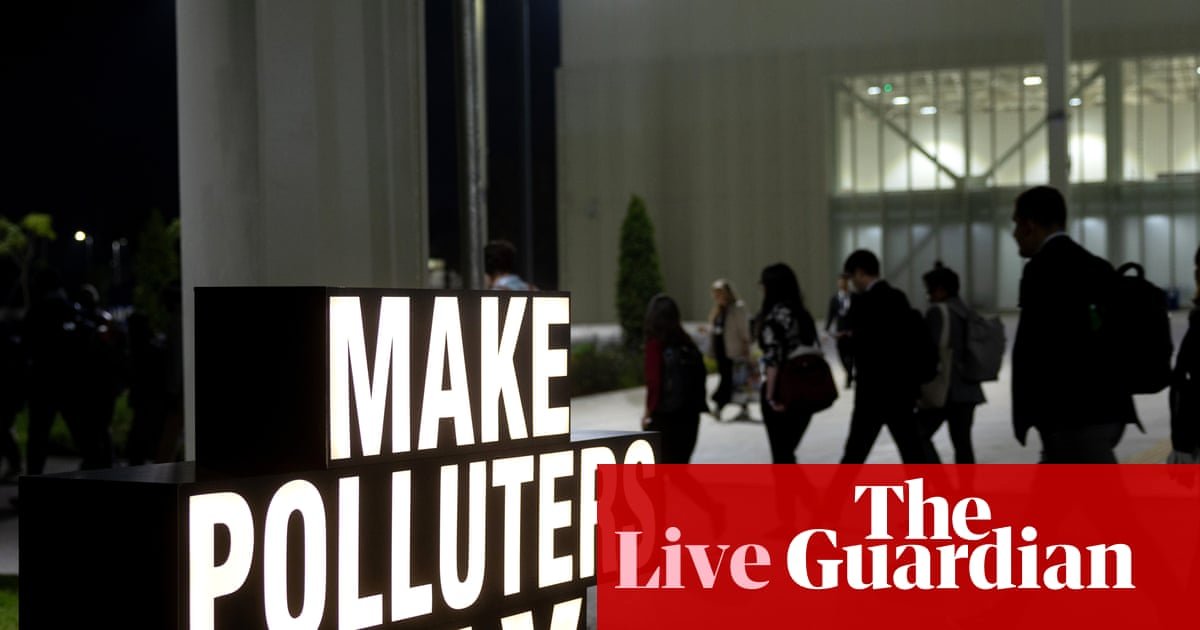
This morning, activists from Climate Action Network staged a protest at the Cop31 venue demands polluters pay up, and fill the loss and damage fund set up to help vulnerable countries deal with the fallout from violent weather.
Momentum is growing to get dirty industries to contribute to climate finance. Yesterday, the UK signed a statement backing levies on polluting sectors to help pay for countries to adapt to more violent weather and recover from the damages that follow. No global “solidarity levies” have yet been put in place but a taskforce backed by the French government has suggested raising revenue by adding a small charge to tickets for the most frequent flyers and passengers in business class, as well as charges on crypto-currency transactions.
A push by the automotive lobby in the UK to weaken electric car sales rules could jeopardise the country’s climate targets, my colleagues Jasper Jolly, Jillian Ambrose and Kiran Stacey write. The warning from official advisers comes one week after prime minister Andy Burnham told Cop31 “Britain is back”.
Weakening the UK’s electric car sales rules would probably cause the government to miss legally binding climate targets, according to advisers tracking Britain’s progress to net zero.
The analysis by the Climate Change Committee (CCC) suggests the policy would blow a hole in the plan for achieving net zero carbon emissions by 2050 – prompting concerns that Andy Burnham’s government will have to slash the UK’s carbon emissions reduction targets, known as the carbon budgets.
In a letter published on Wednesday, the CCC said the UK is “likely to miss” its climate targets if it confirms plans to allow more sales of petrol and diesel cars and vans in the next four years.
Those changes could result in an extra 8.4m tonnes of CO2 pollution a year from the UK by next decade.

Graham Readfearn
I’m not a big one for omens, but we have three official days left of talks here in Antalya and the skies were rather foreboding as we arrived at the venue this morning. All dark and moody.
Let’s hope the metaphorical and literal skies clear.
Gabrielle Canon
Debate continues on the global electrification pledge – a key priority set by the COP31 presidency of Turkey to transition to 35% electric by 2035 – with entrenched divisions around whether it needs to be tied to renewable energy.
While parties argue over whether increased efficiency and reduced emissions are enough to drive the pledge even for grids still heavily tied to fossil fuels, concerns are also rising that the rush to build energy-hungry data centers could undercut progress.
The host-country has not just set its sights on expanding electrification but dramatically growing its potential to produce energy: Turkey wants to become the regional hub for datacentres over the next decade – and that will require a great deal more capacity.
Turkey’s datacentre market is already planning a rapid expansion, with construction slated to continue in Istanbul. A market analysis released earlier this year projected significant growth from $715m to $1.79bn between 2025 and 2031. President Recep Tayyip Erdoğan promised the country would increase data center capacity to at least 1 gigawatt by 2030 at this year’s Turkey Artificial Intelligence Summit, setting at least 2% of public investment projects toward artificial intelligence projects.
On 5 November, just ahead of the international climate summit, Energy Minister Alparslan Bayraktar recently unveiled a plan for $500bn in energy investments by 2040, which includes $330bn for electrification ambitions. That plan also projects data centers will generate an additional 55 terawatt-hours (TWh) of electricity demand in that same time frame.
While Turkey is hoping to scale renewables alongside energy consumption, Ümit Şahin Senior Scholar and the Coordinator of Climate Change Studies at Istanbul Policy Center told the Guardian the push for data center expansion could add obstacles.
“The 55 TWh figure is striking,” he said. “Electrification is a sound climate policy, but the planned expansion of datacentres could undermine both electrification efforts and the renewable energy transition by substantially increasing electricity demand.”
Good morning, I’m Ajit Niranjan bringing you the Cop31 liveblog from Berlin. We’re heading into the final hectic days of negotiations, and my colleagues on the ground will be guiding you through the conclusion of these contentious climate crisis talks.
Slow progress as talks enter crucial final stretch
Damien Gayle
Delegates arrived to the Cop31 conference centre under grey skies and showered by a fine drizzle this morning. The weather could have been straight from a school creative writing piece, for these are the final days when the UN climate talks get serious.
Since the chaotic – and unexpected – first draft of the “cover decision” on Monday, progress has been slow in Antalya. It has been difficult to figure out what the story is. Unlike previous Cops, there is no headline-grabbing initiative to follow. The 35 by 35 electrification project lacks glamour. The promise to be an “implementation Cop” has not been fulfilled.
Divisions have been clear, however. They are along similar lines to usual. Who will pay for climate breakdown? All the developing world delegates I speak to here say climate finance is the most important issue. It pervades all discussions. Developing countries, already facing debt crises, want public finance from wealthier countries. But the richer countries say they have their own debt problems, crises at home and security issues that require greater military spending.
It is up to the presidency to find ways to bridge the gap between parties. Typically, presidencies have done this by convening informal negotiations, where high level delegates – often ministers – get together to work out a solution. It dates back to Durban’s Cop17, where the South African presidency staged “indabas”, the Xhosa word for a gathering of tribal elders. Last year in Brazil it was mutirão, a word with Guarani roots that had become co-opted into Brazilian Portuguese.
This year, climate diplomats will be getting together in the divan.
Source: https://www.theguardian.com/environment/live/2026/nov/18/cop31-climate-crisis-talks-turkey-latest-news-updates
About the Author