Opening summary

Frances Mao
Hello and welcome to our live coverage of the fighting in the Middle East.
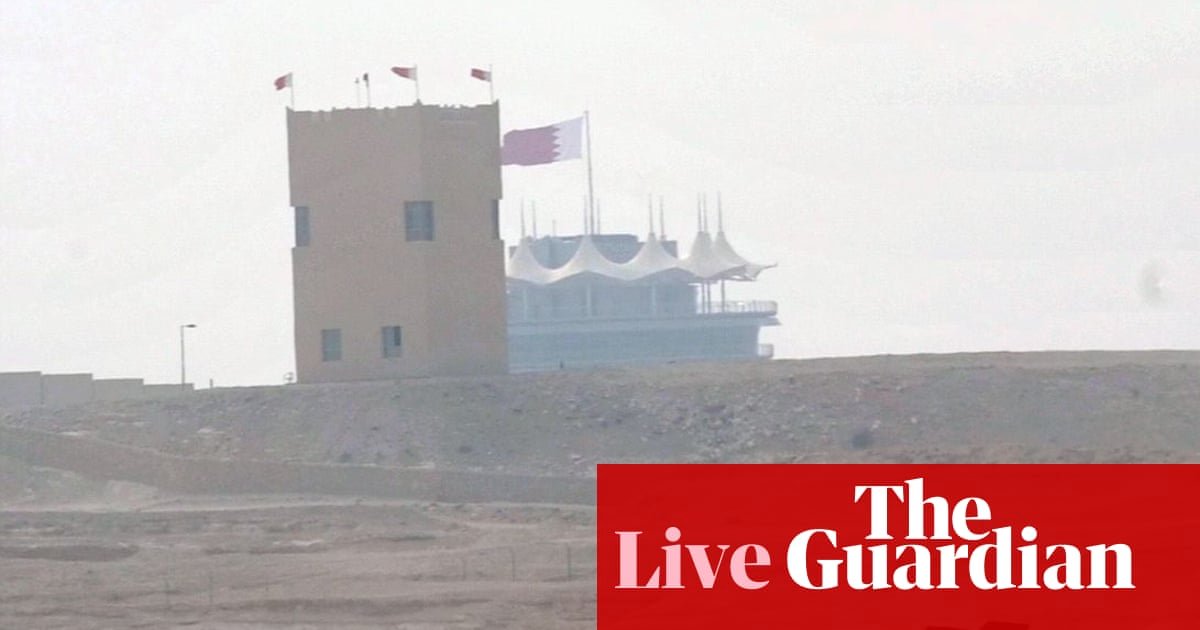
Iran has targeted an airbase in Bahrain in the latest resumption of strikes since September, prompting public warnings and sirens to ring out in the Gulf kingdom this morning.
According to Iranian media, the IRGC said it had sent six drones to attack a US radar system hosted in the US-allied island state.
Explosions were heard around the capital, Manama, but Bahrain authorities say their air defences intercepted the attacks before they reached their targets.
Bahrain, which lies directly across the Persian Gulf from Iran, is home to the US Navy’s Fifth Fleet, and has been repeatedly attacked by Tehran during the course of the war, which has seen flare-ups in strikes amid long bouts of inaction.
There are fears Iran’s attacks this morning might signal a resumption of the war while US President Donald Trump has threatened but refrained from returning to major combat. Negotiations to end the war remain at a stalemate, with the US maintaining its naval blockade and Iran its stranglehold over the strait of Hormuz.
Developments in the Red Sea this morning will add to further concerns for Gulf oil flows.
The Yemeni government forces supported by Saudi Arabia, fighting the Houthis, have retreated from the Bab el-Mandeb area, giving the Iran-aligned rebels even greater control over the critical shipping lane, which Saudi Arabia and other Gulf oil producers had been relying on to get their supplies out.
Elsewhere, Hamas has confirmed that a senior commander involved in planning the 7 October attacks was killed in an Israeli airstrike on Saturday.
Stay with us for the latest.
Key events
Iranian media are reporting that their Foreign Minister Abbas Araqchi will be in Oman on Tuesday for talks with his Omani counterpart.
Oman, along with Qatar, has been one of the key negotiators in ceasefire and peace talks between Tehran and Washington.
As both sides have settled into a strategy of exerting continued economic pain on the other, we’re yet to see any movement on a deal though.
The US is maintaining a highly expensive military operation in the Gulf, with a naval blockade that aims to stop Iranian oil ships leaving the Persian Gulf, thereby hurting the Iranian economy, and through a missile and drone operation targeting Iran’s southern coastline aimed at protecting and helping commercial ships get out. Oil flows are said to be back near their pre-war level.
But Iran hasn’t strayed from its demands, and the conditions it wants to end the war: a measure of control over Hormuz, removal of the blockade and economic sanctions, having its assets unfrozen, and reparations.
Yemen government forces dropping back from Bab el-Mandeb to shore up Aden capital
I mentioned earlier the withdrawal of Saudi-backed Yemeni government forces from the areas around Bab el-Mandeb where they’ve been attempting to stave off the Houthis.
A lightning-strike offensive back in September saw the Houthis sweep almost the entire Red Sea coast and almost seize control of the critical Red Sea strait, which has become another chokepoint in the flow of oil and and energy supplies from Gulf producers.
Here’s the full statement from the Yemeni forces, who are now redeploying towards Aden, where their government is based.
The Houthis are gathering steam in the south, where most areas remain under government control.
The Souther Yemeni forces said:
The Southern Armed Forces announce the implementation of a redeployment operation for its forces from Dhubab Airport and the Bab el-Mandeb area, west of Taiz Governorate.
This step is taken based on the priority of securing the capital, Aden, and the neighbouring governorates, as well as strengthening the front lines and addressing existing threats.
The Houthis’ stronghold currently remains most of northern Yemen, where they control the capital Sanaa and other populous areas. Since the civil war erupted in 2014, the Houthis have pushed the internationally-recognised Yemeni government south and stunned the Saudi-backed administration with their push south in September.
That prompted a military fight back operation, and Saudi Arabia striking Houthi areas in Yemen as the Houthis targeted airports and oil supplies in the Gulf kingdom.
The US thinks Iran still has between 1,500-2,500 missiles in its arsenal despite the US-Israeli damage done this year to its production facilities, reports the Wall St Journal.
That’s the “low confidence” assessment from intelligence analysts, the American paper reports, citing US officials.
They noted difficulties with tracking Iran’s stockpile, and assessing whether they’re ready for launch or remain in storage.
But they noted that Iran has appeared to manage to slowly rebuild its arsenal during the long lulls in fighting and mostly from stockpiled weapons components. Tehran has also kept up a ready supply of drones and short-range missiles.
The assessment would go against what Trump and his Secretary of Defence/War, Peter Hegseth, have been claiming repeatedly throughout the nearly-nine months of war so far; that the US has “decimated” Iran’s long-range fighting capability.
Both the US and Israel had also stated the goal of destroying Iran’s ballistic-missile capabilities when they launched war on 28 February.
Israel kills Hamas commander in strike on Gaza refugee camp
Hamas has confirmed the killing of Samir Mahmoud Hassan Abu Younis, commander of the group’s Rafah Brigade, in an Israeli airstrike on a Gaza refugee camp on Saturday night.
The BBC reports that eyewitnesses in Gaza saw four missiles strike a tent in the Al-Waha camp in Al-Mawasi, which shelters hundreds of displaced people in the southern part of the strip.
The Israeli military said it had taken steps to “mitigate harm to civilians” in the strike. It said it had also targeted other Hamas militants in the strike but gave no further detail.
Israel’s military first announced the killing on Sunday, saying they had targeted Younis who they said had been working on restoring Hamas and getting members to “advance and carry out terror attacks”.
Younis had been one of the senior Hamas figures who helped plan and oversee the October 7 attacks. He had only been the Rafah brigade leader role for two months, after Israel killed his predecessor, Nael Abu Obeid.
In their statement announcing his death, Hamas said Younis was “one of the most important commanders involved in planning and overseeing the 7 October attack”.
Earlier this week, an Israeli strike on Nasser Hospital, the largest operational hospital in southern Gaza, killed at least six people, including a surgeon and patients, and injured 30, local officials said. The IDF said it had been targeting a commander of Hamas’s armed wing.
Israel is still striking Gaza on a near daily basis despite the the US-brokered ceasefire having come into action since October last year. More than 1,620 people have been killed in Gaza since the ceasefire, and more than 74,650 people have been killed in Gaza since the war began.
Here’s a recap of what the various sides have said this morning regarding the latest Iranian strikes targeting a US air base in Bahrain.
Iran’s Revolutionary Guards:
The US air defence radar system at the Al-Riffa helicopter base in Bahrain was targeted by six drones belonging to the IRGC Aerospace Force.
The Strait of Hormuz is closed, and any aggression by the American enemy will be met with an even harsher and more forceful response.
Bahrain’s foreign ministry
Iran continues its systematic hostile approach through its sinful attacks targeting the Kingdom of Bahrain.
[Bahrain] rejects turning its territory into an arena for settling scores and holds Iran fully responsible for these attacks.
I’m yet to see a response from the US, but can expect Centcomm (which oversees all American military operations in the Middle East) to comment at some stage, like it did for Friday’s attack. Those strikes also targeted a radar site.
Bahrain locals: ‘I was hoping this period was behind us’
After two months of calm, the explosions have started again for Bahrain citizens.
Locals reported hearing blasts about 4am local time, and then a second round at 6.30am.
It’s exactly what I was hoping wouldn’t happen: Iranian attacks starting again, with all the worry and uncertainty that go with them”, Hayat Ibrahim, 65, told AFP news agency.
Another resident, Mohammed Abdallah, a shopkeeper in the capital Manama, which is just north of the air base targeted said:
I was hoping this period was behind us and wouldn’t happen again.
Bahrain’s Interior Ministry posted public warnings on X, telling “residents to remain calm, proceed to the nearest safe location, and follow news through official channels”.
Iran had last launched strikes in the first week of September, when the regime targeted US military assets in Bahrain, the United Arab Emirates and Kuwait.
Second attack in three days
Iran’s Revolutionary Guards said they had launched six drones targeting a US air defence radar at the Al-Rifaa helicopter base on Sunday morning, reported Iranian media.
They said they had attacked the air base in retaliation for “hostile US actions”. The base is about a 30-minute drive south of Manama.
US forces have been quietly carrying out a series of strikes on Iranian sites in recent weeks, including on the key Qeshm Island in the Strait of Hormuz, where there’s a major IRGC presence. Trump has called them minor strikes.
Bahrain officials this morning have accused Tehran of continuing a “systematic hostile approach” to the kingdom.
The drone flurry this morning comes just 48 hours after Iran launched drones on Friday, the first escalations targeting Bahrain in two months.
That attack targeted an American radar facility. US Central Command said it had shot down the two drones without any injury or damage.
Bahrain officials hadn’t issued any warnings for that attack, but were forced to send out public alerts this morning telling residents to seek shelter. The Interior Ministry told locals to remain calm but proceed to to the nearest safe location.
Opening summary
Frances Mao
Hello and welcome to our live coverage of the fighting in the Middle East.
Iran has targeted an airbase in Bahrain in the latest resumption of strikes since September, prompting public warnings and sirens to ring out in the Gulf kingdom this morning.
According to Iranian media, the IRGC said it had sent six drones to attack a US radar system hosted in the US-allied island state.
Explosions were heard around the capital, Manama, but Bahrain authorities say their air defences intercepted the attacks before they reached their targets.
Bahrain, which lies directly across the Persian Gulf from Iran, is home to the US Navy’s Fifth Fleet, and has been repeatedly attacked by Tehran during the course of the war, which has seen flare-ups in strikes amid long bouts of inaction.
There are fears Iran’s attacks this morning might signal a resumption of the war while US President Donald Trump has threatened but refrained from returning to major combat. Negotiations to end the war remain at a stalemate, with the US maintaining its naval blockade and Iran its stranglehold over the strait of Hormuz.
Developments in the Red Sea this morning will add to further concerns for Gulf oil flows.
The Yemeni government forces supported by Saudi Arabia, fighting the Houthis, have retreated from the Bab el-Mandeb area, giving the Iran-aligned rebels even greater control over the critical shipping lane, which Saudi Arabia and other Gulf oil producers had been relying on to get their supplies out.
Elsewhere, Hamas has confirmed that a senior commander involved in planning the 7 October attacks was killed in an Israeli airstrike on Saturday.
Stay with us for the latest.
Source: https://www.theguardian.com/world/live/2026/nov/15/middle-east-crisis-live-iran-bahrain-strikes-gulf-donald-trump-us-israel-yemen-houthis
About the Author