They had landed in New York City after long journeys from Latin America and West Africa. Some had found work on a construction site in Brooklyn. Others, a home in the apartment building next door.
Two of the young men toiling at the construction site were from Ecuador, another was from Guatemala. All had arrived only a few years ago, all were fathers in their 20s hoping to provide for their young children.
Next door, in the building with four apartments, there were immigrants from Guinea — an Amazon worker, a food delivery driver — and families from Colombia, including a family of four that had just moved there after saving enough money to abandon a migrant shelter.
On Wednesday, their lives collided in a spasm of devastation.
Most, if not all, of the people whose lives changed in an instant when the apartment building tumbled into the construction site were immigrants.
All eight who perished, including three workers at the construction site and two children from Colombia who lived in the building, were born outside the United States. So were many of the 18 people who were injured.
The collapse of the building in the Flatbush neighborhood captivated the world, in part, because it reflected the world.
Television crews from across the globe were drawn to the heap of rubble on Flatbush Avenue. Consulates rushed to support families and organize the repatriation of bodies to faraway homelands.
The calamity rocked one of New York’s most vibrant immigrant neighborhoods, an anchor of Afro-Caribbean cultures that has long served as a landing pad for newcomers, blending growing communities from Africa, South Asia and Latin America.
But it also laid bare the tension between New York’s identity as a city of immigrants and the perils that migrants with tenuous legal status sometimes face in establishing a livelihood.
The deaths echoed earlier tragedies that claimed the lives of vulnerable workers, from the 1911 Triangle Shirtwaist Factory fire, which killed 146 mostly Jewish and Italian workers, to the 2015 trench collapse in the meatpacking district that killed Carlos Moncayo, a 22-year-old Ecuadorean construction worker, prompting tougher state penalties for contractors.
And it underscored the substandard housing conditions that immigrants are often subjected to in New York, where they can find themselves in older, poorly maintained and overcrowded apartments. The building that collapsed had a litany of unresolved violations: exposed electrical wiring, missing smoke detectors and an inadequate water supply for the sprinkler system, according to city records.
“This tragedy has impacted an immigrant workplace and an immigrant home,” said Manuel Castro, the former commissioner of immigrant affairs in New York City. “That should give us pause. We know these tragedies impact our communities disproportionately.”
As families assessed their losses, Brooklyn prosecutors opened a criminal investigation into how the residential building at 1321 Flatbush Avenue had caved into a hole at the construction site.
Adults and children, they had come to New York, legally or not, seeking better lives, according to friends and relatives. They resorted to the grueling, low-wage jobs that are integral to the city’s economy.
They had found the promise of opportunity in Flatbush.
The construction site at Flatbush and Bedford Avenues had drawn Latin American workers, the backbone of nonunion construction projects outside of Manhattan. More than 60 percent of all construction workers in the city are immigrants, 41 percent of whom are undocumented, according to a 2021 estimate from the Center for Migration Studies, a research organization.
Three of them died after the three-story apartment building pancaked into the ground where they were working.
“They were doing the foundation work, the lowest of the work but the most important part,” said Hildalyn Colón Hernández, the chief of operations at New Immigrant Community Empowerment, a nonprofit that specializes in organizing and training day laborers. “They were not in the wrong place at the wrong time — they were working.”
There was José Luis Caguana Cosquillo, 26, who migrated from Ecuador four years ago and had been relieved to find work after a stretch of unemployment, eager to support his 4-year-old son and his wife, who is expected to give birth this month.
Gabriel Siguencia, 22, had moved to the region in March 2025 to support his wife and son in Ecuador. He had started as a carpenter at the construction site two weeks ago and decided to work overtime on Wednesday.
“He just came here to do work, to be able to provide for his family back in Ecuador,” his stepsister, Kayla Chimborazo, said in an interview.
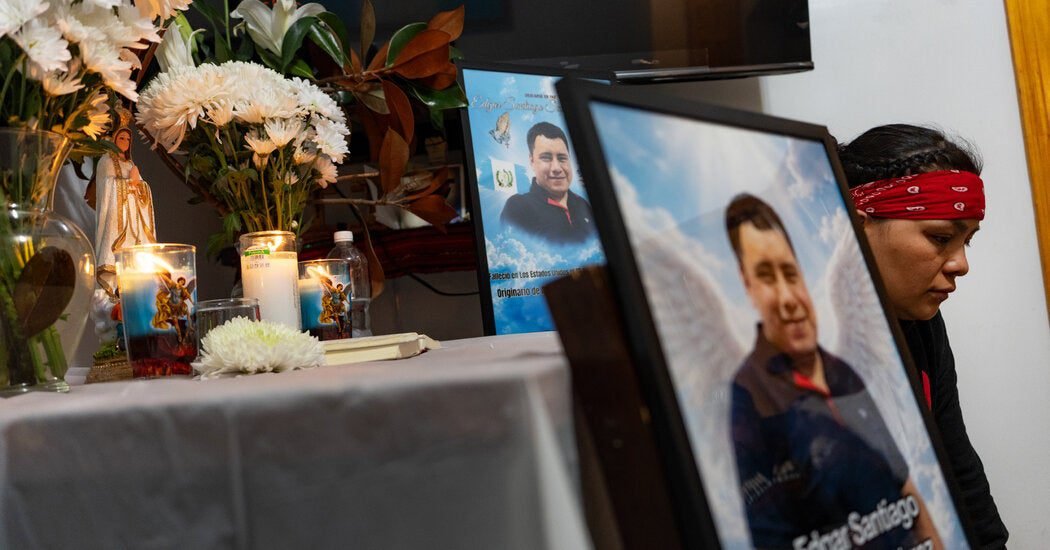
And Edgar Santiago Sapón Gutierrez, 26, a husband and father of a 6-year-old boy, had arrived from Guatemala three years ago.
“We are very devastated by the situation because in the end, we didn’t come to this country to face something like this,” his uncle, Eliseo Vásquez Talé, said in Spanish. “What we want is for justice to be served,” he added, saying that his nephew’s death was preventable.
Mr. Vásquez Talé said his family planned to transport his nephew’s body to his native country.
Walther Sinche, a community organizer in Queens, said city officials should have done more to protect the workers, stressing that day laborers are often afraid to complain about dangerous working conditions, out of a fear of retribution or being targeted by immigration officials.
Some of the immigrants who lived in the collapsed building were part of New York’s more recent, volatile immigration chapter.
They had entered the United States during the Biden administration, when millions of migrants crossed the southern border. More than 200,000 found their way to New York, overwhelming the city. Still unsettled years later, they had been contending with President Trump’s immigration crackdown, which had already subdued Flatbush, home to a bustling community of Haitians, after Mr. Trump stripped Haitians of legal protections that had shielded them from deportation.
“We have the intersection of immigration and people afraid to come out and speak,” Jumaane Williams, the New York City public advocate, said on Friday. “We want to make sure that we’re speaking up for them.”
Anderson, 35, migrated from Medellín in Colombia with his wife and son three years ago “in search of a better future,” he said in an interview in Spanish. The couple, who had a second child in New York, had moved into a one-bedroom apartment on the third floor of the doomed apartment building for $1,500 a month just over a week ago. They had secured stable jobs — him in painting, her as a home attendant — that had allowed the family to finally leave a migrant shelter.
“We searched everywhere,” Anderson, who asked that his family’s name not be used to maintain their privacy, said. “We wanted to make sure our children had enough space.”
They now have no home. But they survived.
Another family that had recently arrived from Colombia lived on the floor below; two cousins, ages 9 and 11, and a 31-year-old man, Juan Daniel Sabala Guzman, died.
The two other apartments were occupied by immigrants from Guinea, according to neighbors, including a man who lived with his pregnant wife; they both survived.
Two other men from Guinea died: Mamadou Bhoye Barry, 23, and Mamadou Bhoye N’Diaye, 31, who were cousins and roommates. Mr. Barry had been preparing for his night shift as a food delivery worker before the building collapsed. With no partner or children, he had lived in a migrant shelter two years ago, a friend told The New York Times, and had bounced between jobs, including as a cleaner at Kennedy International Airport. His body would be found in the rubble hours later.
Mr. N’Diaye, an Amazon worker, had also been getting ready to go to work.
Anderson was not at home when the building began to crumble. His wife, Johana, 31, was, alone with their sons Pablo, 9, and Joseph, 2. They plummeted to the ground. Pablo suffered a head injury, and Joanna broke her collarbone and four ribs.
Joseph was saved by an Ecuadorean construction worker who scooped him up from the rubble moments later.
“We didn’t come here to cause problems, but we’re the most vulnerable,” Anderson said in Spanish, reflecting on his time in New York. “I have hope we’ll see better days.”
Kaja Andric, Miles G. Cohen, Matthew Haag, Bianca Pallaro, Wesley Parnell and Nate Schweber contributed reporting.
Source: https://www.nytimes.com/2026/11/14/nyregion/building-collapse-brooklyn-immigrants.html
About the Author