The way stories are told about wars really matters. It is a point powerfully made by the classical scholar Alice König who, in her work on ancient and modern warfare, points out that the way war is depicted and narrativised feeds into the way wars are actually conducted. Creating and absorbing a story (whether that is told in prose or poetry, or offered by an artwork or memorial) is more than packaging or reflecting on the past; it is about generating images and expectations, and about envisioning the future. Stories, she argues, influence real-world behaviours.
The war correspondent Christina Lamb has also made this connection in relation to sexual violence in conflict: depictions of war from Homer onwards show that women have always been trafficked and raped, used as bargaining chips and spolia, their bodies made battlefields. But stories told for centuries, for millennia, have taken this violence for granted, looking blindly past the experience of women. Rape was recognised as an independent war crime and a tool of genocide only in 1998. And so it goes. Rape becomes a brutal and cheap weapon in every new war.
The powerful create wars; wars create power. Unless, that is, the wars go terribly wrong and reality butts into the intended narrative – see the US’s midterm elections, when the story Donald Trump wanted to tell about the Iran war was turned back against him by the irreducible fact of prices at the fuel pumps. The most bald contemporary example of the war-power feedback-loop is perhaps that of today’s Russia, where the second world war (or the great patriotic war, as the acceptable discourse has it) is constantly invoked by Vladimir Putin, seeded liberally into the wider culture and the education system; the invasion of Ukraine is then claimed as, essentially, its extension. For Russian propaganda purposes, the violence against Ukraine is a “denazification”, as if the years between 1945 and 2022 had been magically collapsed.
All of which is why new stories about war are needed – ones that are more truthful and more complete than the dominant patriarchal narratives of heroism and sacrifice. Not that the official narratives are always malign: the processions and the solemnity and the medals brought out on Remembrance Sunday have a dignity and a respectfulness that are of deep value. But there must be a truthfulness, too. The old lies, as Wilfred Owen knew, do no one any good. Poets like him have been the real truth-tellers in war. Instead of lighthearted, invulnerable warriors, or bronze heroes posed on plinths, he brought us the truth of men on the battlefield “Bent double, like old beggars under sacks, / Knock-kneed, coughing like hags.”
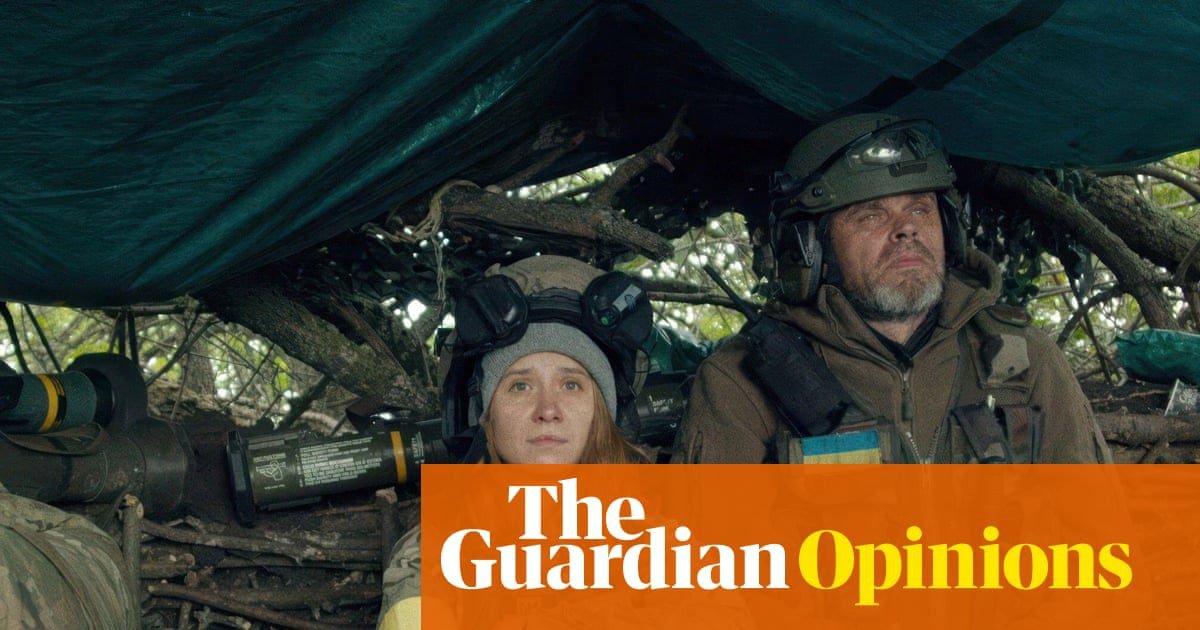
War and the act of storytelling are deeply intertwined. Stories about war, such as the Iliad, were among the earliest to be written down. Embedded into that ancient Homeric epic is perhaps an even older form of song: the lament for the dead. The Iliad ends with the corpse of the Trojan prince Hector mourned by Andromache, Hecuba and Helen – his wife, mother and sister-in-law. One veteran of the Russo-Ukrainian war, the artist Bohdan Bunchak, once told me how he and his fellow soldiers, those who survived a terribly dangerous task in the deadly forest in 2023, stayed up for hours into the night, though exhausted, talking about what had happened – who had survived, who died – as soon as they had returned to the relative safety of their base. The storytelling begins at once. In the wake of battle, you tell stories to prove you are alive, and to mourn the dead.
But wars are too jagged and incomprehensible for the whole story of them to fit into the inherited forms. And it is doubtful, too, whether “story”, with all of its implied neatness and coherence, could ever be adequate to the dark demands of describing war. The poetry of Paul Celan (who was born in Chernivtsi, then part of Romania, now Ukraine) almost breaks form itself in its anguished straining to express the darkness of the Holocaust. Ukrainian artists and writers, as the war drags on, are finding their own new forms.
The writer Sasha Dovzhyk, for example, in her new book, Apocalypse Baroque, has stories that might be described as “documentary fairytale”. These tales of real people are melded with motifs from folklore that give them a strange, off-kilter feeling, an unnerving quality that, paradoxically, connects them more closely to the actual texture of life under an invasion than straight documentary could achieve. Alisa Kovalenko’s films – Traces, about survivors of wartime sexual violence, and My Dear Theo, made as a letter to her small son in case she failed to survive her year in the armed forces – are rigorous and thoughtful, but incredibly intimate first-hand records of war. They are completely shorn of false heroism.
There are plenty of conventional memorials being created in Ukraine, some more successful than others, but the most moving I can think of are the “situational gardens” that the artist Dasha Chechushkova has been making with friends – humble flowerbeds, not meant to be grand or permanent, but small plots of growing things made in honour of the dead. The quiet, communal work of their creation – in defiance of so much brute destruction – is as important, perhaps, as the result. This year, she made one in Edinburgh when she was on a residency in the city. Her etchings after Goya’s blackly satirical Los Caprichos can be seen in a new exhibition, titled The Rupture, at Edinburgh’s Talbot Rice Gallery. They express not jingoistic fervour but the inner bleakness – feelings of depression and helplessness – that the war has brought with it. Also in the show is a simple artwork by Taysir Batniji, a Palestinian artist who was born in Gaza, which is nothing more than a stack of bars of soap on a shipping pallet near the exit. The soaps – visitors may take one as a parting gift – is engraved with the Arabic phrase, “dawam el hal men al mahal”, meaning “nothing is permanent”, or “this too shall pass”.
after newsletter promotion
An act of remembrance in the guise of a bar of soap would be inexplicable to those who built the great bronze men of more bombastic times and places, but it is, to me, more effective and more honest. It is a friendly offering. You might think about the circumstances that led to its creation as you complete the ritual of washing your hands. The soap itself and its motto wear down over time. Its small message, nothing will last, is both a promise and a threat.
Source: https://www.theguardian.com/commentisfree/2026/nov/14/ukraine-gaza-better-stories-war-artists-remembrance
About the Author