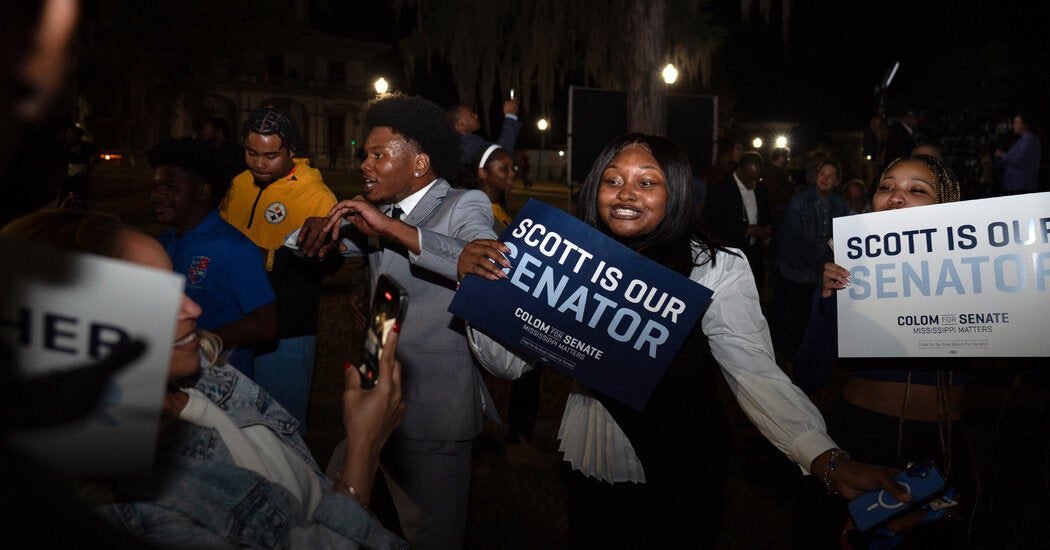
On the lawn of Tougaloo College, steps from the chapel where the civil rights leaders Fannie Lou Hamer and Medgar Evers gave speeches, they danced.
Students from Tougaloo and other nearby historically Black institutions lined the sidewalk to cheer and applaud. Members of Black fraternities and sororities, dressed in their letters and colors, embraced one another. “Thank the Lord, we did it,” one woman declared.
It was a day that many had prayed would come, though they could never know when. That evening, Scott Colom made their hopes a reality, speaking in front of the college chapel as the senator-elect from Mississippi.
Tyler Dotson, 21, a freshman at Tougaloo College, was awe-struck. “It was everything,” he said, describing how it felt to hear that Mr. Colom had won. “We’ve been waiting a long time.”
“It’s something big, remembered in history,” he added, grinning. “We back.”
When the U.S. Senate race in Mississippi was called for Mr. Colom, who will become the first Black senator from the state since the Reconstruction era, shouts of celebration erupted at the local N.A.A.C.P. office.
At a law office in Jackson, everyone stopped working and screamed for joy.
At Tougaloo, the rows of chairs filled long before the victory speech began, as hundreds gathered at the college that had been both a haven and a proving ground for a generation of civil rights activists and Black leaders.
It had been eight days since the election. It had been 63 years since Medgar Evers, the civil rights leader who led voting rights drives in the state, was assassinated in his driveway. And it had been more than 150 years since a Black senator had been chosen to represent Mississippi.
For generations, Mississippi was a bastion of slavery, segregation, lynching and Black voter suppression.
Mr. Colom will be the third Black senator to represent the state. The first two were chosen by the state legislature and served during Reconstruction — Mr. Colom will be the first chosen by voters.
“It lets me know that my work isn’t in vain,” said Jermarius Everett, 20, wearing a black and gold jacket of Alpha Phi Alpha, the fraternity to which Mr. Colom also belongs. “I can sit in the seats that once controlled people like me.”
Some in Mississippi, including Nadia Colom, Mr. Colom’s wife, pointed to President Barack Obama’s election in 2008 as the last moment where this kind of hope reverberated through their communities.
At a bar in downtown Jackson, Robert Morris, 37, sat on the patio and said the Senate election had made history he never expected to witness as a lifelong resident of the Deep South.
“I never thought I’d see a Black president, never thought I’d see a Black senator, especially a Black senator from Mississippi,” Mr. Morris said. “Remember when André 3000 said the South has something to say? Well, now Mississippi does. Everybody is paying attention to us, and we’re going to do things right.”
Many college-educated residents of Mississippi have left the state over the years to seek jobs and more progressive environments elsewhere. Terry Rogers II, a 21-year-old senior studying political science at Tougaloo, said Mr. Colom’s win could help change that.
“This is what we’ve been praying for, for years, for generations,” he said. Mr. Rogers had spent Tuesday driving a college van to shuttle students between government offices to check on their ballots as the race remained uncalled. “This makes me want to continue to be a Mississippian. This makes me love my state even more than I already did.”
As Mr. Rogers spoke, another student shouted in joyous disbelief: “He won! You see that? You see that?”
Many voters brought along the next generation, eager to help them absorb the moment.
“I don’t have the words to describe the joy,” said Lisa Ross, 63, a lawyer in Jackson. She brought her great-niece and great-nephew to Tougaloo College, “to see Scott and what they can become.”
“We’ve been working so hard, and I’m so glad we didn’t give up,” she said.
Vonda Reeves, 68, a doctor in Jackson, learned of Mr. Colom’s win during a break in her tennis lesson. Then, she said, “the world exploded. Everything became surreal to me.”
“It was like I was levitating because of the joy I felt,” Dr. Reeves said, adding that she wished her parents had been there to see the milestone.
The celebration reflected the coalition that Mr. Colom had built: not just the Black voters enraged by efforts to undermine their voting power and their representation, but the white Democrats who had hoped that their political drought could end with Mr. Colom.
Mary Evelyn Dear, 32, had never been to Tougaloo College and hesitated to go alone. But she dabbed some glitter around the corners of her eyes and drove over, unwilling to miss the moment.
“I wanted this to happen so badly — it’s part of history,” said Ms. Dear, who is white. She jumped on her couch and shrieked with joy after days of refreshing the ballot totals over and over again.
Many leaders saw Mr. Colom’s win as a poignant triumph for voting rights.
“Mississippi voters made history because they refused to be intimidated, discouraged, or counted out,” said Derrick Johnson, the national president of the N.A.A.C.P., in a statement. This year, the N.A.A.C.P. opened 11 field offices and registered more than 17,000 voters, he added. The Jackson office still has bullet holes from the time Mr. Evers worked in the state, when he faced several assassination attempts before being killed in his own driveway.
Reginald Crear, 45, had grown up hearing his father’s stories about the Jim Crow era in Mississippi. On Wednesday, he had his father on a video call so he could watch Mr. Colom’s speech with him.
“It really gives me goose bumps,” he said, adding “it was surreal, a real surreal moment.”
Amid the exuberant celebrations, Mike Hurst, the chairman of the Mississippi Republican Party, said in a statement, “Scott Colom ran a good campaign here in Mississippi, and I congratulate him on his victory.”
He continued: “While elections may determine who holds public office, they do not define who we are as a people nor diminish the principles we hold dear. Tomorrow, the sun will rise over the same Mississippi we loved yesterday.”
Nsombi Lambright, 53, was at the local N.A.A.C.P. office when the news broke that Mr. Colom had won. People began singing “We Shall Overcome,” the civil rights anthem, and started hugging and crying. She wore a shirt with a picture of Emmett Till, the 14-year-old boy lynched in Mississippi in 1955.
“We have felt really beat up over the last year,” she said, pointing to the deaths of Nolan Wells, an 18-year-old found dead after a boat trip with friends, and Kohen Wiley, the toddler shot and killed by a police officer, as examples of events that had shaken Black Mississippians this year. “We needed this.”
Michael Goldberg, the Politics reporter for Mississippi Today, contributed reporting from Jackson.
Source: https://www.nytimes.com/2026/11/12/us/elections/mississippi-colom-senate-race-black-voters.html
About the Author