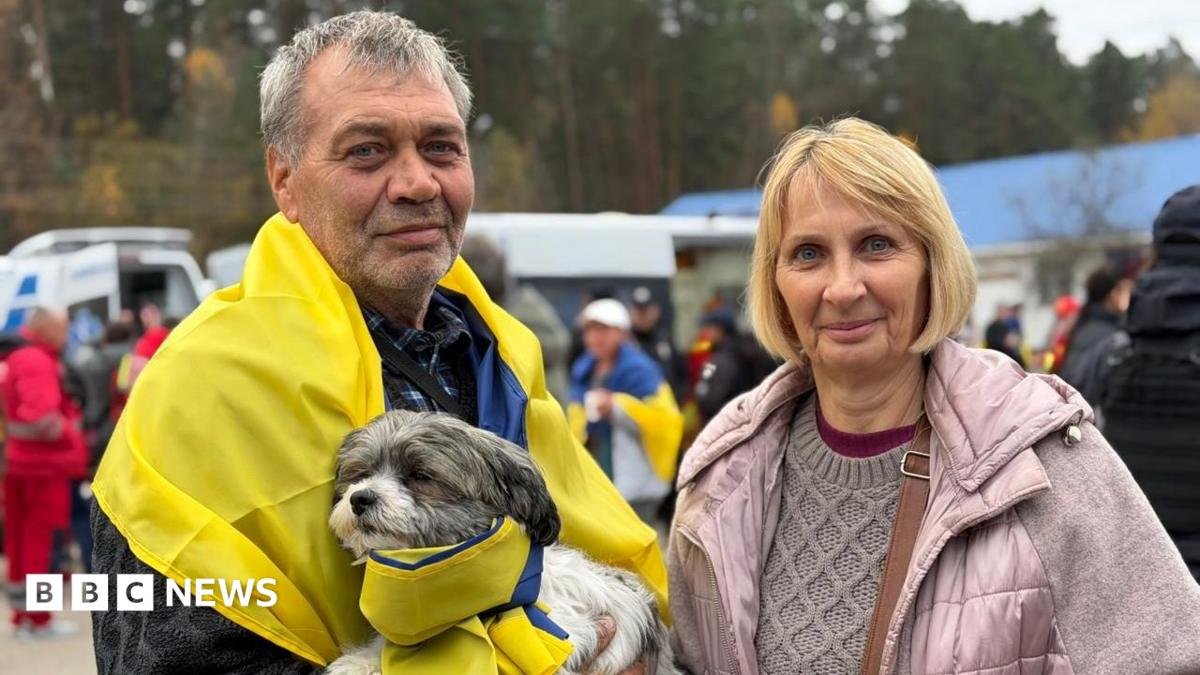
Olha has one word to describe what life has been like in the frontline city of Oleshky over the past few years: “Horror”.
Disembarking alongside her from a coach in the Ukrainian region of Chernihiv with their immediate family and dog, her husband Viacheslav put it this way: “We came back from hell.”
The couple were among hundreds of residents evacuated from the Russian-occupied city who crossed into northern Ukraine via Belarus on Saturday, many reuniting with loved ones they had not seen for years.
Oleshky, seized by Russia during the first few days of its full-scale invasion in February 2022, is trapped on one side by the Dnipro River and on the other side by Russian forces.
Olha and Viacheslav had lived there with their son and daughter, both in their 30s. Even as the shelling around them intensified, they feared that trying to escape could be even more dangerous, with routes mined and subject to drone attack.
As supplies dwindled, the couple said they made an attempt to find food by crossing through minefields earlier this month. “People were stepping on mines, dying and being maimed, all just to survive,” Olha told the BBC.
Those who were too afraid to go out in the city had resorted to cooking garden weeds to survive.
“We saw that the situation wasn’t getting any better, so we realised we had to get out,” Olha said.
That opportunity came earlier this week when a humanitarian ceasefire, brokered by US First Lady Melania Trump, took effect in the Kherson region, providing the first few days of peace in the area for four years and allowing Oleshky residents to evacuate.
Up to 6,000 people, including 200 children, were believed to still be living in Oleshky and its surrounding areas, with 1,700 in the city itself.
Residents had a four-hour window on Friday to leave, with a convoy of 25 buses brought in for up to 750 evacuees, along with ambulances for people with limited mobility.
After travelling through Russian-occupied territory to southern Russia, then flying to Belarus, evacuees arrived on busses to a military facility in Chernihiv on Saturday.
On the tarmac, where evacuees were processed before travelling onwards, some elderly residents were so weak they had to be carried on stretchers. Others experienced emotional reunions.
Source: https://www.bbc.co.uk/news/articles/cqglw3k7djp1o?at_medium=RSS&at_campaign=rss
About the Author