That’s all, folks!

Tom Phillips
Thanks so much everyone. That’s all from me. Or, as the potty-mouthed Jair Bolsonaro would say: “Acabou, porra!” (“That’s the bleeping end of it!”).
I really appreciate everyone following and supporting our coverage of Brazil. Certainly, a rocky road ahead for Lula. But for now, tens of millions of Brazilians, and the world, breathe a sign of relief.
Key events
Was Lula’s victory a case of the ‘lesser of two evils’?
Dougie McGilvray asks: To what extent was Lula’s victory a case of choosing the “lesser of two evils”, given his previous corruption convictions (annulled on procedural grounds) and net-negative approval ratings? Is this part of a broader Latin American trend of increasing polarisation and persistent corruption concerns? Argentina seems a particularly stark example, with no credible candidates emerging from either the left or right, let alone the political centre. What should the left learn from the region’s shift to the right, and to what extent has it contributed to this polarisation?
Tom: I think that while Lula has huge support in some parts of the country, for a lot of voters, that was indeed the case. Many people seem to have been casting an “anti-Bolsonaro” vote, because of their revulsion at the idea of such a radical political project returning to power. They remember the Covid chaos under Jair Bolsonaro, when 700,000 Brazilians died and he mocked patients and undermined vaccination efforts. They remember the violence of January 2023 when Bolsonaro’s supporters trashed congress, the supreme court and presidential palace. They are aware of the allegations of Flávio Bolsonaro’s alleged ties to organised crime and the police investigations into suspicions of money laundering. And on Sunday they said: no.
I think that in Lula’s next government he will need to build a broad church, including moderate, democratic sectors of the right in his administration. And he will also need to show real results on one of the most pressing concerns Brazilians have – crime and violence – to stop the right weaponizing this issue against the left, as they have done successfully in places such as Brazil, Colombia and El Salvador.
Is US meddling in Latin America under reported?
PersonN0nGrata asks: US interference in this election has been rife from the evidence, from the administration and the US based corporates. This follows a pattern throughout Latin America where US interference has been continuous and escalated, up to and including actual military attacks. Why is this not given the prominence it should be in reporting?
Tom: Thanks for the question. We’ve been reporting extensively on Trump era US interference in Brazilian politics since last year when the campaign ramped up in an attempt to derail Jair Bolsonaro’s coup trial.
We reported on how one of Lula’s ministers saw their US visa revoked, how a supreme court judge was sanctioned over Bolsonaro’s trial, which Trump claimed was a witch-hunt, and in the lead-up to this campaign we published a big story about how the US campaign had echoes of Washington’s cold war-era attempt to manipulate Brazilian politics in the lead-up to the 1964 coup, which ushered in two decades of authoritarian rule in which hundreds of people were killed or disappeared. We’ve also reported on how Meta has been accused of trying to meddle in Brazil’s election, claims it has denied.
With our team around the region we have also been reporting a great deal on US military strikes in the Caribbean and off the coast of Ecuador, including this great recent piece by my colleague Tiago Rogero which is definitely worth a read if you missed it. I’ve been back to Venezuela twice this year myself to report on the aftermath of Trump’s invasion to abduct Nicolás Maduro in January. This piece is from a housing estate I visited that came under attack as US attack helicopters swept towards Caracas.
What role did women play in the election?
Kirsten Schulz asks: There’s been much reporting about how Gen Z brought in the vote, not least via orchestrated WhatsApp. Lula thanked the women of Brazil for his re-election, or at least the “carinho” they have shown him. What role did women have in the election?
Tom: Brazil’s nearly 84 million female voters appear to have played a decisive role in the election. One poll just before the second round found that 55% of women planned to vote for Lula, and 45% for Bolsonaro. The number was reversed when it came to male voters: 56% to Bolsonaro and 44% to Lula. Political scientists say women are often repelled by Jair Bolsonaro’s history of radical policies and misogyny.
Before this election, it was predicted that women would have the final say – and that seems to have been in large part what happened. In the final presidential debate, Lula pointed to how Bolsonaro had once voted against extending maternity leave and asked him: “What do you have against women?” He didn’t have a convincing answer for female voters – who make up nearly 53% of the electorate – and seems to have been punished at the polls.
Lula is 81. Who will step into his shoes?
Heather Clarke asks: Thanks so much for your well informed reports from Brazil, you must be exhausted and exhilarated. Lula is 81. Who should we be watching to step into his shoes? Who could be the next leader of the PT (“Partido dos Trabalhadores”)? Also he said he wanted a fresh start but this is his fourth term and he doesn’t have many allies in the Senate, how can he take a progressive agenda forward? And what lessons can progressives take about campaigning to overturn seemingly impossible odds?
Tom: Thanks for reading, Heather. I am exhausted, indeed. And, like Lula, I need a holiday! Despite constant doom-mongering about Lula’s supposed lack of an heir, I think there are a few interesting names to watch. There’s Flávio Dino, 58, the supreme court minister and former Maranhão governor, who some suspect may step back into politics next year. There’s Rafael Fonteles, the Workers’ party (PT) governor elect of Piauí state, who has played an important role in the 2026 election and is tipped as a possible finance minister in Lula 4.0. He’s 41. Another name to watch is Guilherme Boulos, 44, a charismatic activist and politician who became Lula’s Minister of the General Secretariat last year. His beard and combative style are reminiscent of Lula.
Interestingly, some people have also been talking about the vice-president, Geraldo Alckmin, too, although he’s from the centre right. Lula shared the microphone with Alckmin on election night, leading some to suspect he will play a much bigger role in the next administration and possibly the 2030 election. Finally, we have Fernando Haddad and Camilo Santana, both former education ministers who are close to Lula.
As for what lessons can be learned, I think the role of social media mobilisation is crucial. The ‘Lula’s Army’ WhatsApp group and its 10m members clearly played a huge role in turning the election around, despite clear signs of meddling from US tech giants. The role of young people was also absolutely central to Lula’s fightback. The student-led protests that began in Niterói, near Rio, immediately after Lula’s first round loss, and then swept the country, clearly played a major role in helping Lula regain the initiative, up and down the country.
Even in pro-Bolsonaro parts of the Amazon, I recently saw large numbers of young people out on the streets trying to change voters’ minds and vote Lula, in large part as a result of this mobilisation. Lula hinted at that in his first speech after the result was announced on Sunday night, thanking young people for their “generosity” in fighting for their country’s democracy and future.
Is Brazil a priority for Andy Burnham and the UK?
Danidown asks: Has Andy Burnham reached out to congratulate Lula yet and what was the main takeaway? Are the PM and Lula actually planning to do any business together on green energy, or is it mostly talk?
Tom: Yes, he has – although it took Andy Burnham more than 24 hours to release a 33-word tweet, which has caused some perplexity and frustration among Brazilian officials and observers who had hoped for a quick recognition of the result. (In the message Burnham celebrated Lula’s win as “a true victory for democracy and progressive values”.)
That said, Ed Miliband has been in touch with top members of Lula’s team. I was just on the phone with Celso Amorim, Lula’s foreign policy chief and a former ambassador to London, and he has been in touch with Miliband since the election. They know each other well because Amorim once studied with the foreign secretary’s father, the left-wing intellectual Ralph Miliband. Amorim called Burnham’s message “very warm and positive”.
It would be nice to see a British prime minister make an official visit to Brazil – the last such visit was, amazingly, back in 2012 I think, when David Cameron was in power. But the 24-hour delay in Burnham’s tweet suggests, alas, that his government may not see Brazil as a priority. Let’s hope it’s not just talk. The British envoy to Lula’s last inauguration, in January 2023, was the then environment secretary Thérèse Coffey. Hopefully, the prime minister will come this time, although perhaps don’t hold your breath.
(PS: Many years ago I travelled to the Amazon with Ed Miliband for this story so he knows and is interested in Brazil, which is a good sign)
Has Christian fundamentalism changed Brazilian politics?
JamesRyan asks: What factors underpin the growth in Christian fundamentalism (specifically the Pentecostal movement) in Brazil? What are its consequences for Brazilian politics, and is this a pattern reflected across South America?
Tom: Hi James, Pentecostal missionaries first came to Brazil in the early 20th century but there has been a massive expansion of their activities since the 1970s and 80s. Evangelical churches embedded themselves in deprived and neglected communities such as Rio’s favelas, which had grown massively because of the urbanisation process that started in the 50s. Those churches sought to offer immediate solutions to day-to-day problems residents were facing: alcoholism, addiction and urban violence. In recent years the “prosperity theology” preached by these churches has struck a chord in communities and regions where people are desperate to get ahead in this life, rather than the next one.
The reach of such churches spread so quickly – and massively outpaced the Catholic activists who once offered social and spiritual support in such places – because it was relatively easy to recruit pastors, who didn’t need any of the training required to enter the Catholic priesthood. That means that evangelical churches can now be found absolutely everywhere you go in Brazil, from poor communities in the south-east to extremely remote parts of the Amazon, and even illegal goldmines.
The consequences for politics and society have been dramatic – evangelicals now make up nearly 30% of the population – although it’s important not to see the evangelical church as an entirely monolithic movement. Before this year’s election, one well known Rio pastor/politician, a former Bolsonarista called Otoni De Paula, backed Lula.
But many important leaders of the mega churches have thrown their weight behind the Bolsonaro family, believing they will push their conservative agenda when it comes to issues such as abortion, drug legalisation and same-sex marriage. Such leaders have huge sway over their flocks. One poll on the eve of the second round showed that 73% of evangelical voters planned to vote Bolsonaro and 27% Lula.
It is a trend you see across Latin America, to a greater or less extent, from Nicaragua and El Salvador in Central America, to Brazil, Colombia, Peru and Venezuela in South America. In Argentina and Mexico you see it less, so far at least, because of the historic role of the Catholic church.
Why did Brazil’s stock market tank after the result?
Jeremy Hurley asks: Why did the Brazil stock market tank after the election result, and will it recover?
Tom: Basically, because the markets had been convinced that Flávio Bolsonaro was going to win and that after taking power he would implement a “chainsaw” style austerity programme inspired by Javier Milei’s government in Argentina, deal with Brazil’s budget deficit, and bring down interest rates. Lula’s victory came as a shock to investors who believe his fourth presidency will see increased and unsustainable public spending.
Yes, I’m sure things will stabilise at some point soon after the initial panic – during Lula’s previous administrations investors made a lot of money, particularly during his first two terms. There is talk of Lula naming his vice-president, the centre-right politician Geraldo Alckmin, as finance minister in order to calm markets down. Another possible name Rafael Fonteles, a mathematician who is the governor of Piauí and used to run that state’s finances.
Can Lula curb the violence?
Adam Law asks: Two major issues in Brazil’s election were corruption and violence. There is plenty of discussion about corruption, but it is violence that motivates many to turn politically right politically. Is there a way that the left can deliver on this issue without becoming authoritarian?
Tom: That’s a really good question and, as someone who lives in Rio de Janeiro, it is one that has been on my mind a lot. The far right has been very good at blaming “soft” left wing policies and federal government incompetence for the failure to control armed violence. It was a huge part of the campaign against Lula in the run up to this election.
But public security is a state matter and Rio state has largely been governed by the right for years now. Their hard-line, shoot first ask questions later approach has not worked – in fact many believe it has made the violence even worse and led to massacres such as the one I covered in the Complexo da Penha almost exactly one year ago. It must be said that similar tactics have been used in Bahia state, which has a huge problem with violence and is governed by the Worker’s party (PT). My colleague Tiago Rogero has written about this.
Clearly, though, Lula needs to do something different in his fourth term – and it won’t be joining Donald Trump’s “Shield of the Americas” crackdown on “narco-terrorists”, as Bolsonaro had planned to do. Lula has promised to create a public security ministry and “offer protection to workers, and put crooks in jail”. Controversially, during the campaign he said he now backed lowering the age of criminal responsibility to 16 – a major U-turn. That’s a sign that there will be a tougher stance towards crime in Lula 4.0 – but fortunately one that will fall short of the all-guns blazing doctrine supported by Bolsonaro-style politicians. Hopefully, he will continue to crack down on arms trafficking given the huge number of guns that went into circulation during Jair Bolsonaro’s presidency – many of which ended up in the hands of drug dealers Bolsonarista politicians claim they want to fight.
Tragically, I do think we are likely to see even more bloodshed in Rio state, where the recent election was won by Douglas Ruas, a little known Bolsonarista politician and former police officer who has vowed to declare war on crime. Three of the police officers involved in last year’s Complexo da Penha operation have also been elected (one to Congress, two to Rio’s state parliament), showing there is real public support for such policies and actions. Next year is going to be a tough one for residents of the city’s favelas, I fear.
How can Brazil fight outside interference?
Patric Mauz says: How can Brazil ‘shore up’ the democratic process against outside influences? The natural resources that Brazil stewards is a massive amount and it is so very obvious that wealthy outside parties would very much like to have a say in that. Datacentres and natural resources are more important than the Amazon rainforest or local native tribes to those who have the wealth and power. It will only get worse and that is terrible for future generations.
Tom: I think the key answer to this question is in the first speech Lula gave after the result was announced on Sunday night. “This was an election in which we had to overcome outside interference, through digital platforms, which we are going to have to regulate,” Lula told us at the São Paulo hotel where he was following the vote count. “It is unacceptable that we don’t recognise that crimes committed in the digital world must be treated the same as real-life crime. We cannot have monstrously huge corporations making millions and billions, paying zero taxes in this country, and trying to steer the outcome of its elections,” Lula went on.
Clearly – not just in the lead-up to this election, but stretching back several years – social networks in Brazil and elsewhere – have been skewing their output in favour of far-right candidates and movements.
On the eve of Sunday’s vote, Meta was accused of actively trying to interfere in Brazil’s election in Bolsonaro’s favour – although it denied those claims.
One of Lula’s biggest – and most complex – tasks during his fourth term will be trying to tackle this problem.
Has Lula halted logging in the Amazon?
Haranf asks: Has there been a significant decline in logging and deforestation since Lula has been president?
Tom: Yes, there has been a historic reduction of deforestation, not just in the Amazon but also in the Cerrado savannah at the heart of Brazil. This has been the result of a major push by Lula’s government, under the leadership of former environment minister Marina Silva, who may now return to government having failed to win election to the senate. Lula’s efforts came after four years of destruction under Jair Bolsonaro, who governed from 2019 to 2022, and set about dismantling Brazil’s environmental protection agency, Ibama, and other efforts to protect the environment. Back then, environmental officials were effectively banned from talking to journalists like me. They were grim times for the environment.
When I spoke to Marina Silva on Sunday night she was overjoyed that Lula’s efforts to protect the environment could continue now he had secured a second term. “My heart is happy and filled with gratitude to God and the Brazilian people,” she told me. “The thing I most feared was that our Indigenous territories would be invaded again [under another Bolsonaro government]. Now, I am certain that they will be preserved and that there is no risk of illegal miners returning to destroy these populations.”
That is one of the most uplifting elements of Sunday’s result, I think, although things will not be easy going forward given the major expansion of the far right presence in Congress, which will make stripping away environmental protections easier. After the recent first round election, the Climate Observatory umbrella group warned that 64 of Brazil’s 81 senators and 345 of the 513 lower house lawmakers were now in some way hostile to environmental protection issues. So it’s going to be tough for Lula.
Has the football shirt been reclaimed from the right?
DapperDon asks: It seems to me that national football team colours have been hijacked in recent South American elections with conservative and rightwing candidates adopting team colours to claim patriotism. Arguably Bolsonaro Snr was one of the first to politicise national pride back in 2018, but it seemed not to have been as much of a factor in this election with Jnr. Are folk growing accustomed/cynical to this ugly, naked attempts at association, or did the left combat this effectively?
Tom: I think the left has been quite clever about reclaiming Brazil’s national shirt from the far-right in recent months. For years leftwing Brazilians shunned the jersey because of its association with Bolsonarism. The problem has been compounded by the association of some of the country’s top footballers, such as Neymar, with the Bolsonaro movement and family. But during this year’s World Cup and election I’ve seen lots of progressive people and politicians wearing it.
There has been a concerted effort to make sure all Brazilians can feel pride in the shirt. At Lula rallies you now see lots of vendors selling yellow shirts with Lula’s name and his election number 13 printed on the back. On social media, Lula supporters have even been using the yellow shirt to get around what they see as the bias in terms of promoting left and rightwing content. By wearing the shirt, they believe they can trick the algorithm into turbocharging leftwing content, because it identifies it as being from the right. Let’s hope the trend continues.
On Sunday night, Lula took to the stage to celebrate his victory alongside his social media whizz ally, André Janones, who was wearing the yellow “Canarinho” shirt. That image is on the front page of the Guardian today.
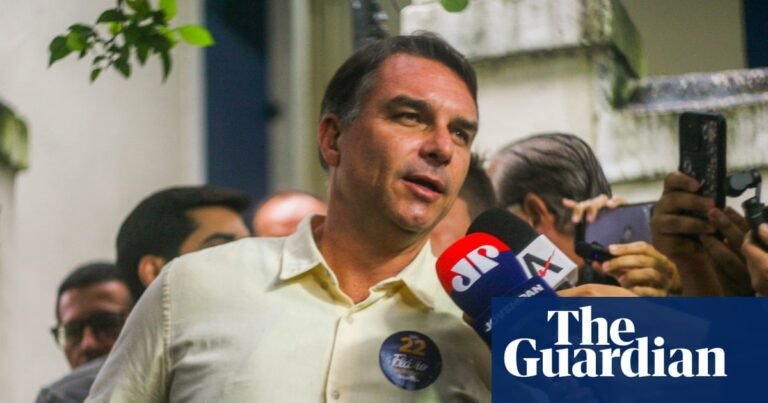
Will Flávio flee the country?
ThirdHandLuke asks: What are your views on Flávio Bolsonaro being banned from leaving Brazil so soon after losing the election? As an interested outsider, to me the optics don’t look particularly great, given Lula’s statement “Democracy always”.
Tom: The optics do indeed look odd. But Bolsonaro is the focus of several serious criminal investigations and his relatives and allies have a long history of skipping the country to avoid justice. His brother, Eduardo Bolsonaro, left Brazil for the US in early 2025 and has not returned. He would have to serve a four-year sentence for coercion if he returned. Jair Bolsonaro’s former spy chief, Alexandre Ramagem, fled the country through the Amazon last September to avoid having to serve a 16-year sentence for his role in the coup attempt that happened after Lula won the 2022 election. Carla Zambelli, another prominent Bolsonarista, is facing extradition from Italy after fleeing there. Jair Bolsonaro briefly sought shelter in the Hungarian embassy in Brasília, in 2024.
There are unconfirmed reports that Flávio Bolsonaro may have already left the country. Federal police are investigating claims that he fled across the border into Argentina and plans to take a private jet to the US. We are trying to find out what is going on and will keep readers posted.
Yesterday, on Today in Focus, I predicted that Bolsonaro would probably leave the country in the days or weeks ahead because he feared arrest. And it looks like I may have been right. Reports in the Brazilian media today say that allies of Bolsonaro have been trying to get in contact with him this morning but have not been able to.
Brazil has land borders with nine countries and the territory of French Guiana, stretching nearly 10,500 miles. So if someone wants to escape, it is not hard. Yesterday Bolsonaro was given 24 hours to surrender his passport. But he has reportedly yet to do so.
Will Lula stand up for justice in Ukraine and Russia?
LiamCurran asks: I am delighted with Lula’s victory and the progressive policies and changes that should come with it, but have been severely appalled at his support for Putin and his atrocities committed in the Ukraine war and the general abuse of human rights in Russia. Do you think Lula would ever change this policy and stand up for democracy and justice in Ukraine and Russia?
Tom: I think Lula’s position on the Ukraine war and its longstanding strategic partnership with Moscow is unlikely to change. Brazil’s agribusiness sector is hugely reliant on fertilisers bought from Moscow. In fact, Brazil is now Russia’s biggest customer of fertilizers such as phosphate. After the start of the war, Brazil also became one of the biggest importers of Russian diesel. The Ukrainian president Volodymyr Zelenskyy congratulated Lula “on his impressive election result”. He also said that he hoped “Brazil continues to play an active role in international affairs and contributes to the effective protection of human rights, the rights of peoples, and the rights of states”.
Speaking at the UN recently Lula called for diplomatic efforts to end the war. “We all know that there will be no winners on the battlefield. Diplomacy is the only option,” he said. But I would not expect any more forceful condemnation of Vladimir Putin from Brasília, no.
Will Lula’s win end the region’s far right turn?
Clara Panozzo asks: How do you think Lula’s win will affect Javier Milei in neighbouring Argentina? And will Lula’s fourth and last term bring about the beginning of the end of the far right turn in the region?
Tom: I’ve heard it said that, deep down, Javier Milei wanted Flávio Bolsonaro to lose. Had Bolsonaro become Brazilian president, Brazil – as the region’s biggest economy – would surely have become ground zero for the Trumpian far right in South America. Eduardo Bolsonaro – who is close to the Maga movement – would possibly have become foreign minister or ambassador to the US. And Milei – who has tried to position Buenos Aires as a Maga mecca – would have lost his position as Trump’s go-to man in the region.
That said, relations between Brazil and Argentina aren’t going to be easy. Lula clearly despises Milei (I’ve heard he doesn’t even like to utter his name) – and the feelings seem to be mutual. While Lula apparently has a decent relationship with Chile’s hard right president, José Antonio Kast – who has already said he’ll attend Lula’s inauguration in January – Milei is unlikely to be on the guest list.
I think it would be premature to declare the demise of the far right in Brazil, or the region because of Sunday’s result, although it is certainly a major repudiation of the Bolsonaros by a majority of Brazilians. The Bolsonaro movement has put down deep roots in Brazilian society and, while Flávio may now have to leave the country or face jail, there will still be three members of the family in Congress from next year. Key state governments, such as Rio and São Paulo, are run by Bolsonaristas.
Perhaps, however, Lula’s election will erode the Bolsonaro clan’s supremacy over the Brazilian right. I suspect one lesson conservative politicians might take from the result is that the Bolsonaro name has, for many voters, become a toxic brand. For them, it might, therefore, be wise to shift away from the Bolsonaros and seek a leader without that baggage and that surname. With Flavio Bolsonaro defeated and Jair Bolsonaro, the movement’s leader, now unlikely to emerge from house arrest – in the short term at least – there might be a window of opportunity for a less extremist right wing leader to emerge.
That said, the smart money is probably on the pro-Bolsonaro governor of São Paulo, Tarcísio de Freitas, becoming the key leader of Brazil’s right. Some even believe that, like Milei, he was secretly rooting against Flávio Bolsonaro because he harbours presidential ambitions of his own and hopes to challenge whoever Lula’s successor is in the 2030 presidential election. Time will tell.
Is there any legal way for Bolsonaro to contest the result?
BMcG0305 asks: A couple of questions. Is there any legal way Bolsonaro could use to contest the result? Also is there any potential way to stop certification of the result?
Tom: In a nutshell, no. His party acknowledged the election results yesterday and although Flávio Bolsonaro has said he will take legal action, legal experts agree he hasn’t a hope in hell of success. Donald Trump’s rather half-hearted claim of a “rigged” election, suggests the US president isn’t going to go to war with Brazil over this either – even if Steve Bannon is calling for all diplomatic and trade relations to be cut. It just isn’t going to happen.
Apart from Milei, rightwing leaders in Latin America have all recognised Lula’s win. In Brazil, meanwhile, prominent rightwing leaders have urged supporters not to take to the streets to protest against the election win, as they did before the 2022/23 coup attempt.
So, as I said in our Today in Focus podcast, I think Bolsonaro’s presidential aspirations – and hopes of challenging the result – are toast.
Welcome to the Conversation
After losing the first round of Brazil’s presidential election to far right rival Flávio Bolsonaro, incumbent Luiz Inácio Lula da Silva, better known simply as Lula, pulled off the most stunning political fightback in modern Brazilian history by winning the second, in so doing securing a fourth presidential term. It will see him become the country’s longest-serving leader.
The result – 51.79% to Lula, 48.21% to Bolsonaro – was delivered after a supreme court judge had extended polling time by two hours, and after Lula’s camp accused their opponents of sabotaging public transport in an attempt to keep their voters from the polls. It was the first time in Brazilian electoral history that a first-round verdict had been overturned.
But Bolsonaro, son of former president Jair Bolsonaro who is serving a 27-year jail term for his part in an attempted coup after the last presidential election, refused to accept the result – just as his father had done, four years before. He called Lula’s victory “sacanagem”, a Portuguese word that roughly translates as “bullshit”.
Brazil remains a deeply divided country and Lula will have to navigate a hostile Congress, packed full of Bolsonaro allies, if he is to make significant legislative changes in his fourth term. His options are also constrained by a gloomy economic outlook, with Brazil experiencing soaring debt and entrenched structural problems. As he turns 81, will the re-elected president have the energy to face down the far right opposition for another four years and to lay out the ground for a credible successor?
And what does Lula’s latest victory mean for the wider region, and for the country’s relationship with Donald Trump’s administration? In the Guardian’s Opinion pages columnist Jordana Timerman wrote that “Lula’s victory shows that the rightward shift is neither inevitable nor irreversible. But the movement retains substantial electoral support, influence over the political agenda and a powerful ally in Washington.”
The Guardian’s Latin America correspondent Tom Phillips will be answering your questions on the election result, what it means for Brazil and the wider region, and what the country’s future may hold, here from 15:00 GMT on Tuesday 27 October. Comment with your question below, or email conversations@theguardian.com
Source: https://www.theguardian.com/world/live/2026/oct/27/brazil-election-reader-questions-lula-bolsonaro
About the Author