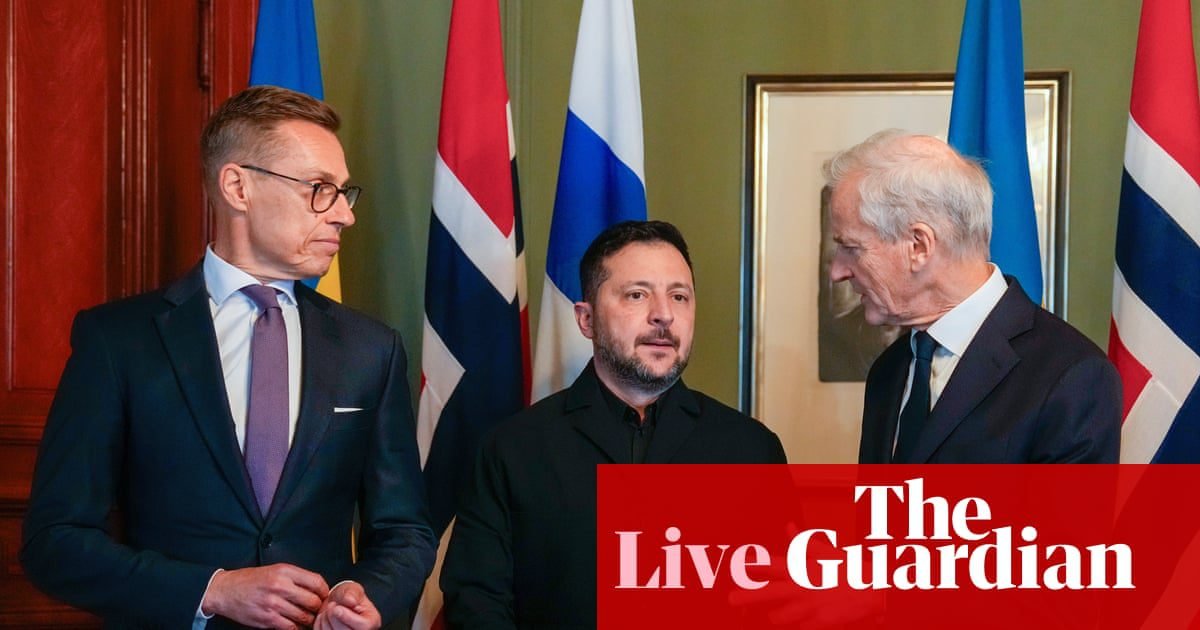
Finland’s Stubb and Norway’s Støre held ‘frank and substantive’ call with Putin on Ukraine
Oh, that’s interesting.
There were some rumours making rounds this morning that the Finnish president Alexander Stubb and Norway’s Jonas Gahr Støre, who hosted the US-Ukrainian talks in Oslo last week, may have been active again.
And we now have a formal confirmation: the pair spoke on the phone with Russia’s Vladimir Putin to discuss the latest on Ukraine.

Their call was “a follow-up” to the Oslo meeting, Stubb’s office said in a statement, as the Nordic pair wants to advance their diplomatic efforts to end the Russian war of aggression in Ukraine.
“Finland and Norway border Russia. They are firm supporters of Ukraine. The aim of the call was to convey messages directly regarding future negotiations to help to end the war to President Putin. The call was related to the upcoming meetings to be held in Abu Dhabi,” the statement read.
The trilateral talks between Russia, Ukraine, and the US in Abu Dhabi are expected in early November.
“Norway and Finland have always promoted peace and security in our region. The two countries have a shared interest in stability and predictability in the Baltic Sea region and the High North. This was highlighted in the call.”
Curiously, the statement noted that “Stubb and Støre took the call as leaders of their respective countries and did not speak on the behalf of Europe as a whole.”
Reacting after the call, Stubb called the discussions “frank and substantive,” saying that “ending the war requires direct discussions” with Russia.
“The war comes with enormous human and material costs. The suffering and destruction will impact generations. In the call we stressed the importance of de-escalation”, Norway’s Støre added.
Key events
‘We have to be ready for a scenario in which the UK and Nato find itself at war with Russia,’ UK’s Streeting warns
Jakub Krupa
Meanwhile, Wes Streeting, the defence secretary, has warned that Russia’s Vladimir Putin is “testing us and testing Nato’s resolve” as he condemned hybrid threats and “state-sponsored terrorism” from Russia.
Streeting repeated his recent warnings that “we have to be ready for a scenario in which the United Kingdom and the Nato alliance finds itself at war with Russia”. He went on:
Not because we want war – we have no quarrel with the Russian people, and we have no desire for war with Russia; Nato is a defensive alliance – but when Putin gives assurances that he has no intentions to provoke a war with Nato, we are reminded of what he said about Ukraine only days before the invasion.
Speaking in Warsaw alongside Poland’s defence minister Władysław Kosiniak-Kamysz, Streeting stressed Nato is ready “to defend every inch of Nato territory” and will continue its support for Ukraine.
The defence secretary added:
The more ready we are to face against Russia, to defend every inch of Nato territory, the less likely we are to find ourselves in that scenario.
Poland is one of our greatest and certainly our most reliable friend in Europe, and we value and treasure this friendship very much.
The partnership is “not simply about our shared history,” but also “our shared determination that in that contest between freedom and tyranny, the United Kingdom and Poland will not be bystanders.”
He said that UK forces will next month take part in major exercises as part of the multinational force for Ukraine.
Ukraine needs ‘real de-escalatory steps’ on energy and infrastructure, Zelenskyy says
Ukraine’s Volodymyr Zelenskyy stressed that “real de-escalatory steps are needed regarding our energy and infrastructure” ahead of critical winter months, as he responded to the reported call with Putin.
In his debrief with Finland’s Stubb and Norway’s Støre, the leaders also discussed preparations for the Abu Dhabi talks next month.
“Finland and Norway, as countries that border Russia, have a particular interest in sound and reliable security arrangements.
We also discussed various formats for our engagement with partners in Europe that could be useful in further supporting diplomacy, our defence, and our shared security.
There must be peace, de-escalation is needed, and Russia must stop dragging out the war.”
Putin blames EU, Nato for ‘confrontational policies’ and says Russia’s interests must be accepted ‘in full’ in any peace talks
The Kremlin’s readout from Putin’s call with Stubb and Støre offers some more revealing lines from the Russian side, which perhaps show why Frederiksen (and no doubt other leaders) remain deeply sceptical of the idea that these discussions can change anything.
Putin “recalled the root causes” of the Russian invasion of Ukraine, the Kremlin said, and stressed that any peace settlement could only be reached with “full and unconditional considerations of the legitimate interests of the Russian Federation,” and as we know these tend to be phrased in a very expansive way.
He also blamed the EU and Nato for “confrontational policies,” which in his view “are leading to a prolongation of hostilities.”
The three leaders agreed to keep talking, so expect these issues to come up again.
Danish PM ‘very sceptical’ about Finnish-Norwegian engagement with Putin on Ukraine
But not everyone seems to be particularly convinced by the joint Finnish-Norwegian initiative.
Denmark’s Mette Frederiksen told the country’s broadcaster DR that she was “very sceptical” about this “independent initiative by Norway and Finland,” stressing “it has not been coordinated with the rest of us.”
“I see no signs that Russia desires peace with Europe – neither in the hybrid warfare taking place every single day, nor in Ukraine, where they are launching fierce and aggressive attacks on a daily basis.
I believe we should keep Europe united, rather than going it alone.”
She told DR that she didn’t know “what they think can be achieved by this.”
“We have previously emphasised – in very clear terms, on behalf of the rest of Europe – whenever others have gone it alone and traveled to Moscow, that it is crucial for us Europeans to stand together. That is something many of us have fought for all these years,” she said.
Russian news agency Tass has a bit more on the Stubb/Store/Putin call from the Russian side.
The agency it’s the first time the leaders spoke by phone since the full-scale invasion in March 2022.
The leaders agreed to continue contacts and discussed the upcoming meetings in Abu Dhabi.
Stubb confirms ‘good phone call’ with Zelenskyy as part of ‘efforts to find a just and lasting peace’ in Ukraine
Finland’s Stubb has just confirmed his call with Zelenskyy.
He said:
“Norwegian PM @jonasgahrstore and I had a good phone call with @ZelenskyyUa.
We discussed our prior call with President Putin. Finland and Norway will continue to support Ukraine, and the efforts to find a just and lasting peace.”
Stubb and Støre are now reportedly briefing Ukraine’s Zelenskyy on their talks, according to AFP.
Finland’s Stubb and Norway’s Støre held ‘frank and substantive’ call with Putin on Ukraine
Oh, that’s interesting.
There were some rumours making rounds this morning that the Finnish president Alexander Stubb and Norway’s Jonas Gahr Støre, who hosted the US-Ukrainian talks in Oslo last week, may have been active again.
And we now have a formal confirmation: the pair spoke on the phone with Russia’s Vladimir Putin to discuss the latest on Ukraine.
Their call was “a follow-up” to the Oslo meeting, Stubb’s office said in a statement, as the Nordic pair wants to advance their diplomatic efforts to end the Russian war of aggression in Ukraine.
“Finland and Norway border Russia. They are firm supporters of Ukraine. The aim of the call was to convey messages directly regarding future negotiations to help to end the war to President Putin. The call was related to the upcoming meetings to be held in Abu Dhabi,” the statement read.
The trilateral talks between Russia, Ukraine, and the US in Abu Dhabi are expected in early November.
“Norway and Finland have always promoted peace and security in our region. The two countries have a shared interest in stability and predictability in the Baltic Sea region and the High North. This was highlighted in the call.”
Curiously, the statement noted that “Stubb and Støre took the call as leaders of their respective countries and did not speak on the behalf of Europe as a whole.”
Reacting after the call, Stubb called the discussions “frank and substantive,” saying that “ending the war requires direct discussions” with Russia.
“The war comes with enormous human and material costs. The suffering and destruction will impact generations. In the call we stressed the importance of de-escalation”, Norway’s Støre added.
The head of Ukraine’s president Zelenskyy’s office, Kyrylo Budanov, has confirmed that the ceasefire in Oleshky is in operation.
“Ukrainian Parliament Commissioner for Human Rights Dmytro Lubinets has headed to the site and will be responsible for coordinating the process. We are in constant contact with him.
It is critically important that this mission to rescue our people be carried out successfully and safely. I am sincerely grateful to everyone involved in carrying out and supporting this operation. Every Ukrainian life is priceless.”
Morning opening: Russia, Ukraine begin localised ceasefire to allow aid to Oleshky, but strikes on Kyiv continue
Jakub Krupa
Russia and Ukraine have started a localised ceasefire to allow for a humanitarian operation to begin in the Russian-occupied town of Oleshky, but Russian strikes continued in other parts of the country, including Kyiv.
Overnight, Russia launched 16 ballistic missiles and more than 280 drones, with at least 15 people injured in Kyiv, with further attacks in the Chernihiv, Chernivtsi, Dnipro, Donetsk, Kharkiv, Kherson, Odesa, Sumy, Vinnytsia, Zaporizhzhia regions.
“A serious escalation in Russia’s operation against our logistics. Almost everywhere, Russia’s targets were the energy sector, logistics, and ordinary urban infrastructure,” Ukraine’s president, Volodymyr Zelenskyy, said.
He added that “the artificial and prolonged delays in the delivery of interceptor packages for Patriot and Nasams systems … are directly helping Russia achieve the objectives of its terrorist campaign.”
“Every such delay means another Russian strike on one facility or another. Unfortunately, strikes are taking place every day. Russia is constantly taking new steps toward escalation.”
I will also be looking at the latest updates from Serbia after Sunday’s parliamentary elections, France after last night’s proposals seeking to end student protests, and elsewhere.
It’s Tuesday, 27 October 2026, it’s Jakub Krupa here, and this is Europe Live.
Good morning.
Source: https://www.theguardian.com/world/live/2026/oct/27/russia-ukraine-oleshky-serbia-france-europe-latest-news-updates
About the Author