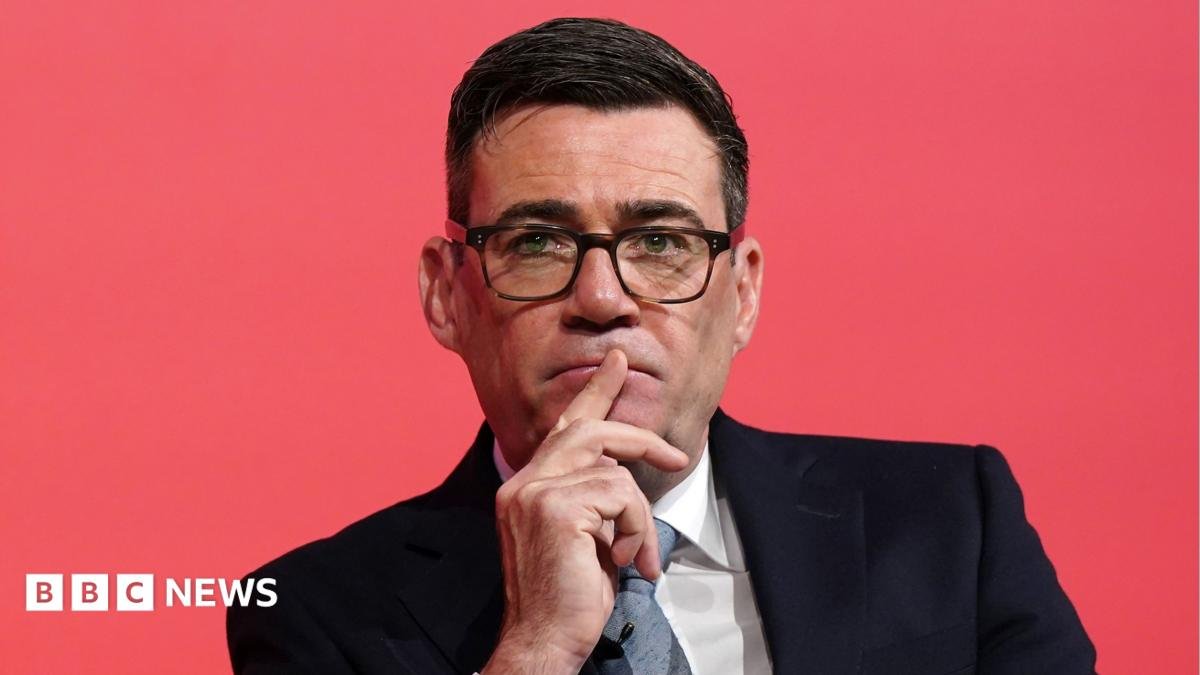
Burnham is set to be greeted with military honours at the German capital’s Chancellery ahead of his first face-to-face meeting with the chancellor.
On Thursday, the two leaders will formally ratify the 2025 Kensington Treaty, a partnership committing both countries to tackle hostile activity through deeper cooperation on science, technology, defence, security and growth.
Speaking ahead of the visit, Burnham said the UK and Germany were “joining forces to find, expose and disrupt” threats.
He continued: “Attacks on our infrastructure, our businesses and our democracies are not a distant threat.
“They reach into people’s homes and workplaces, and they are designed to make us weaker and more divided.”
Asked on BBC Radio 4’s Today programme what may change as a result of Thursday’s meeting, Foreign Office Minister Stephen Doughty highlighted the issues of space and quantum technology.
“We’re going to be seeing new partnerships between German space companies and our Spaceport in Scotland; we’re going to be ensuring research and technical capability between our top researchers working on quantum technologies which are going to change the world of computing.”
He would not be drawn further on how the UK will increase defence spending – and in response to Lescure’s remarks, added: “We always welcome warmth from our European friends and partners.”
European leaders have warned the threat of hybrid attacks against Europe by Russia has intensified in recent weeks.
Hybrid warfare or hybrid attacks are loose terms which tend to describe non-military methods designed to exert pressure and destabilise an adversary – for example cyber attacks, sabotage or misinformation.
Sir Mark Lyall Grant, former UK national security adviser, explained that hybrid warfare “falls somewhere between peace and war – it’s in that sort of grey zone, an area where Russia has been extremely active for some time”.
He told Radio 4’s Today that while Russia had posed a threat to the UK since Vladimir Putin became president in 2001, there had been an “intensification” in response to European support for Ukraine following Russia’s invasion.
“We know Russia has been mapping undersea cables in the North Sea; that’s something I’m sure Andy Burnham will be talking to Chancellor Merz about because it affects both the UK and Germany,” he added.
Last month, a senior Russian diplomat was summoned by the British government over an “egregious and reckless attack” on Leipzig airport, while the EU’s foreign affairs chief also summoned Russia’s envoy in Brussels.
It is a major international freight hub used for providing support to Ukraine. Moscow has denied any involvement in the incident.
Meanwhile, questions have also been raised this week about Germany’s reliability as an intelligence partner, following the bombshell arrest of a former spy chief on suspicion of espionage.
August Hanning has been accused of espionage, treason and obtaining classified information for a foreign power, the German Federal Prosecutor’s Office says.
He ran the Federal Intelligence Service (BND) from 1998 to 2005 and has since been working as a private consultant.
The talks also come during a period in which Merz’s own political future has come under intense scrutiny.
Burnham replaced Prime Minister Sir Keir Starmer in July after the former leader was forced out by his own MPs just two years after winning a landslide election victory.
Similarly, Merz has faced persistent rumours he could be replaced by his party due to his poor approval ratings and following setbacks in regional elections.
Although the chancellor appears to have overcome an immediate crisis in his leadership, questions remain over his future.
Additional reporting by Ottilie Mitchell.
Source: https://www.bbc.co.uk/news/articles/cmwyq34qexdzo?at_medium=RSS&at_campaign=rss
About the Author