Blue Lights has always been a very modern cop drama. Its tales of everyday callouts, fractious office relationships and complex long-term efforts to smash organised crime have all played out against the backdrop of post-Troubles Belfast, where lingering sectarian resentments make enforcing the law even harder than it is in the rest of austerity-era UK. But it’s never been explicitly topical: it’s never felt as if it is reading today’s national news headlines with the same appalled gaze as the rest of us. Until now.
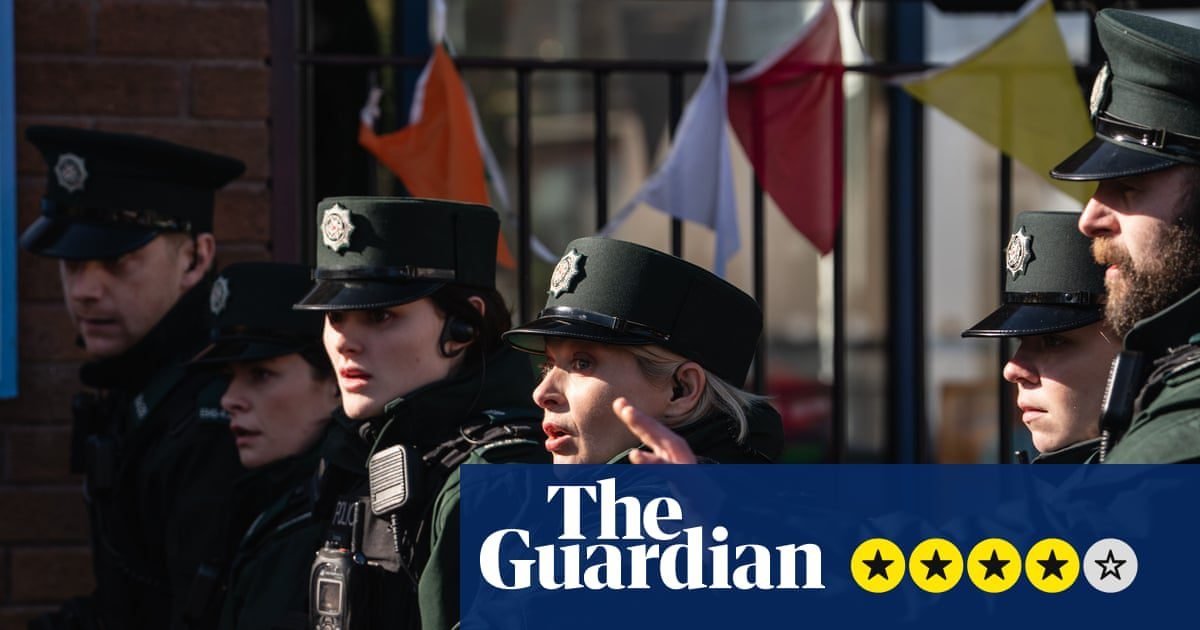
Our fourth visit to Blackthorn station pitches us and the police into a race riot. A centre offering support and resources to refugees is hosting a fete, which is a positive contribution to the area for those open to it: station sergeant and amateur baker Stevie (Martin McCann) marvels at the texture of Syrian pastry at an event that has been allocated minimal police presence. Minutes later, the whole squad has rushed to the scene to hold a line against an angry mob who want immigrants out of Northern Ireland. Bricks fly. Lives are in danger.
Pitting the police against neo-fascists – to be clear, Blue Lights is set in a world where these two groups are entirely in opposition – enables the show to put a new spin on its familiar mechanics. The classic Blue Lights scene sees idealistic officers attempt to use reason and compassion to defuse terrifying situations where those weapons are blunt, because the emotions at play are too deep-seated to be bargained with. Facing off against racists turns up the heat of that dynamic.
As usual, Grace (Siân Brooke), a former social worker who insists on bringing her interpersonal skills to scenarios in which police are trained to remain impassive, takes it upon herself to solve an impossible problem. Blue Lights finds one of its most disturbing antagonists yet in racist influencer Katie (Tabitha Smyth), a young woman who livestreams every “protest” on her phone and encapsulates how dangerous it can be when angry people are half right. She has the smug zeal of an “auditor”, as social media now calls them, ie someone who has cottoned on to the fact that filming interactions with authority figures is a powerful way to hold them to account, but who then abuses the privilege.
When Grace inevitably tries to appeal to Katie directly, we get a stark representation of the core issue. Katie feels she is from a community that has been impoverished and abandoned, whose people have been let down by public institutions, and that the latest injustice is a failure to stop the malign influence of foreign invaders. It’s hard to convincingly argue that the last of those three is wrong when the first two are not, and when you stir in the localised hatred of the police that has a large amount of historical justification on its side, Grace is in trouble.
Not that Blue Lights is willing to let that strand take over the whole show – there is plenty else going on, and it’s a mix of Blue Lights doing Blue Lights things, and the series dabbling in less interesting genre tropes. Blackthorn is threatened with closure by high-ups who claim its metrics aren’t strong enough, which means a difficult start for newly promoted chief inspector Helen (Joanne Crawford), who will always be more an officer in uniform than a manager in a suit. If that feels like a plotline any police drama might use, there’s also the textbook Blue Lights setup of a regular traffic stop where the driver turns out to be one of Northern Ireland’s most dangerous criminals, and the police become a complicating factor in security-service operations to which ordinary bobbies aren’t supposed to be privy.
All that fits with the show’s overarching theme of humble police officers struggling to do their job when every task is affected by political machinations far above them, or by social or historical forces beyond their control. Under that pressure they form intense bonds with each other, often romantic ones, and often those relationships are doomed. Season four cycles back to the murder in season one of Gerry (Richard Dormer), for whom his colleague and wife Sandra (Andi Osho) is still trying to win justice – efforts that run into the same old hushed warnings and coldly slammed office doors.
A mid-season episode this year brings Dormer back for an extended flashback showing how Gerry and Sandra got together. Their standalone story sums up how Blue Lights puts a bit of soapy froth on difficult subject matter: arguably a show that was fully committed to its own harsh reality wouldn’t find time for such indulgence, but it is rather lovely. And, as Blue Lights pivots to deal with awfulness that’s bang up to date, it’s sharp enough.
Source: https://www.theguardian.com/tv-and-radio/2026/sep/29/blue-lights-review-bbc
About the Author