Ryanair boss says airline will dispute account of passenger who said they were partially sucked out of window
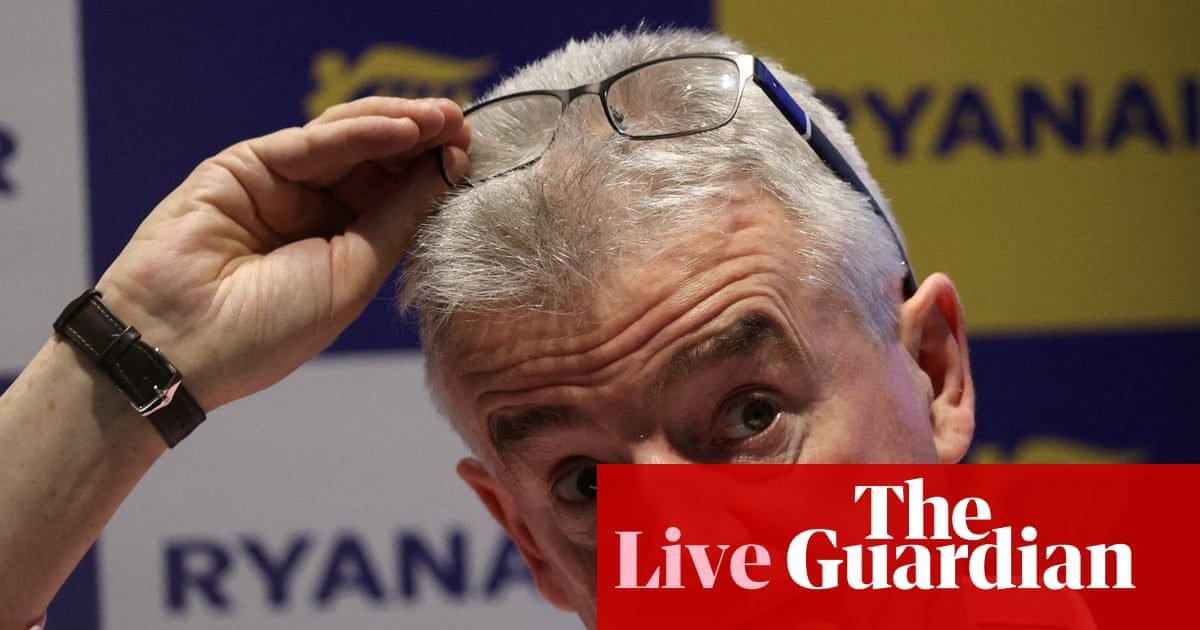
Ryanair boss Michael O’Leary said that the airline will be “disputing” that any part of a passenger’s body was sucked out of a window midflight.
Ljubisa Karović, 61, suffered neck and shoulder injuries after the window broke during the flight from the Greek city of Thessaloniki to Memmingen near Munich, Germany, on 10 July.
The National Transportation Safety Board (NTSB) in the US is investigating the incident during the flight.
Speaking to reporters after the Ryanair annual general meeting in Dublin on Thursday, O’Leary said the passenger was “certainly sucked towards the window, but he didn’t get out the window”.
Asked if the passenger was partially out of the window, he said:
He wasn’t partially out the window.
No, no, no. Part of his face didn’t get out the window.
We don’t think any part of his body got out the window, but he was certainly sucked in very dramatic circumstances towards the window.
O’Leary said Karović was “belted into the seat” and added:
We will be certainly at the end of the process disputing that he or any part of his anatomy will bend out the window.
The airline chief acknowledged the man suffered injuries and added:
We’re not trying to downplay it.
Look, that incident is being investigated by the NTSB, and we have to await the outcome of the NTSB report.
Asked if Ryanair had done any checks or fixes as a result of the incident, he said:
There’s nothing we can do at the moment. We are a participant in the investigation with Boeing, with the NTSB, with GE on the engine side.
Most of the focus is what happened to the engine. Why was it not self-contained within the cowl of the engine?
The Ryanair boss said the company was in touch with the passenger’s lawyer and acknowledged he was entitled to “some compensation” but said he did not believe there was any basis for “any class action” or a payout of “millions and millions”.
Karović, a Serbian businessman, previously told The Guardian he was “still strapped in” with his seatbelt.
His wife Svetlana said they were “eternally grateful” to one passenger who she believes is Albanian for his part in the rescue.
He did all he could to bring him in and then tried to block the window, first with a bag that was immediately sucked out and then with a suitcase, which worked.
Key events
European government borrowing costs jump; UK gilt yields at 19-year high
UK, German and French government borrowing costs have surged today, as energy prices jumped, fuelling investor fears over rising inflation.
The moves come ahead of the European Central bank’s latest policy announcement, with a quarter point interest rate hike widely expected.
There is also the fallout from the US Treasury’s plan to buy back $6bn in government debt, announced on Wednesday.
The yield, or interest rate, on the 10-year UK government bond, known as gilt, hit 5.295%, the highest since August 2007 and up 2 basis points on the day. Two-year gilt yields, which are more sensitive to inflation fears, rose 2bps to 4.742%, the highest since November 2023 while five-year yields were the highest since September 2023 at 4.828%.
The yield on Germany’s 30-year government bond, known as Bund, rose 2.5bps to 5.08%, the highest since December 2003. the 10-year yield hit 3.45%, the highest since April 2011.
France’s 10-year government bond yield was the highest since October 2008 at 4.344%, up 1 basis point.
Scott Bessent, the treasury secretary, said the US would buy back $6bn worth of government debt – called US treasuries – in an effort to alleviate a selloff in the US bond market that has put pressure on interest rates.
But the size of the deal failed to appease bond buyers and the yield on 10-year Treasuries rose to a three-year high.
Oil and gas prices surge amid Middle East escalation, drone attacks on Russian gas plants
Oil prices continue to climb, and are above $102 a barrel now after the US and Iran stepped up their attacks on ships on Wednesday.
Brent crude touched $102.17 a barrel and is now trading at $102.09, up 88 cents or 0.87%.
British gas prices jumped above 200p per therm, the highest since December 2022. The front-month contract is now 1.1% higher at 199.89p per therm, after touching 200.5p per therm earlier.
Continental European gas prices also rose. The benchmark for the EU, the Dutch wholesale gas price, breached €80 again, as on Wednesday, which was the first time it had gone above that level since January 2023. The front-month contract is trading 1.1% higher at €80.21 per megawatt hour.
There were reports that Ukrainian drones hit gas processing facilities in Russia’s Yamal region. On Wednesday, an industrial facility caught fire in Novy Urgengov in northern Russia following a drone attack, regional governor Dmitry Artyukhov said on Wednesday, according to Reuters – the first such attack on the country’s natural gas hinterland.
EU gas stores are only 67% full, well below the five-year average of 84%.
Analysts at ING said:
This leaves the market vulnerable as we head closer towards the upcoming heating season.
Mark Crouch, market analyst at the trading platform etoro, said Primark’s recovery is still some way off, and welcomed the home delivery announcement.
The sharp drop at the open is the market saying Primark’s turnaround is still a story, not a number. Like-for-like sales at Primark, expected down 3% in the fourth quarter after a 2.2% drop in the third, tell investors the recovery they had started to price in is not here yet. Summer price cuts and a sharper UK offer have not turned the existing store base. New shops in the US can still lift the headline. They cannot, on their own, justify the multiple a standalone Primark will need. Europe remains the problem, and that is half the estate.
Home delivery in the UK is the right call and closes a long running gap. It will not rescue this Christmas, and the market has treated it accordingly.
The longer term case still seems intact for patient investors: a decent balance sheet, a 2027 split that should surface value, and a brand that still works when the offer is right. This morning is a reminder that the City is no longer paying up for the plan. It wants proof on the shop floor, and it did not get it.
European stock markets mixed; Associated British Foods biggest FTSE loser
The FTSE 100 index has edged nearly 10 points lower to 10,660, while Germany’s Dax also dipped 0.1%. Other European indices pushed cautiously higher, with the French Dax up 0.2%, Italy’s FTSE MiB 0.55% higher and Spain’s Ibex climbing 0.4%.
Associated British Foods is leading losses on the FTSE 100, down almost 10%, despite announcing that Primark will start offering home delivery in the future. Total sales are falling at the budget clothing chain and were barely positive in the UK and Ireland.
Aarin Chiekrie, equity analyst at Hargreaves Lansdownm saud:
Associated British Foods’ (ABF) fourth-quarter results have left investors hungry for more as its crown jewel, Primark, is expected to deliver a like-for-like sales decline of 3%. Growth in the UK and Ireland was barely positive, while sales in Continental Europe fell by more than 4% as consumer confidence remains particularly weak.
Primark also announced plans to introduce home delivery across Great Britain. While this will likely help boost the top line, running an efficient and profitable delivery and returns service is no easy task, and with Primark’s low price point, doing it profitably is even more difficult.
In the meantime, new store openings are the key lever being pulled to drive the top line higher, contributing 5% growth and helping total Primark sales to rise by 2% over the period. Work on the planned demerger of Primark is progressing smoothly and is now expected to be completed in December 2027.
ABF’s sugar business is also struggling.
It was a mixed performance from the rest of ABF’s food businesses, with growth across grocery and ingredients largely offset by continued declines in the sugar and agriculture divisions. Performance in the sugar division continues to be held back by lower yields following a period of unfavourably hot and dry weather, as well as weaker average selling prices in Europe.
All in, ABF reiterated its rather vague full-year guidance for group-level underlying operating profits to fall below last year’s level of £1.7bn. But market forecasts are sitting around 13% lower at £1.5bn, which feels more realistic to us. Today’s update has done little to hint that a sharp improvement in fortunes is around the corner for ABF, and profitability in the Sugar division looks set to worsen still in 2027, offsetting progress in other parts of the business.
Oil price rises above $101 a barrel
Oil prices are heading higher again, with Brent crude rising above $101 a barrel.
Brent crude, the global oil benchmark, rose as high as $101.94 a barrel this morning, the highest level since 23 July after tensions in the Middle East escalated.
Donald Trump said on Wednesday he expected the war with Iran to end after the US midterm elections in November, and threatened again to attack Pickaxe Mountain, a heavily fortified site, programme.
The two sides launched their biggest wave of attacks on shipping since the start of the six-month-old war – Iran said it had attacked 10 ships near the strait of Hormuz (where daily traffic has dwindled to single digits) on Wednesday after the US sank five Iranian oil tankers.
Ryanair chief executive Michael O’Leary reiterated the airline’s recent warning that if oil prices stay high, there will be a significant uplift in air fares next year.
Here is our full story on Primark starting to offer home delivery in Britain “in the future” – it’s a bit of a moment.
Independent retail analyst Nick Bubb said:
We flagged last Friday that there has been plenty of speculation about tough trading in the John Lewis department store business and we assumed that overall first-half sales would have been something like 3% down, with ‘big ticket’ products taking a beating, but on an ex-VAT basis the fall was 4% and the biggest fall (-4.8%) was in fashion.
And, despite good work on margin and cost control, that sort of top-line drop hit the bottom line at John Lewis, with the usual H1 operating loss up from £53m to £83m this year (we expected £80m).
The hope might have been that Waitrose could help to make up the JL shortfall, but the business has been investing heavily in store refurbishments etc and although there was 2.8% sales growth at Waitrose in H1, there was a bit of margin pressure and the heatwave brought higher supply chain costs, so Waitrose operating profits in H1 were slightly down, from £110m to £103m (we expected £105m).
Usually the H1 investment programme would be expected to pay off in the seasonally more important H2, but JLP are ‘cautious’ about the outlook, given the uncertainties about the autumn budget etc.
John Lewis losses widen to £124m as shopper confidence dips
In other retail news, losses at the owner of John Lewis and Waitrose widened by more than 40% in the first half of the year as it struggled with higher costs and with shoppers feeling less confident about their money.
The John Lewis Partnership, which operates 36 department stores and more than 300 Waitrose supermarkets, said its pre-tax loss for the six months to 1 August climbed to £124m, compared with £88m in the same period in 2025.
Jason Tarry, the chair, said the drop reflected the company’s “continued investment in our transformation, a more challenging trading environment and the increased costs of doing business”.
Some of the higher costs included greater national insurance contributions, as well as “managing operations through the heatwaves”, JLP said.
The group is in the midst of a turnaround plan, in which 16 department stores and at least 20 Waitrose outlets have been closed and thousands of staff jobs cut.
The drop in profit comes after Peter Ruis, head of the department store arm, said last month he would step down after less than three years in the role. He has been replaced by Will Kernan, former boss of the River Island fashion chain.
In March the company felt confident enough to pay its 69,000 workers, whom it calls partners, a bonus – of 2% of salary – for the first time in four years, following a 6% rise in its underlying profit. Staff shared a bonus pot of £35m, worth about one week’s extra pay each.
However, the retailer has since struggled with weak consumer spending this summer, as successive heatwaves deterred shoppers from heading to the high street, instead using online specialists, and the rising cost of living has hit spending on big-ticket items such as sofas and beds.
First-half sales at Waitrose grew 4% to £4.3bn, while at department stores sales dropped 2% to £2bn.
Introduction: UK flight disruption expected to clear; Primark to start offering home delivery in Great Britain
Good morning, and welcome to our rolling coverage of the global economy, the financial markets, the eurozone and business.
Flight chaos in the UK is expected to clear today, after more than 2,000 flights arriving in or departing the UK have been cancelled since an air traffic control system issue on Tuesday.
Flight schedules are expected to return to normal, with no flights cancelled today, according to the aviation analytics company Cirium.
The chief executive of National Air Traffic Services (Nats), Martin Rolfe, has faced calls to resign. The government has given him a week to report back on the reasons for the technical failure.
The problem was fixed on Tuesday but further flights were cancelled or delayed on Wednesday, a total of 2,145 over two days. Cirium said 399 flights were cancelled on Wednesday alone.
British Airways was the worst affected airline, with 88 of its 507 flights scheduled to depart on Wednesday affected. The airline said it was “incredibly sorry” to its customers and that the issue had been “entirely out of our control”.
Michael O’Leary, the outspoken boss of budget airline Ryanair, called Rolfe’s position “untenable” and he is likely to voice more criticism at Ryanair’s annual meeting at its headquarters close to Dublin airport later on Thursday.
Primark will start offering home delivery in Great Britain in the future, according to its parent Associated British Foods, which plans to spin the budget retailer off next year.
While Primark offers a Click + Collect service, it had been resisting a move into home delivery, arguing it did not make economic sense because of its low price points.
But AB Foods said today:
Primark’s digital maturity, including the success of Click + Collect, and online market developments, mean there is now the opportunity for profitable growth through the home delivery channel.
Primark has acquired a highly-automated warehouse in Sheffield, northern England. AB Foods said work on the demerger of Primark from its food businesses is advancing well and is expected to be completed in December 2027.
Crude oil prices have dipped but Brent crude remains above $100 a barrel after fighting in the Middle East escalated. it is currently trading at $100.42, down 79 cents or 0.8%.
Shipping traffic through the strait of Hormuz has dwindled to single digits, fuelling concerns over oil supply.
Asian stock markets are a sea of red, with Hong Kong’s Hang Seng tumbling 1.4% while Japan’s Nikkei was flat and China’s CSI 300 index lost 0.4%.
Yields on 10-year US Treasury bonds held steady at 4.8406% after rising to their highest levels in three years on Wednesday, when the Treasury Department announced a $6bn buyback of longer-dated bonds that disappointed some investors.
The European Central Bank is widely expected to raise interest rates by a quarter point at lunchtime, to bring inflation under control.
The Agenda
-
1.15pm BST: European Central Bank interest rate decision
-
1.30pm BST: US Producer prices for August
-
1.45pm BST: ECB press conference
-
3pm BST: US Home sales for August
Source: https://www.theguardian.com/business/live/2026/sep/10/markets-economy-oil-uk-flight-disruption-primark-home-delivery-business-live-news
About the Author