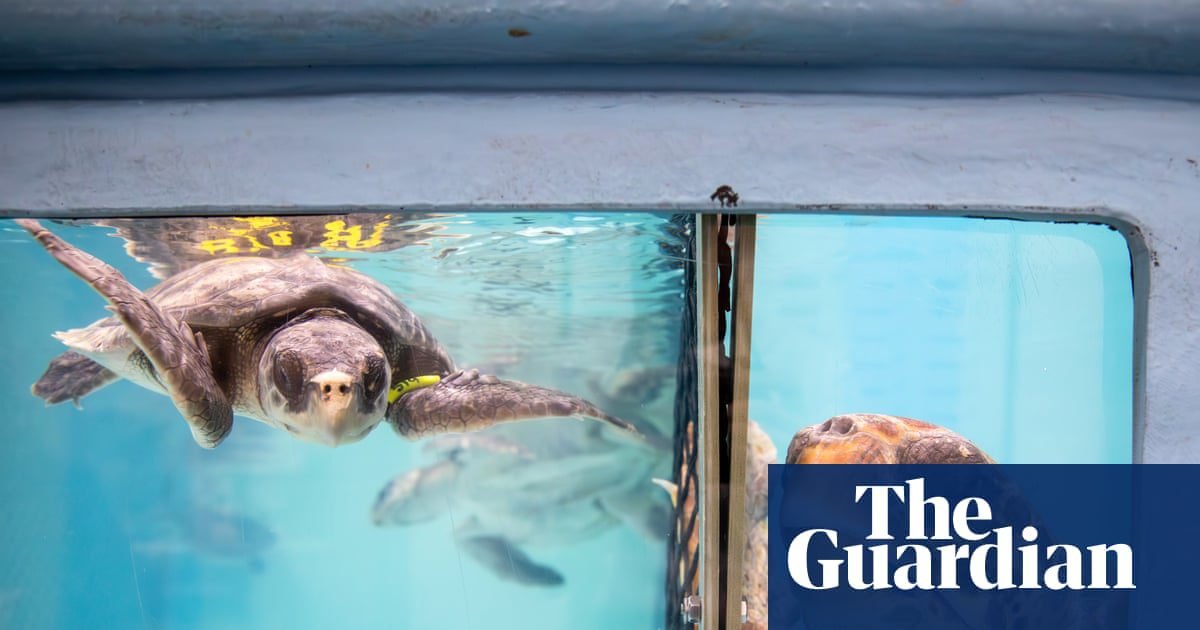
Sea turtle #471 gasped audibly, as veterinarian Kathy Tuxbury palpated the surgical scar on the animal’s left flipper.
The turtle – lovingly renamed “Lucky” by the huge network of conservationists, interns and volunteers working to save its life – is one of the last patients of the year at the New England Aquarium’s Sea Turtle Hospital, waiting to be returned to the ocean.
Lucky has been the beneficiary of what has become a massive, annual rescue effort to save hundreds of endangered sea turtles who get lured into Cape Cod’s warming waters every summer, only to be trapped on frigid beaches when ocean currents turn cold in November and December. The annual number of turtles found stranded like this has grown tenfold since the early 2000s, due at least in part to global heating, scientists say.
Lucky – still too young for experts to tell if it’s a male or a female – was one of 473 turtles found “cold-stunned” on the Cape’s beaches last November and December. Like the others, the animal was in a state of extreme hypothermia when it arrived at the hospital in a banana box on the chilly morning of 1 December. The 18-inch-long, greenish-gray Kemp’s ridley turtle has been at the hospital ever since, undergoing rehabilitation.
The turtle laid still on the exam table. Only the folds of skin under its neck rippled with each gasping breath, as Tuxbury, the aquarium’s senior veterinarian, carefully probed several lumpy spots on its shoulders.
“471 is in good shape,” she declared, noting that Lucky would still have to undergo a pre-release evaluation before being released back to the sea to rejoin the annual migration of the endangered species in the last days of August or early September.
“If the animal is still stable and doing well after 30 days off antibiotics, then we’re good to go,” she said.
Since the early 2000s, the number of young sea turtles washing up on Cape Cod’s beaches has jumped from about 50 a year to close to 500.
The Gulf of Maine, which stretches most of the length of New England, is one of the most rapidly warming water bodies in the world, said Kara Dodge, a research scientist for the aquarium who has spent the last 20 years studying the little-known lives of New England sea turtles. The area offers a late summer paradise for all kinds of sea creatures.
“These turtles are very similar to what we call ‘snowbirds’ here in New England, where they come and spend the summer in Cape Cod,” said Dodge. As the waters are staying warmer, longer, it may be that more and more of them are coming. But the north side of the Cape Cod Peninsula, which reaches 65 miles out into the ocean, serves as a hook-shaped barrier where turtles can easily get stuck.
“If you look at it on a map, it’s a natural, geographic trap,” Dodge said. “And, for a sea turtle, their instinct is to swim south.”
“So we’re a hotspot for mass stranding of sea turtles.”
In the winter months, hundreds of volunteers from the Massachusetts Audubon Wellfleet Bay Wildlife Sanctuary patrol the beaches, searching for turtles that are in such a state of cold shock that they often look dead.
The turtles can survive a long time in the cold water, said Audubon science coordinator Mark Faherty. But, if they get stuck on a beach in freezing air, they can die quickly. So the group monitors the winds and high tides and, sometimes, sends volunteers out in the middle of the night to search for turtles with flashlights.
“Sometimes they’re walking the beaches at one in the morning into a freezing, cold wind,” said Faherty, who said the group has some volunteers in their eighties, who loyally patrol some of the longest, remotest beaches. Specially trained staff and volunteers then load each turtle into a banana box for transport, sometimes bringing up to 30 a day to the hospital.
“We get them up to the New England Aquarium, mostly via volunteer drivers who have to keep their cars cool. They can’t blast their rock music, you know. You have to maintain sort of a clinical environment in your car,” said Faherty.
There, the New England aquarium staff conduct sea turtle “triage.” The animals must be warmed up slowly and reintroduced to sea water over days, said Adam Kennedy, the hospital’s director. All the turtles get radiographs and exams with some receiving injected fluids and antibiotics as well. Many are suffering from dehydration or are skinny from malnourishment, when they arrive. Some have to be treated for pneumonia from breathing cold ocean spray, while others get infections.
“Think of us as the emergency room for a big hospital,” said Kennedy “We’re the emergency room and the ICU kind of all wrapped into one.”
Since the hospital can only handle long term care for about 65 turtles, the aquarium works with the National Oceanic and Atmospheric Administration to quickly dispatch recovering turtles to partnering animal rehabilitation centers up and down the east coast, and along the Gulf of Mexico as far west as Missouri.
The turtles are transported in vans and sometimes even flown by volunteer pilots in private planes to the more distant rehab sites.
Lucky initially stayed at the hospital because of severe pneumonia, then needed surgery for an infected joint, a common problem for turtles who have been stranded. The operation was performed by a top surgeon. Veterinarian Tuxbury said that a board-certified orthopedic veterinary surgeon from Tufts University volunteers his time to perform needed sea turtle joint fixes.
“It’s an amazing network of sea turtle people,” said Kennedy of all the volunteers and conservationists who contribute to the annual rescue effort. “And we all have one focus: which is to get the turtles back to the wild.”
For turtles brought in alive the survival rates are remarkably high – about 85%. Turtles who are sent to southern rehabilitation locations can be released as early as midwinter. This year aquarium staff drove 18 turtles south from New England for spring releases in North Carolina. Four more batches have been released from beaches on the south side of Cape Cod this summer.
A few of the turtles get elaborate satellite tags with antennas sticking off their backs, so that researchers, as well as interested members of the public, can study their little-known migration habits on the aquarium’s Sea Turtle Tracker. It shows how they move from nesting regions along the shores of Mexico and go as far north as Canadian waters.
By 5 August, only Lucky and five other turtles remained in the hospital, while staff tried to clear up their last lingering medical concerns before it got too cold for beach releases in Cape Cod. The prognosis for all of them was looking good.
Aquarium intern Analya Stewart, 21, stood on a platform using a purple-gloved hand to lob gooey pieces of squid into a giant, blue tub containing four turtles and 6,000 gallons of sea water.
Charlotte Clark, who herself started as a sea turtle intern years ago and has since become a full-time biologist at the hospital, explained that every morsel a specific animal eats is supposed to be recorded down to the last gram.
“Each turtle has a limit for their diet,” she said. Yet, “these are wild animals; we don’t want them to associate with humans.”
So Stewart was mushing the squid into its juices, then standing back to toss it towards a specific turtle and quickly netting it back up if the turtle didn’t take the bite.
“This is my very first internship,” said Stewart, a biology major from Hampton University in Virginia. She said she’d never guessed she’d spend her summer throwing squid at sea turtles.
“When I got here I was a bit taken aback,” she said. “But it has been a great experience.”
On 11 August, Lucky was medically cleared for a return to the wild. The sea turtle, with a repaired left flipper, is due to be released from Cape Cod on 18 August with a tracker that researchers can monitor.
Source: https://www.theguardian.com/us-news/2026/aug/15/cape-cod-stranded-sea-turtle-hospital
About the Author